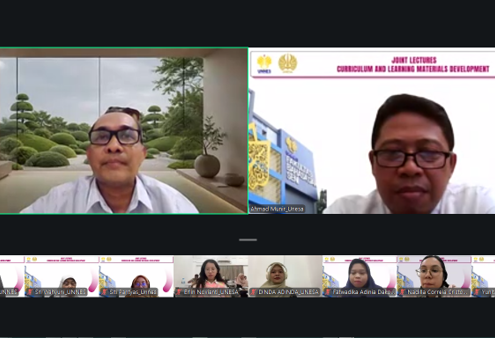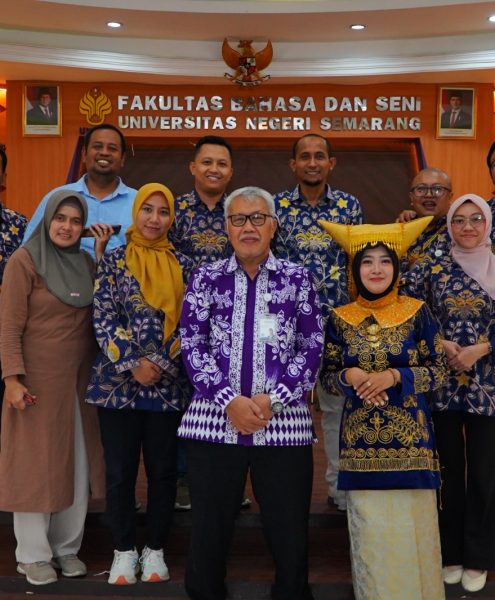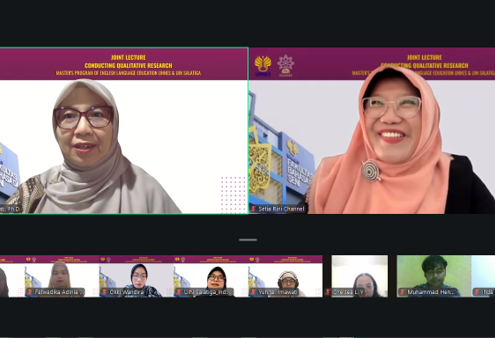


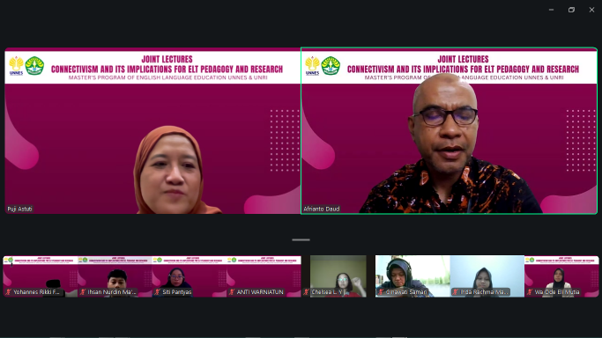
The Master’s Program in English Language Education at the Faculty of Languages and Arts (FBS), Universitas Negeri Semarang (UNNES), held a joint lecture titled “Connectivism and Its Implications for ELT Pedagogy and Research” on September 17, 2026, bringing together students and academics from UNNES and Universitas Riau (UNRI) to explore innovative approaches to English language teaching in the digital age.
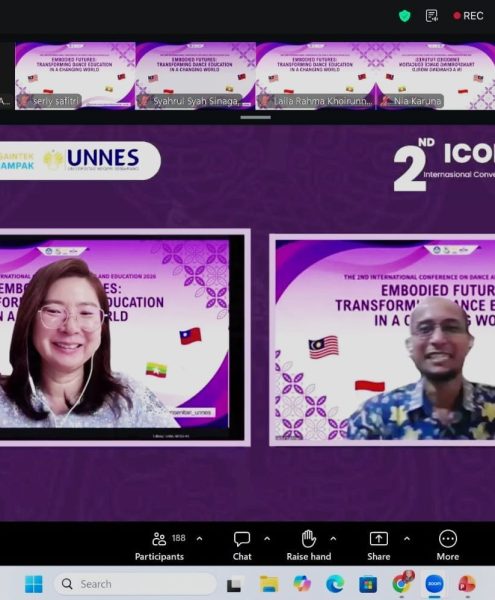
Conducted virtually via Zoom, the lecture involved UNNES master’s students enrolled in the Theories and Principles in ELT course and students from the English Language Education Program at Universitas Riau. The event provided a collaborative academic platform for examining how digital connectivity is reshaping language learning, teaching practices, and educational research.
The session featured two distinguished scholars, Prof. Dr. Afrianto Daud, S.Pd., M.Ed., from Universitas Riau, and Prof. Puji Astuti, S.Pd., M.Pd., Ph.D., from Universitas Negeri Semarang. Both speakers shared insights into Connectivism and its implications for English Language Teaching (ELT) pedagogy and research.
Discussions focused on Connectivism as a learning theory that emphasizes the role of networks, digital technologies, and interconnected sources of knowledge in contemporary education. Participants explored how learning increasingly takes place through interactions among individuals, information resources, and digital platforms, extending beyond conventional classroom environments.
The speakers also addressed the relationship between technology, knowledge networks, instructional practices, and research development in ELT. These discussions encouraged participants to critically examine how connectivist principles could inform innovative teaching strategies and research approaches in increasingly technology-rich learning environments.
Beyond introducing theoretical perspectives, the joint lecture offered students opportunities to connect educational concepts with contemporary challenges in language education. Through academic exchange, participants were encouraged to reflect on the relevance of Connectivism to learner autonomy, collaborative knowledge construction, and the effective integration of digital resources into English language teaching.
The initiative aligns with the vision of the Master’s Program in English Language Education at UNNES to become a leading program in advancing innovative English language education through the integration of language education theories, linguistics, and literacy approaches, with a strong research orientation and a commitment to character development and quality education.
By connecting educational theory with technological developments and research-based perspectives, the joint lecture reinforced the program’s commitment to equipping graduate students with relevant, adaptive, and innovative academic competencies.
The event also formed part of the program’s annual joint lecture initiative, which seeks to strengthen its academic environment, broaden scholarly perspectives, and promote sustained collaboration with partner universities.
Advancing Quality Education and Academic Partnerships
The joint lecture also supported UNNES’s commitment to the United Nations Sustainable Development Goals (SDGs), particularly SDG 4 (Quality Education) and SDG 17 (Partnerships for the Goals).
Its contribution to SDG 4 was reflected in the promotion of high-quality academic learning, innovative pedagogical approaches, and digital literacy in English language education. By exploring the implications of Connectivism, the lecture encouraged participants to develop teaching and research practices that respond to the changing demands of contemporary education.
Meanwhile, the collaboration between UNNES and Universitas Riau contributed to SDG 17 by facilitating interuniversity knowledge exchange, strengthening academic networks, and creating opportunities for continued cooperation in teaching and research.
The involvement of scholars and students from both institutions also highlighted the importance of collaborative learning environments in advancing educational innovation. Such partnerships enable universities to share academic expertise, broaden research perspectives, and collectively respond to emerging challenges in language education.
Through this joint lecture, the Master’s Program in English Language Education at FBS UNNES reaffirmed its commitment to fostering research-oriented learning, academic excellence, and meaningful institutional partnerships.
The initiative is expected to encourage further academic collaboration between UNNES and UNRI while inspiring students to explore innovative pedagogical and research approaches that support the future of English language teaching in an increasingly connected world.