



Building disaster-resilient communities requires more than infrastructure and early warning systems. Education, particularly through schools, can play a central role in preparing communities to understand risks, respond to disasters, and protect lives.
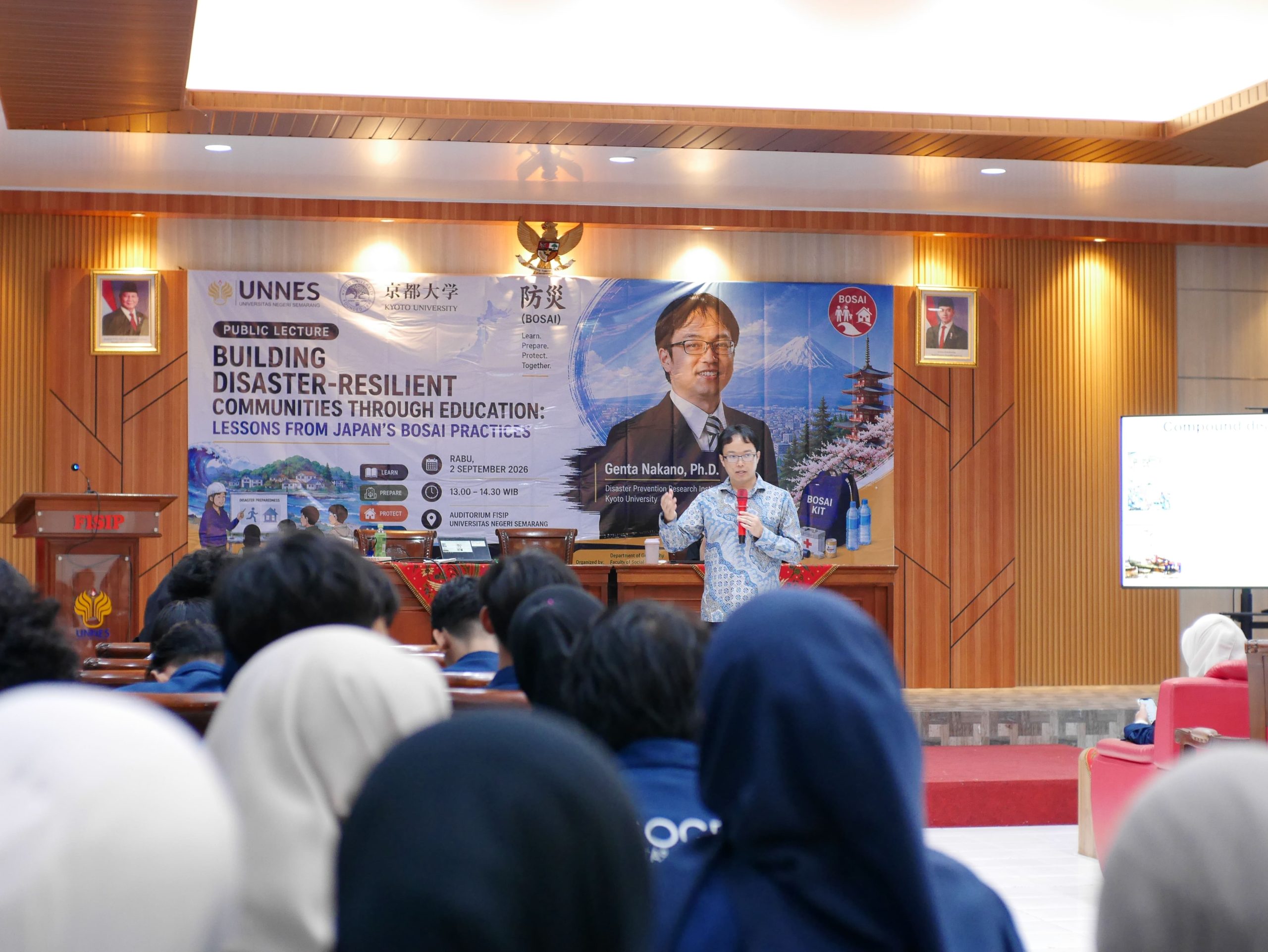
This was highlighted by Genta Nakano, a researcher and lecturer at Kyoto University’s Disaster Prevention Research Institute, during a public lecture for Geography and Geography Education students at the Faculty of Social and Political Sciences (FISIP), Universitas Negeri Semarang (UNNES), on Wednesday (September 2, 2026).
Speaking on the theme “Disaster Resilient Communities through Education: Lessons from Japan’s BOSAI Practices,” Nakano presented several findings from his research on disaster risk reduction education and community preparedness in Japan.
One of the key lessons came from the Great Hanshin-Awaji Earthquake in 1995. Nakano explained that approximately 35,000 people were rescued following the disaster. Around 27,000 were rescued by local residents, while approximately 8,000 were assisted by professional responders, including police, firefighters, and the Self-Defense Forces.
The experience demonstrated the limitations of relying entirely on professional emergency responders during a large-scale disaster.“Citizens must protect their own lives,” Nakano emphasized.
According to Nakano, this principle has influenced disaster education in Japan, where preparedness is introduced to communities from an early age.
One example is Maiko High School in Hyogo Prefecture, which established its Environment and Disaster Mitigation Course in 2002, following the Hanshin-Awaji earthquake. Students learn about natural hazards, conduct fieldwork, study disaster damage and reconstruction, learn about disaster-related laws, and participate in volunteer activities.
Nakano’s research involving 378 graduates from ten cohorts found that 65 percent of respondents considered their current work or study to be related or somewhat related to disaster preparedness. Meanwhile, 21 percent were directly involved in disaster-related fields.
The findings indicate that disaster education at school can have effects beyond the classroom, potentially influencing students’ future activities and professional roles.
Nakano also presented a community-based example from Okitsu in Shimanto, Kochi Prefecture. Elementary school students in the fifth and sixth grades participate in developing BOSAI maps, which identify evacuation sites, tsunami heights, landslide risks, evacuation times, and potential hazards under different conditions, including at night.
The mapping activity has developed beyond a classroom exercise. A map created in 2018 was transformed into a game to make disaster preparedness more accessible to the community.
The initiative also generated practical changes. Among them were the relocation of childcare facilities to higher ground, the installation of nighttime evacuation markers, improvements to bridges, greater parental participation, and better evacuation signs.
The experience illustrates how schools can function as a bridge between knowledge and community action.
Nakano described the approach as a collaborative model involving schools, communities, local governments, and universities. Through this model, students are not only recipients of disaster knowledge but also become participants in identifying risks and developing solutions in their own communities.
For Geography student Naela Sekar, Nakano’s presentation provided a new perspective on how disaster preparedness can be introduced from childhood.
“The topic presented by Nakano Sensei was very clear and interesting, especially regarding Japan’s natural disaster management system, which has been taught to Japanese society as a community from elementary school,” she said.
Another Geography student, Ghina Aliya, said the lecture demonstrated the importance of strengthening disaster education, particularly in countries facing significant natural hazards.
“The lesson was insightful and inspiring. It emphasized that disaster education in society is important and needs greater attention, especially in countries that face many natural hazards,” Ghina said.
She added that disaster education should begin at the community level to create broader social change.
Nakano’s research suggests that disaster resilience is not solely a technological or infrastructural issue. It is also a matter of knowledge, skills, participation, and collective responsibility.
The Japanese BOSAI experience demonstrates how schools can become strategic spaces for connecting disaster education with community preparedness. Students can learn to identify local risks while simultaneously involving parents, residents, local governments, and other institutions.
The approach is also closely connected to the Sustainable Development Goals (SDGs), particularly SDG 4 on Quality Education and SDG 11 on Sustainable Cities and Communities.
Disaster education can equip people with the knowledge and skills needed to reduce risks while strengthening community participation in creating safer, more inclusive, resilient, and sustainable communities.
For Indonesia, which also faces various natural hazards, the experience offers a relevant lesson: building disaster resilience can begin in the classroom, but its impact should extend into the wider community.