


UNNES Hosts NUS Scholar for Lecture on Islam in Southeast Asia

Universitas Negeri Semarang > Faculty of Social Sciences and Political Science > News > UNNES Hosts NUS Scholar for Lecture on Islam in Southeast Asia

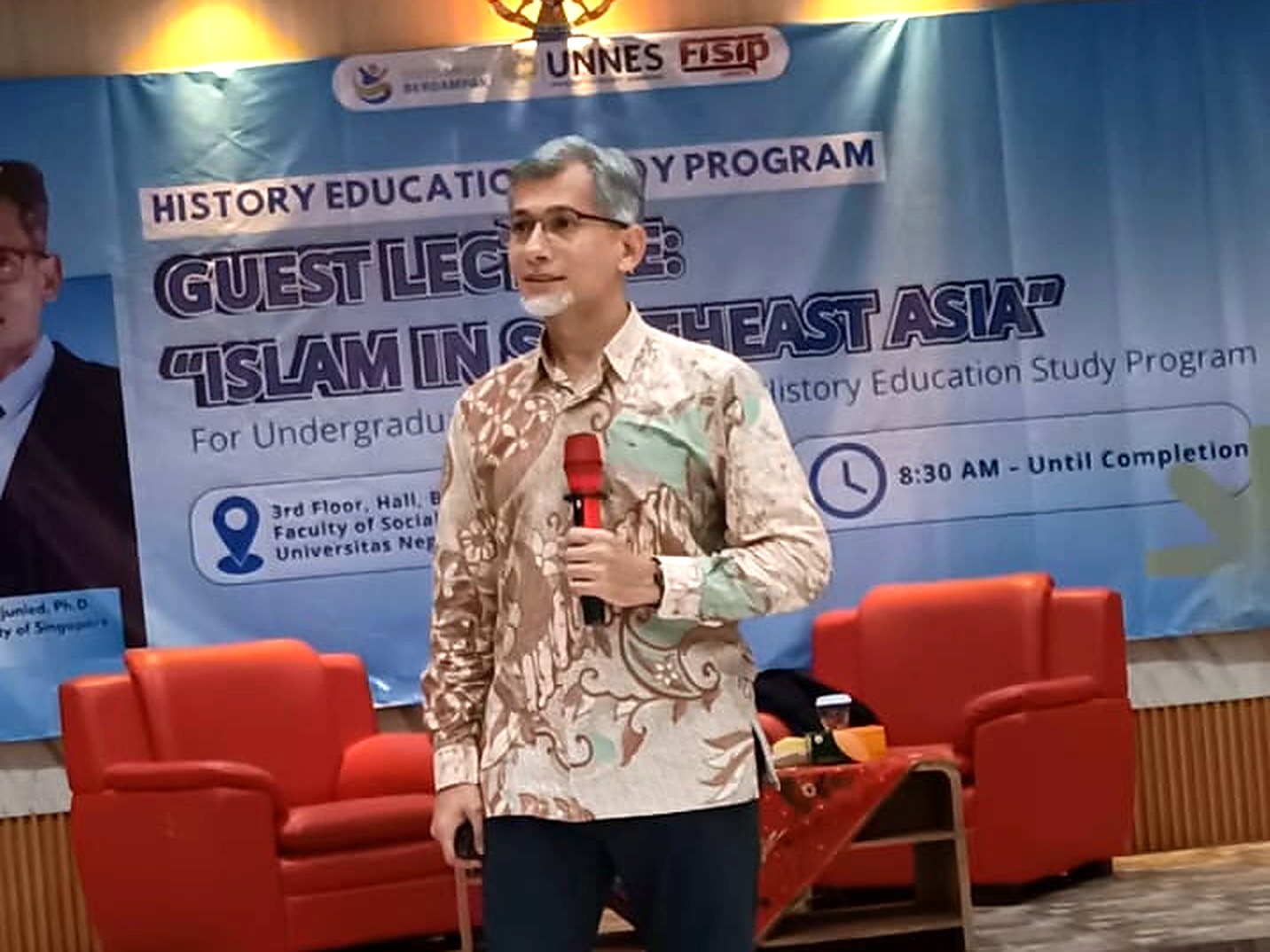
The History Education Study Program at Universitas Negeri Semarang (UNNES) hosted an international guest lecture featuring Professor Khairudin Aljunied of the National University of Singapore (NUS) on Wednesday, bringing together 200 students to explore the historical spread of Islam, intellectual networks and the development of Muslim societies across Southeast Asia.

Held at the Faculty of Social and Political Sciences (FISIP) in the C1 Building auditorium, the lecture, titled Islam in Southeast Asia, aimed to strengthen students’ understanding of Islamic history and equip future history teachers with broader regional perspectives.

Islamic history forms part of the History Education curriculum at UNNES, providing students with knowledge of the cultural exchanges, intellectual movements and social transformations that have shaped Muslim communities throughout the region.

History Education Study Program coordinator Andy Suryadi, S.Pd., M.Pd., welcomed the visiting scholar and participants, while FISIP Vice Dean for Academic and Student Affairs Dr.scient.med. Fadly Husain, S.Sos., M.Si., officially opened the event.

Aljunied, whose research focuses on Islamic intellectual history, reformist movements and Muslim networks in Southeast Asia, has extensively examined how religious ideas circulated across geographical and cultural boundaries.

His 2022 book, Shapers of Islam in Southeast Asia: Muslim Intellectuals and the Making of Islamic Reformism, explores the contributions of Muslim intellectuals to the development of Islamic reformist thought in the region.

The book introduces the concept of an Islamic reformist mosaic, highlighting the diversity of reformist ideas and the interconnected intellectual traditions that have influenced Muslim societies across Southeast Asia.

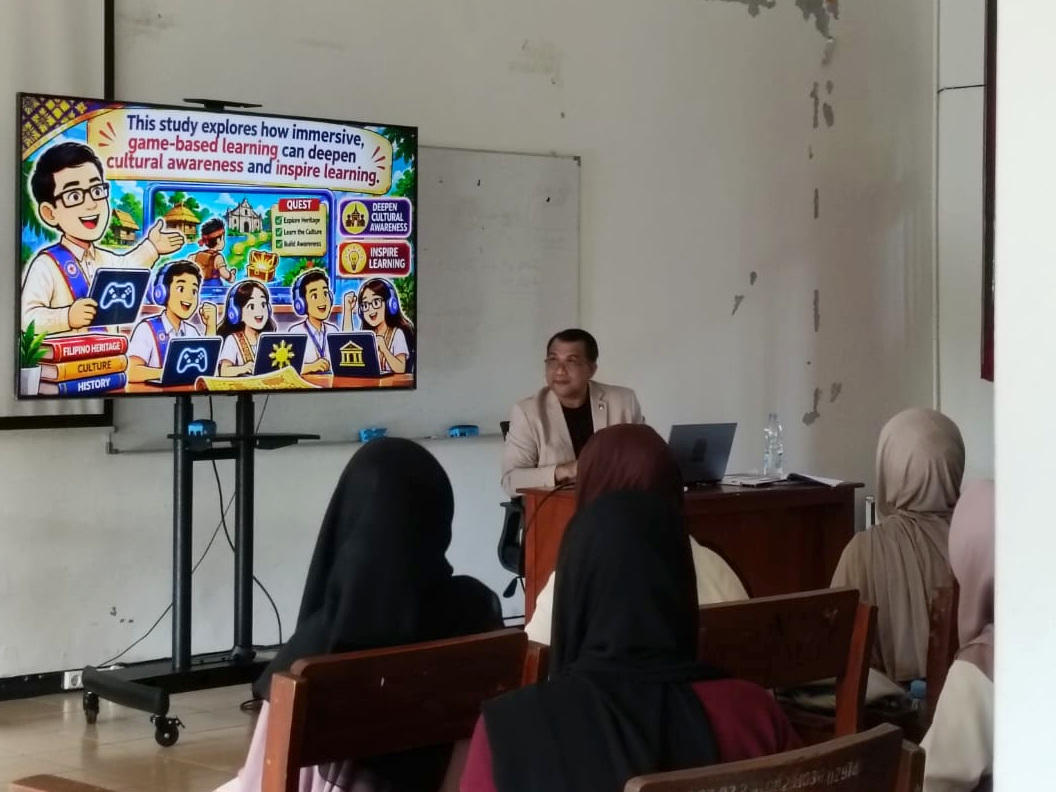
The lecture also featured an interactive discussion in which students raised questions about Islam in the Indonesian archipelago and the relevance of Islamic approaches to addressing psychological challenges among young people.

The discussion extended beyond conventional historical narratives to consider the relationship between religious thought, mental health and contemporary social issues.

The subject is closely related to Aljunied’s research on Zakiah Daradjat, an influential Indonesian scholar widely recognized for her pioneering contributions to Islamic psychology.

In his 2021 article, Islam as Therapy: Zakiah Daradjat and the Uses of Religious-Oriented Psychology, published in Indonesia and the Malay World, Aljunied examines how Daradjat integrated Islamic teachings, Muslim psychospiritual traditions and modern psychological knowledge into approaches to mental health and personal well-being.

Daradjat, a professor at the former State Islamic Institute (IAIN) Syarif Hidayatullah Jakarta, now UIN Syarif Hidayatullah Jakarta, played a significant role in developing religious psychology in Indonesia, particularly in relation to education, mental health and the psychological challenges facing young people.

For UNNES history education students, the discussion offered an opportunity to examine Islam not merely as a religious tradition that spread across the archipelago, but also as an evolving intellectual and cultural force that continues to influence societies.

The insights gained from the lecture are expected to enrich students’ historical understanding and provide additional perspectives for developing teaching materials when they enter the teaching profession.

Beyond the student lecture, the academic engagement is also expected to support further professional development for UNNES lecturers through advanced academic writing training.

The proposed training will focus on helping lecturers structure research articles more effectively, develop stronger scholarly arguments and prepare manuscripts that meet the standards of internationally recognized academic journals.
Related Posts

Leave a Reply

* Kode Akses Komentar:

* Tuliskan kode akses komentar diatas:

GDPR

  • Privacy Policy

Privacy Policy

At unnes.ac.id, the privacy of our visitors is of extreme importance to us. This privacy policy document outlines the types of personal information that is received and collected by unnes.ac.id and how it is used.

Log Files

Like many other Web sites, unnes.ac.id makes use of log files. The information inside the log files includes internet protocol (IP) addresses, type of browser, Internet Service Provider (ISP), date/time stamp, referring/exit pages, and number of clicks to analyze trends, administer the site, track user’s movement around the site, and gather demographic information. IP addresses and other such information are not linked to any information that is personally identifiable.

Cookies

unnes.ac.id uses cookies to store information about visitors’ preferences, to record user-specific information on which pages the site visitor accesses or visits, and to personalize or customize our web page content based upon visitors’ browser type or other information that the visitor sends via their browser.

Third-party ad servers or ad networks use technology in their respective advertisements and links that appear on unnes.ac.id and which are sent directly to your browser. They automatically receive your IP address when this occurs. Other technologies (such as cookies, JavaScript, or Web Beacons) may also be used by our site’s third-party ad networks to measure the effectiveness of their advertising campaigns and/or to personalize the advertising content that you see on the site.

unnes.ac.id has no access to or control over these cookies that are used by third-party advertisers.

You should consult the respective privacy policies of these third-party ad servers for more detailed information on their practices as well as for instructions about how to opt-out of certain practices. unnes.ac.id’s privacy policy does not apply to, and we cannot control the activities of, such other advertisers or web sites.

If you wish to disable cookies, you may do so through your individual browser options. More detailed information about cookie management with specific web browsers can be found at the browsers’ respective websites.

Consent

By using our website, you hereby consent to our privacy policy and agree to its terms.

Update

This Privacy Policy was last updated on: 2023-02-14. Should we update, amend or make any changes to our privacy policy, those changes will be posted here.

Contact Us

If you have any questions, comments, or concerns about our Privacy Policy or our practices with regards to your personal information, please feel free to contact us through the contact form on our website or by emailing us at humas[at]mail.unnes.ac.id.

This Privacy Policy is intended as a general guide to our practices in collecting and using information. If there is any inconsistency between this Privacy Policy and the terms of the Service Agreement or any other terms that may apply to specific services you use, then those specific service terms shall apply.

Terms of Use

By using our website, you agree to abide by this Privacy Policy. If you do not agree with this Privacy Policy, please do not use our website. We reserve the right to update this Privacy Policy from time to time without prior notice. Please review our Privacy Policy periodically to check for changes. Your continued use of our website following the posting of changes to this Privacy Policy means that you accept the changes.

Thank you for reading our Privacy Policy. We are committed to protecting the privacy of our website visitors and will continue to update our Privacy Policy to ensure optimal protection.