



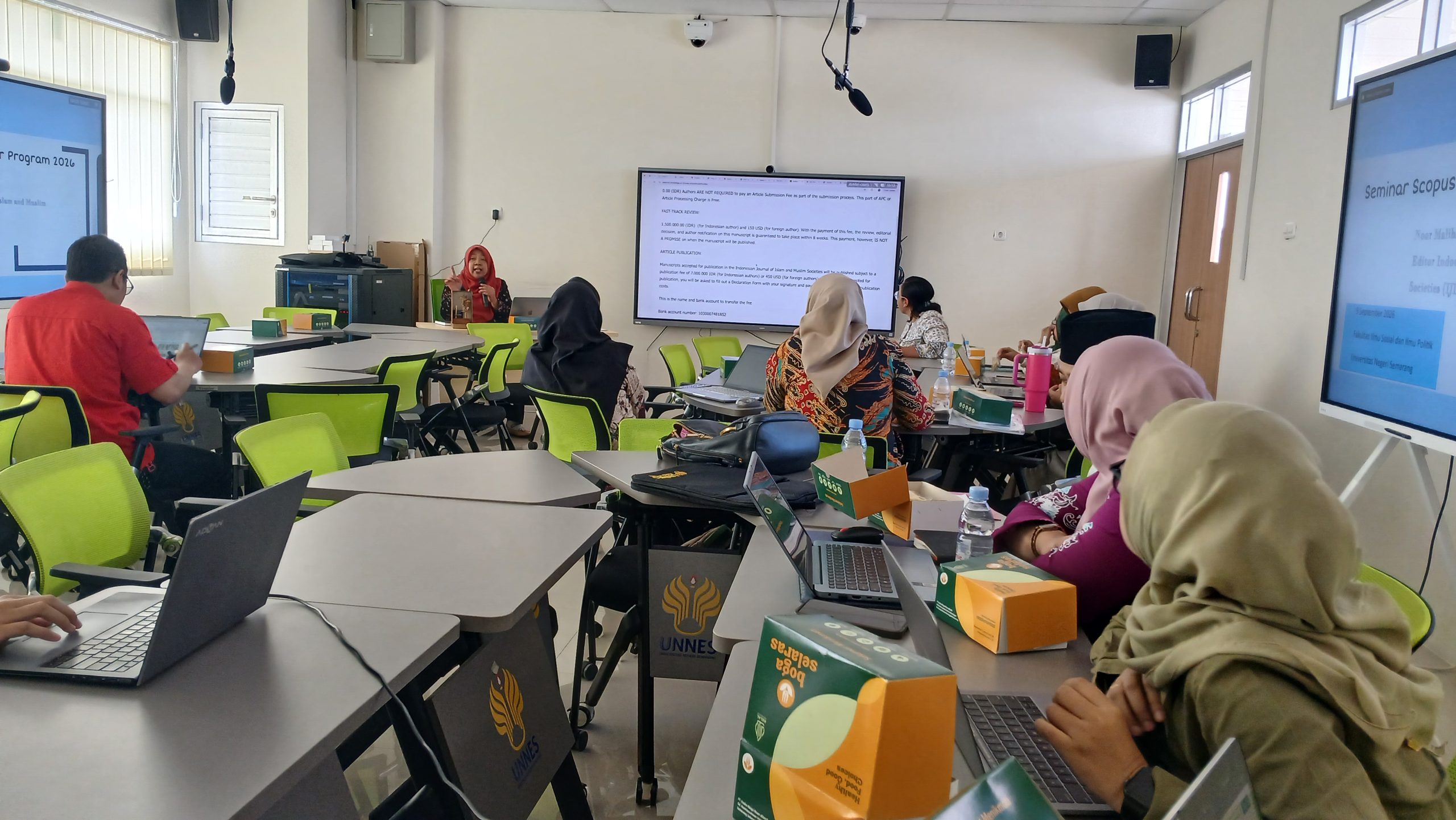
Semarang — The Faculty of Social and Political Sciences (FISIP) of Universitas Negeri Semarang (UNNES) held a Scopus Accelerator Program (SAP) Workshop as part of its efforts to improve the quality and quantity of lecturers’ publications in reputable international journals. The workshop was held on Wednesday (September 9, 2026), starting at 9:00 a.m. Western Indonesia Time (WIB), at the Smart Classroom, AT Soegito Building, FISIP UNNES.
The workshop was attended by lecturers from the Political Science, Pancasila and Civic Education (PPKn), and Communication Science study programs. The event featured Noor Malihah, S.Pd., M.Hum., Ph.D., an editor of the Indonesian Journal of Islam and Muslim Societies (IJIMS) at Universitas Islam Negeri (UIN) Salatiga, as the speaker. Her experience as a journal editor provided participants with an opportunity to gain insights into the editorial process and considerations involved in publishing articles in reputable international journals.
The workshop was opened with remarks by Vice Dean for Field 3 of FISIP UNNES, Dr. Sos. Puji Lestari, M.Si. In her remarks, Puji expressed her appreciation and gratitude to the speaker for attending the event and sharing her knowledge with FISIP UNNES lecturers. She explained that the FISIP UNNES SAP was designed to assist lecturers in preparing and improving the quality of their articles for publication in reputable international journals.
“The FISIP UNNES SAP is intended to provide support for lecturers in publishing their articles in reputable international journals. Therefore, programs like this are important for strengthening lecturers’ understanding of international publication standards,” she said.
In her presentation, Noor Malihah discussed publication strategies from the perspective of a journal editor. One of the key aspects that authors need to consider is understanding the characteristics and scope of the target journal. Submitted articles should demonstrate alignment between their topics, approaches, and research focus and the journal’s scope.
In addition to the substance of the article, authors also need to pay close attention to the journal’s technical requirements. Articles should be prepared in accordance with the journal’s author guidelines and manuscript template. According to Noor, compliance with these requirements not only demonstrates the author’s preparedness but also helps facilitate the editorial process.
“Authors need to understand the characteristics and ‘landscape’ of each journal they are targeting. A well-written article should not be submitted to a journal whose scope is not relevant to the topic. In addition, the manuscript should follow the specified author guidelines and template,” she explained.
She further noted that failure to comply with a journal’s basic requirements may increase the likelihood of an article being rejected at the initial editorial stage. Therefore, authors need to carefully map potential journals before submitting their manuscripts, including understanding the journal’s focus and scope, the characteristics of the articles it publishes, and its applicable writing requirements.
The workshop featured an interactive discussion and a direct review of one of the participants’ article drafts. This session allowed participants to gain a more concrete understanding of the aspects that need to be improved to ensure that an article meets the standards and requirements of its target journal.
During the question-and-answer session, Iwan Hardi Saputro, a lecturer in the Political Science Study Program at FISIP UNNES, asked about the types of research contexts that could be relevant to IJIMS. He also raised a question about paragraph-writing standards in academic articles and their relationship to the Indonesian National Qualifications Framework (KKNI).
The question led to a broader discussion on journal selection strategies, establishing the relevance of an article to a journal’s scope, and ensuring that the substance and presentation of a manuscript meet the academic standards expected by international journals.
The in-depth discussion provided participants with new insights, particularly into the editorial perspective used to assess submitted manuscripts. Participants gained not only a better understanding of the substantive aspects of academic articles but also insights into the importance of strategically selecting target journals and carefully preparing manuscripts before submission.
The Scopus Accelerator Program Workshop concluded successfully. Through this program, FISIP UNNES continues to strengthen lecturers’ capacity to produce high-quality scholarly publications while increasing the prospects of having their articles accepted by reputable international journals.