



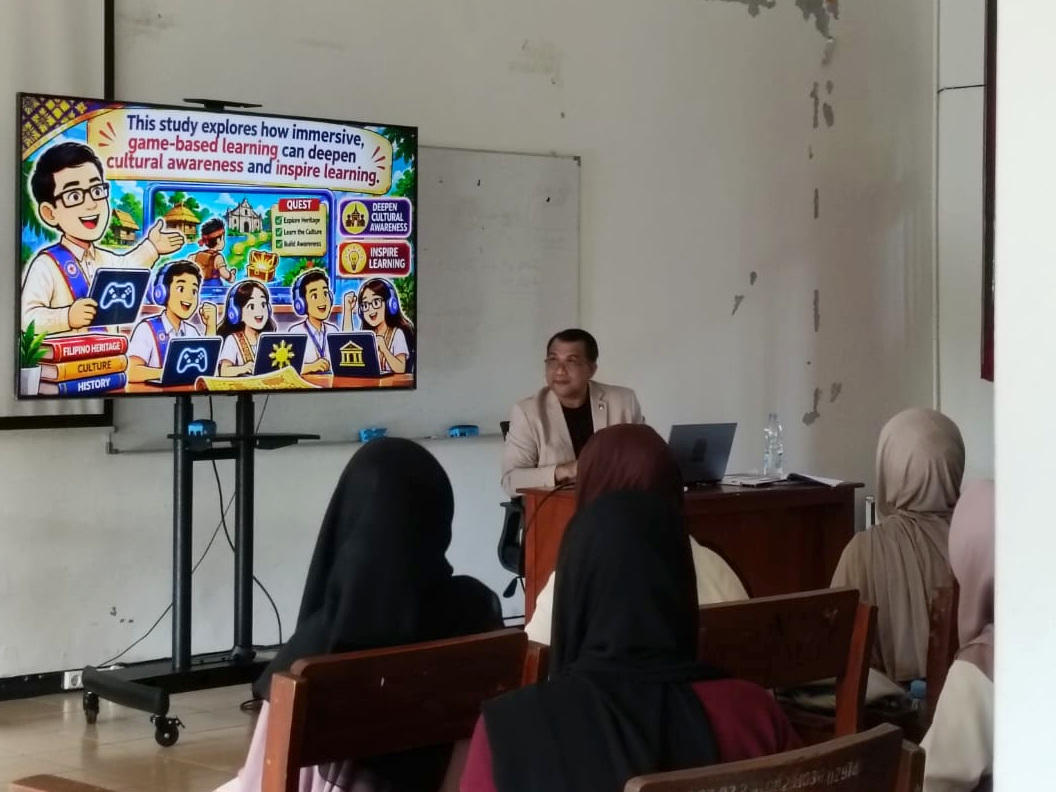
The traditional Indonesian game bentengan has a close counterpart in the Philippines, where it is known as Agawan Kuta. The cultural connection became a highlight of an international guest lecture on history and heritage organized by the Faculty of Social and Political Sciences (FISIP) at Universitas Negeri Semarang (UNNES) on Wednesday (Nov. 11).
The lecture, featuring Prof. Roel Verdadero Avila, Ed.D., Ph.D., of Philippine Normal University (PNU) South Luzon, brought together 45 history education students in Room 213 of the C2 Building. The event introduced innovative approaches to teaching history by incorporating traditional games, local knowledge and cultural heritage into classroom activities.
The lecture aimed to equip future history teachers with practical insights into developing creative teaching methods and educational media rooted in local wisdom. Rather than relying solely on textbooks and lectures, students were encouraged to explore how familiar cultural practices could make history lessons more engaging and meaningful.
One of the most interesting examples discussed was Agawan Kuta, a traditional Filipino game that closely resembles Indonesia’s bentengan. Both games involve two opposing teams attempting to defend their territory while capturing their opponents’ base.
The games require speed, teamwork, strategic thinking and cooperation. Beyond their recreational value, they reflect social traditions and collective values passed down through generations.
The similarities between bentengan and Agawan Kuta also offer an interesting perspective on the cultural connections among Southeast Asian societies. Although the games have different names, their shared characteristics demonstrate how traditional forms of recreation can reflect broader regional cultural similarities.
For history education students, the discussion highlighted that cultural heritage extends beyond historical buildings, monuments and archaeological artifacts. Traditional games, as expressions of intangible cultural heritage, also provide valuable insights into the everyday lives, social relationships and cultural identities of communities.
Through game-based learning, traditional activities such as bentengan can be adapted into interactive history lessons. Teachers, for example, could modify the game to introduce historical concepts involving territorial defense, military strategies, the development of kingdoms or cooperation among communities.
Such an approach allows students to experience historical concepts through participation rather than merely memorizing dates, names and events. It also offers opportunities to develop critical thinking, communication and collaborative problem-solving skills.
The use of traditional games in education may also contribute to preserving local cultural heritage. As digital entertainment increasingly shapes children’s recreational activities, incorporating traditional games into classroom learning offers another way to introduce younger generations to cultural practices that have been passed down over time.
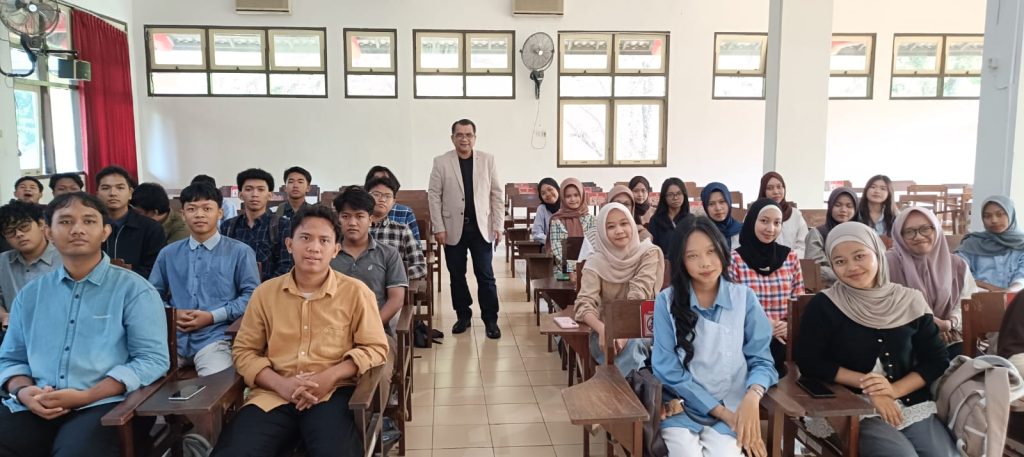
Avila, who serves as Dean for Academics and the Hub at PNU South Luzon, has academic interests in integrating local wisdom and cultural heritage into educational practices. Philippine Normal University is a higher education institution specializing in teacher education and professional development in the Philippines.
The lecture also explored the broader relationship between history and heritage, emphasizing the educational potential of traditional knowledge, community practices and cultural experiences.
For the 45 UNNES history education students attending the event, the discussion provided new perspectives on designing innovative and culturally relevant teaching materials. The approach encourages future teachers to identify cultural resources within their own communities and transform them into meaningful learning experiences.
The academic exchange also reflected the growing importance of international collaboration in teacher education, particularly in exploring how Southeast Asian countries can learn from their shared cultural traditions.
Through the international guest lecture, FISIP UNNES sought to strengthen the competencies of future history teachers while promoting innovative educational approaches that recognize and preserve local cultural heritage.