

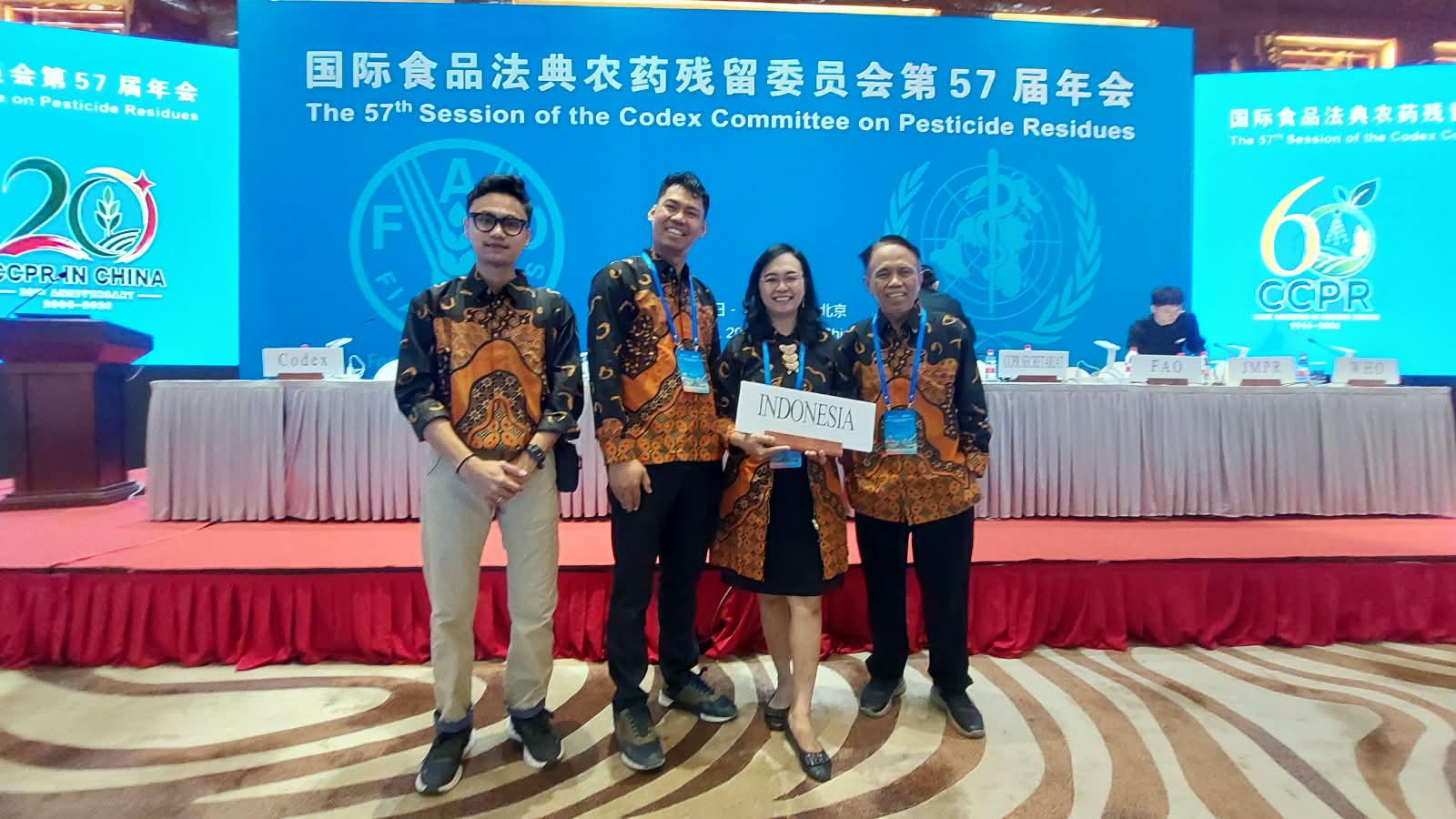
BEIJING, CHINA – Universitas Negeri Semarang (UNNES), through its Center of Excellence for Coffee and Spice Postharvest Technology (PUI-PT Co-Spice), has strengthened its role in international food standardization as part of Indonesia’s delegation to the 57th Session of the Codex Committee on Pesticide Residues (CCPR57), held in Beijing, China, from September 7 to 12, 2026.
The international forum, operating under the Joint FAO/WHO Food Standards Programme, addresses pesticide residue standards in food and feed, particularly Maximum Residue Limits (MRLs). These standards carry implications beyond food safety. They affect consumer protection, national regulations, agricultural production, and the acceptance of commodities in international trade.
Indonesia’s delegation was led by Prof. Dr. Joni Munarso of the National Research and Innovation Agency (BRIN) as Head of the Indonesian Delegation. The delegation also included Dr. Eka Yuli Astuti, Head of PUI-PT Co-Spice UNNES, and Sigit Ismaryanto, S.E., representing business stakeholders and the Indonesian Spice Council.
The composition reflected a collaborative approach to international food-standard diplomacy, bringing together research institutions, universities, businesses, and commodity stakeholders. It also underscored a growing recognition that global food standards need to bridge scientific evidence with the realities of agricultural production and international trade.
Six Decades of Global Pesticide Residue Standards
CCPR57 marked an important milestone as the committee commemorated 60 years since its establishment. The first CCPR session was held in the Netherlands in 1966, while its 57th session convened this year in Beijing.
The meeting was chaired by Duan Lifang, Chairperson of the CCPR from China. During the opening, China’s Vice Minister of Agriculture and Rural Affairs Zhang Xingwang highlighted food safety, green development, science-based pesticide use, and the harmonization of international pesticide residue standards.
Chairperson of the Codex Alimentarius Commission Allan Azegele also emphasized that six decades of CCPR work demonstrate the importance of international cooperation grounded in science, mutual respect, and consensus.
Among the strategic issues discussed at CCPR57 was the priority list of pesticide compounds to be evaluated by the Joint FAO/WHO Meeting on Pesticide Residues (JMPR).
The discussion demonstrates why MRLs occupy a critical position in the global food system. They provide references for regulators and producers, contribute to science-based consumer protection, and help facilitate international food trade.
Indonesia Brings National Interests to Global Standard-Setting
Indonesia submitted national positions on several pesticide MRLs for food and feed.
The country supported progress on MRLs for Bifenthrin (178), Pyriproxyfen (200), Boscalid (221), Flubendiamide (242), Broflanilide (326), and Trifloxystrobin (213).
Indonesia’s considerations included the conditions surrounding imported and exported commodities, particularly products for which MRL values have not yet been established under Indonesian National Standards or regulations issued by the National Food Agency. In several cases, Indonesian standards are more stringent than the corresponding Codex MRLs.
Indonesia’s participation therefore went beyond following changes in international standards. It provided an avenue for national conditions, scientific considerations, and trade interests to enter discussions within the global standard-setting process.
Malathion and Methyl Bromide: Balancing Safety and Trade
Among the issues receiving Indonesia’s attention at CCPR57 was Malathion (049).
Indonesia supported further discussion of Malathion under the periodic review agenda. The issue illustrated the complexity behind pesticide residue regulation, where scientific evidence, food safety, agricultural practices, postharvest requirements, and international trade can converge around a single standard.
JMPR had previously been unable to complete the residue definition for dietary intake estimation for plant and animal commodities, leading to recommendations to withdraw several Codex Maximum Residue Limits, or CXLs.
CCPR members, however, also considered the continued use of Malathion in agricultural and postharvest practices and the potential disruption to trade that could follow the withdrawal of all existing CXLs.
The CCPR57 Adoption Report eventually retained Malathion CXLs for blueberries, the cherry subgroup, cottonseed, maize, sorghum grain, and wheat under the four-year rule, while other CXLs were withdrawn.
For Indonesia, the discussion illustrates the delicate balance involved in international food-standard setting: protecting public health while ensuring sufficient scientific evidence and considering agricultural, postharvest, and trade realities.
Methyl Bromide (052) was another issue of concern. Indonesia did not support the withdrawal of all existing CXLs for the substance. Its national position noted that pesticide products containing Methyl Bromide remain in use and registered in Indonesia.
Indonesia also engaged informally with Thailand, India, Australia, China, and ASEAN partners to explore the availability of relevant toxicological data.
At CCPR57, the MRL for Methyl Bromide was retained at Step 4 pending periodic review by JMPR, with the forum also considering its importance for quarantine and pre-shipment applications, disease control, and trade facilitation.
Bringing Indonesian Coffee and Spice Interests to the Global Table
The participation of Dr. Eka Yuli Astuti brought an important university research perspective to Indonesia’s delegation, particularly at the intersection of postharvest technology, food safety, standardization, policy, and the interests of Indonesia’s coffee and spice commodities.
For PUI-PT Co-Spice UNNES, participation in CCPR57 went beyond academic representation at an international forum. It offered an opportunity to connect coffee and spice research with the wider ecosystem of global food standards.
One development of particular relevance to Indonesian coffee was the exploration of including Isoprocarb and 2,4-Dichlorophenoxyacetic acid (2,4-D) for coffee commodities in the 2028 priority list. Indonesia also supported the proposed schedule and priority lists for pesticide evaluations by JMPR for 2027, 2028, and subsequent years.
For the Indonesian coffee industry, pesticide residue standards are not merely technical requirements. They can influence whether products are accepted in export markets.
This creates a growing need for Indonesia to develop robust pesticide residue databases based on commodities and production regions. Stronger scientific data would provide a more substantial evidence base when Indonesia presents its interests in future Codex and JMPR discussions.
The involvement of Sigit Ismaryanto, S.E., representing business stakeholders and the Indonesian Spice Council, complemented the scientific and academic perspectives brought by BRIN and Co-Spice UNNES.
Changes in MRLs can directly affect market access, compliance costs, supply chains, production processes, and potential trade barriers. A commodity may possess excellent physical and sensory qualities but still encounter market-access difficulties when it does not meet the food-safety requirements of its destination country.
Bringing business perspectives into international standard-setting discussions therefore helps connect global regulatory developments with the practical realities faced by producers and exporters.
Food Standards Diplomacy Must Be Built on Data
CCPR57 also highlighted the increasing importance of scientific data in the future of international food standardization.
Discussions included the modernization of the Codex Pesticide Residues Database, alignment of CXLs with revised food and feed classifications, and the strengthening of scientific advice provided by FAO and WHO.
The committee also noted the need to address the backlog of JMPR evaluations and support efforts to restore the JMPR-CCPR cycle to a more regular schedule.
For Indonesia, these developments carry a clear message. Participation in global food governance cannot depend solely on diplomatic presence. It increasingly requires credible datasets, research capacity, laboratory infrastructure, scientific publications, and sustained collaboration among government, universities, industries, and commodity stakeholders.
This direction closely relates to Sustainable Development Goal (SDG) 2: Zero Hunger, particularly efforts to support sustainable and resilient food systems, as well as SDG 3: Good Health and Well-being through stronger food-safety protection.
It also contributes to SDG 9: Industry, Innovation and Infrastructure, especially through scientific research, laboratory capacity, and innovation supporting competitive agricultural commodities. The cross-sector and international nature of Codex cooperation further reflects SDG 17: Partnerships for the Goals.
From Beijing to a New Strategy for Indonesian Coffee and Spices
Indonesia’s participation in CCPR57 sends another important message: international standards have become an integral part of national commodity competitiveness.
Indonesian coffee and spices cannot rely solely on their distinctive flavors, aromas, varietal diversity, and postharvest quality. Entering and remaining in international markets increasingly requires compliance with food-safety standards, traceability requirements, and destination-country regulations.
Following CCPR57, this challenge creates opportunities for stronger research on pesticide residues, commodity-specific databases, laboratory and testing systems, alignment of Indonesian standards with developments in Codex, and capacity building for farmers and businesses.
Co-Spice UNNES can play an important role within this landscape by connecting postharvest research and commodity development with standardization and research commercialization.
Its involvement in CCPR provides a foundation for strengthening studies on the safety and quality of coffee and spices, pesticide residues, postharvest technology, standardization, and downstream innovation oriented toward international markets.
At the same time, collaboration with business actors and the Indonesian Spice Council provides a pathway for market needs and challenges encountered by producers to become part of research and standardization discussions.
From Standard Taker to Active Contributor
CCPR57 ultimately demonstrated that pesticide residue standards are about far more than numerical limits.
Behind every MRL are interconnected concerns involving farmers, consumers, industries, exporters, public health, the environment, and international trade. For Indonesia, effective participation therefore depends on its ability to bring robust scientific evidence, reliable data, national production realities, and legitimate trade considerations into global discussions.
The road from Beijing points toward a broader challenge for Indonesian agricultural commodities.
The future competitiveness of coffee, spices, and other Indonesian agricultural products will increasingly depend not only on what the country produces, but also on the strength of its scientific evidence and its capacity to participate meaningfully in international standard-setting.
For Co-Spice UNNES, CCPR57 represents another step in connecting research, food safety, standardization, and global market access.
It is a path toward a stronger Indonesian presence in global food governance, moving gradually from being primarily a standard taker toward becoming a more active contributor to international standard-setting.