

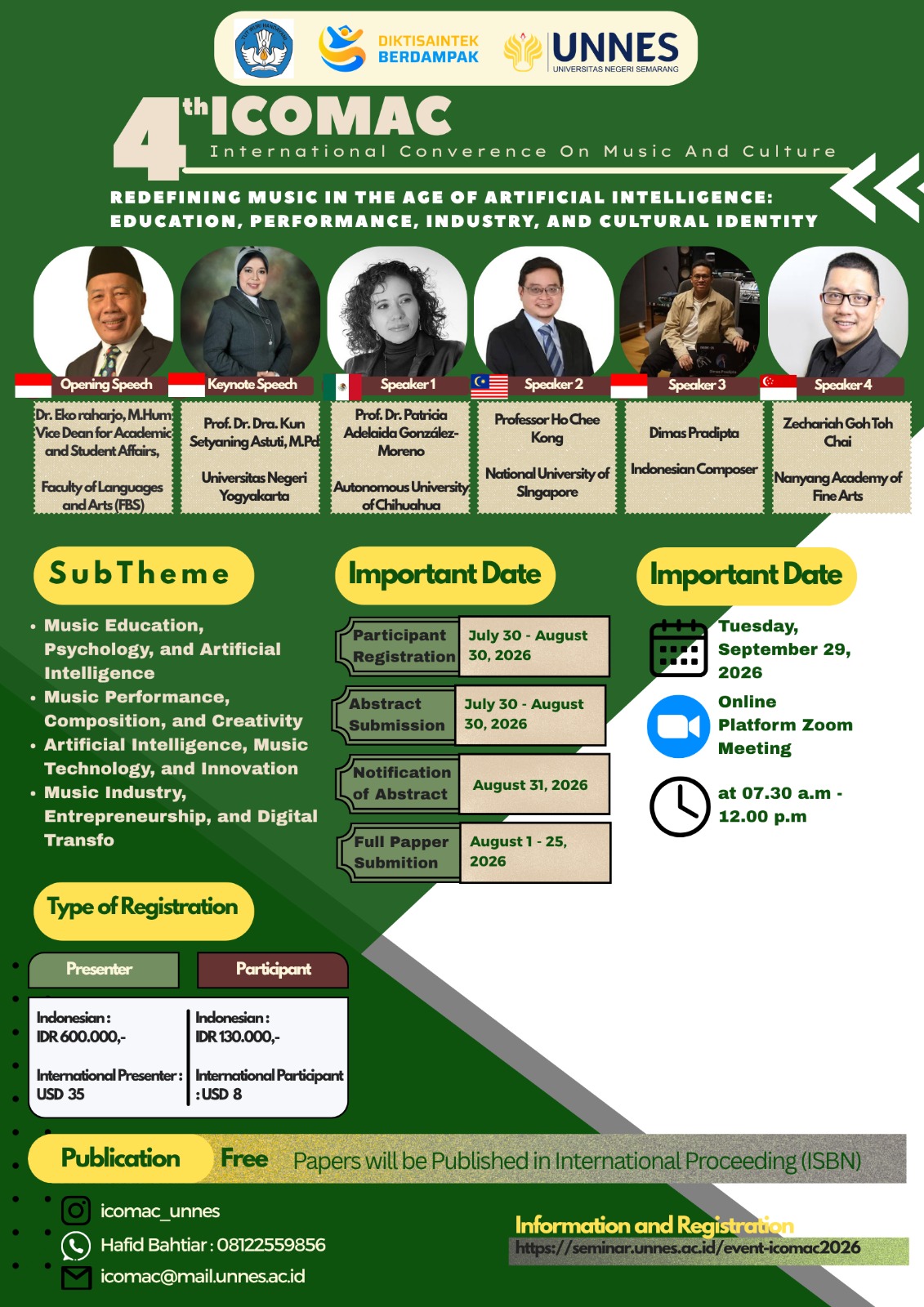
The Faculty of Languages and Arts (FBS), Universitas Negeri Semarang (UNNES), through its Music Education Study Program, is set to host the 4th International Conference on Music and Culture (ICOMAC) 2026, an international academic forum that brings together scholars, educators, musicians, practitioners, and students to examine the changing landscape of music and culture.
This year’s conference carries the theme “Redefining Music in the Age of Artificial Intelligence: Education, Performance, Industry, and Cultural Identity,” placing artificial intelligence at the heart of discussions on how music is taught, created, performed, distributed, and culturally understood.
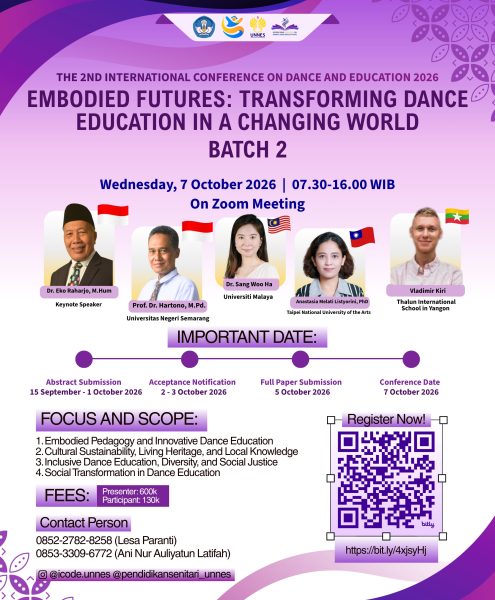
ICOMAC 2026 will take place online via Zoom on Tuesday, September 29, 2026, from 7:30 a.m. to 12:00 p.m. Western Indonesian Time. The conference seeks to encourage dialogue across disciplines and national borders at a time when artificial intelligence is rapidly reshaping creative practices and challenging conventional ideas about authorship, creativity, artistic expression, and cultural identity.
The conference will feature scholars and practitioners from Indonesia and abroad. Prof. Dr. Dra. Kun Setyaning Astuti, M.Pd. of Universitas Negeri Yogyakarta will deliver the keynote speech. International speakers include Prof. Dr. Patricia Adelhaid González-Moreno of the Autonomous University of Chihuahua, Mexico, Professor Ho Chee Kong of the National University of Singapore, and Zechariah Goh Toh Chai of the Nanyang Academy of Fine Arts, Singapore. Indonesian composer Dimas Pradipta will also join the conference as a speaker. Dr. Eko Raharjo, M.Hum., Vice Dean for Academic and Student Affairs of FBS UNNES, is scheduled to deliver the opening speech.
Acting Dean of FBS UNNES, Prof. Heri Yanto, M.B.A., Ph.D., said ICOMAC 2026 reflects the faculty’s commitment to strengthening its international academic environment while responding critically to technological transformations in education, the arts, and culture.
“Artificial intelligence is creating new possibilities as well as new challenges for the arts. Universities should not simply become users of technology. They must also provide critical spaces where we can examine how technology is developed and used while safeguarding human creativity and cultural identity. Through ICOMAC, FBS UNNES seeks to bring together academic and professional perspectives from different countries to engage with these changes,” Prof. Heri Yanto said.
Coordinator of the Music Education Study Program at FBS UNNES, Dr. Abdul Rachman, S.Pd., M.Pd., said the theme was chosen in response to the growing influence of artificial intelligence across the music ecosystem, from classrooms and composition studios to performance spaces and the music industry.
“Music has always evolved alongside social and technological change. Artificial intelligence now offers many possibilities for music education, composition, performance, and the creative industry. At the same time, it raises important questions about creativity, ethics, and cultural identity. ICOMAC 2026 is intended to create a scholarly conversation that goes beyond technological sophistication and brings human creativity and culture back to the centre of the discussion,” Dr. Abdul Rachman said.
The conference covers four major subthemes: Music Education, Psychology, and Artificial Intelligence; Music Performance, Composition, and Creativity; Artificial Intelligence, Music Technology, and Innovation; and Music Industry, Entrepreneurship, and Digital Transformation. Together, these areas provide a broad platform for examining how technological change intersects with musical knowledge, creative practices, education, and industry.
Participant registration and abstract submission are open from July 30 to August 30, 2026. Abstract notifications are scheduled for August 31, while full papers are accepted from August 1 to 25, 2026. Papers meeting the conference requirements will be published free of charge in an international proceeding with an ISBN.
Beyond scholarly exchange, ICOMAC 2026 contributes to UNNES’ commitment to the United Nations Sustainable Development Goals. The conference supports SDG 4: Quality Education by encouraging knowledge exchange, technological literacy, and the development of innovative approaches to music education. Its international participation also aligns with SDG 17: Partnerships for the Goals by strengthening academic networks and opportunities for cross-border collaboration in education, research, music, and culture.
Discussions on artificial intelligence, music technology, innovation, entrepreneurship, and the transformation of the creative industries also intersect with SDG 9: Industry, Innovation and Infrastructure. Through this perspective, technology is approached not simply as a tool for accelerating musical production, but as a rapidly developing field that requires critical, ethical, and culturally sensitive engagement.
Through ICOMAC 2026, FBS UNNES continues to expand its international academic engagement while creating a meeting point between technological innovation and the humanities. As artificial intelligence redraws the boundaries of musical creation and education, the conference places one enduring element at the centre of the conversation: the relationship between music, human creativity, and cultural identity.