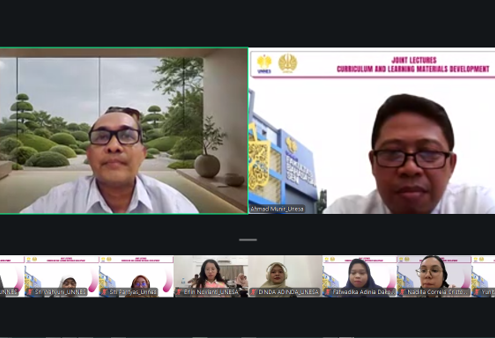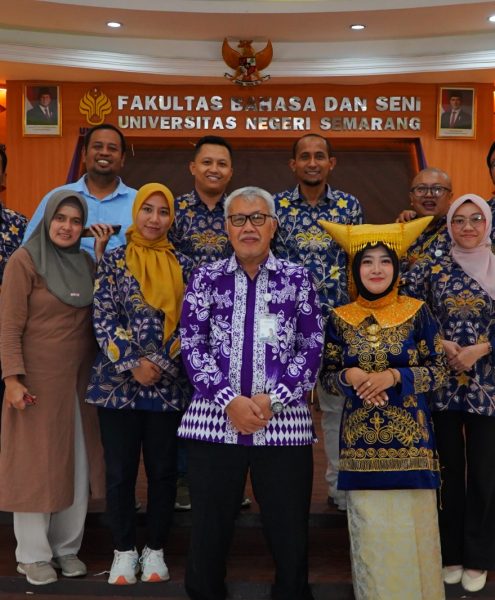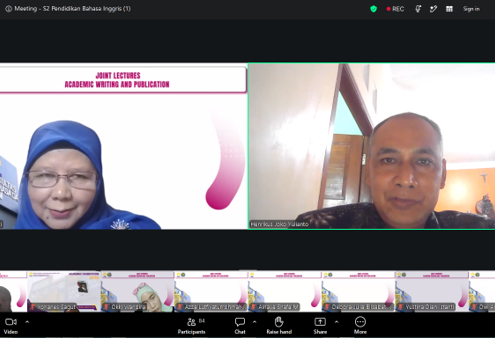


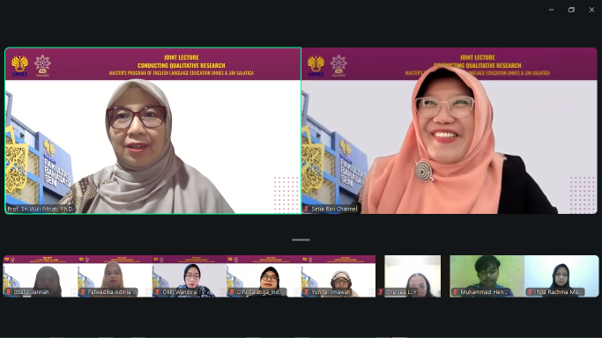
The Master’s Program in English Language Education at the Faculty of Languages and Arts (FBS), Universitas Negeri Semarang (UNNES), held a joint lecture titled “Qualitative Research in ELT” on September 25, 2026, bringing together graduate students from UNNES and Universitas Islam Negeri (UIN) Salatiga to strengthen their qualitative research competencies in English language teaching.
Conducted virtually via Zoom, the event involved students from the Master’s Program in English Language Education at UNNES and the Master’s Program in English Language Teaching at the Graduate School of UIN Salatiga. The lecture provided a collaborative academic platform for exploring qualitative research approaches and developing students’ abilities to identify, investigate, and critically interpret educational phenomena.
The session featured two scholars, Prof. Sri Wuli Fitriati, M.Pd., Ph.D., from UNNES and Dr. Setia Rini, M.Pd., from UIN Salatiga. Their presentations offered complementary perspectives on qualitative inquiry, ranging from classroom discourse analysis to the development of meaningful research questions based on real-world English language teaching experiences.
Prof. Sri Wuli Fitriati delivered a presentation titled “Conducting Qualitative Research: Analyzing Classroom Discourse,” highlighting how classroom interaction can serve as a valuable source of data for understanding teaching and learning processes.
Her session explored the role of classroom discourse analysis in examining communication patterns, language use, instructional strategies, and the ways teachers and students construct meaning through interaction.
The discussion emphasized that classroom communication provides valuable insights into the complexities of language learning, enabling researchers to investigate educational practices within their authentic social and instructional contexts.
Meanwhile, Dr. Setia Rini presented “From ELT Curiosity to Research: Exploring Qualitative Research Questions and Developing the Willingness to Conduct Research,” encouraging students to transform their curiosity about English language teaching into focused and meaningful research inquiries.
Her presentation highlighted the importance of developing research awareness and identifying educational issues that can be explored through qualitative approaches. Students were encouraged to formulate clear research questions grounded in classroom experiences, teaching practices, and emerging challenges in English language education.
Together, the sessions demonstrated that qualitative research involves more than data collection and analysis. It also requires researchers to understand educational contexts, interpret complex phenomena, and develop evidence-based academic arguments.
Fostering Critical Inquiry and a Research-Oriented Academic Culture
Dr. Sri Wahyuni, M.Pd., Coordinator of the Master’s Program in English Language Education at FBS UNNES, emphasized that joint academic activities play an important role in strengthening students’ methodological competencies and fostering a research-oriented academic environment.
She noted that qualitative research skills are particularly valuable for graduate students seeking to understand the complex social, cultural, and interactional dimensions of English language education.
The initiative aligns with the vision of the Master’s Program in English Language Education at UNNES to become a leading program in advancing innovative English language education through the integration of language education theories, linguistics, and literacy approaches, with a strong research orientation and a commitment to character development and quality education.
By strengthening students’ methodological understanding, the program seeks to encourage research that not only meets academic standards but also contributes to the development of educational theory and classroom practices.
The collaboration with UIN Salatiga also provided opportunities for academic exchange among students and faculty members from both institutions. Such interactions are expected to broaden research perspectives, strengthen scholarly networks, and create opportunities for future academic cooperation.
Advancing SDG 4 and SDG 17 Through Research and Academic Collaboration
The joint lecture also reinforced FBS UNNES’s commitment to advancing the United Nations Sustainable Development Goals (SDGs), particularly SDG 4 (Quality Education) and SDG 17 (Partnerships for the Goals).
Its contribution to SDG 4 was reflected in efforts to enhance the quality of graduate education, strengthen research methodology skills, and promote critical and analytical thinking. By encouraging rigorous qualitative inquiry, the initiative aimed to support research that addresses contemporary challenges in English language teaching and learning.
Meanwhile, the partnership between UNNES and UIN Salatiga contributed to SDG 17 by facilitating interuniversity collaboration, knowledge exchange, and the development of academic networks. The joint lecture demonstrated how cooperation between higher education institutions can strengthen research capacity and encourage sustainable educational partnerships.
Through this initiative, the Master’s Program in English Language Education at FBS UNNES reaffirmed its commitment to advancing research-oriented graduate education, academic innovation, and institutional collaboration.
The lecture is expected to equip students with the knowledge and skills needed to design and conduct systematic, context-sensitive, and meaningful qualitative research, contributing to the continued improvement of English language education.