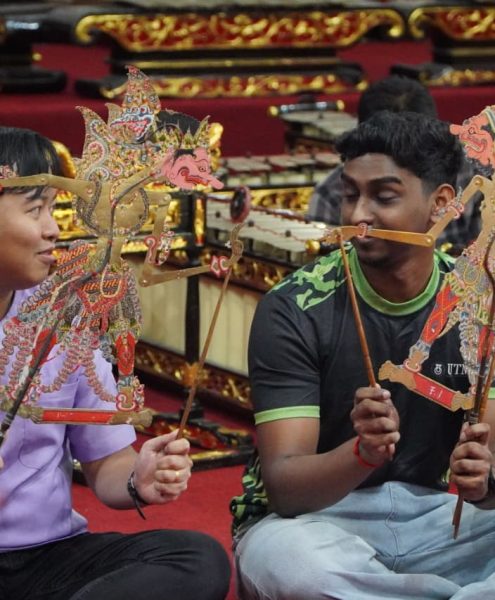


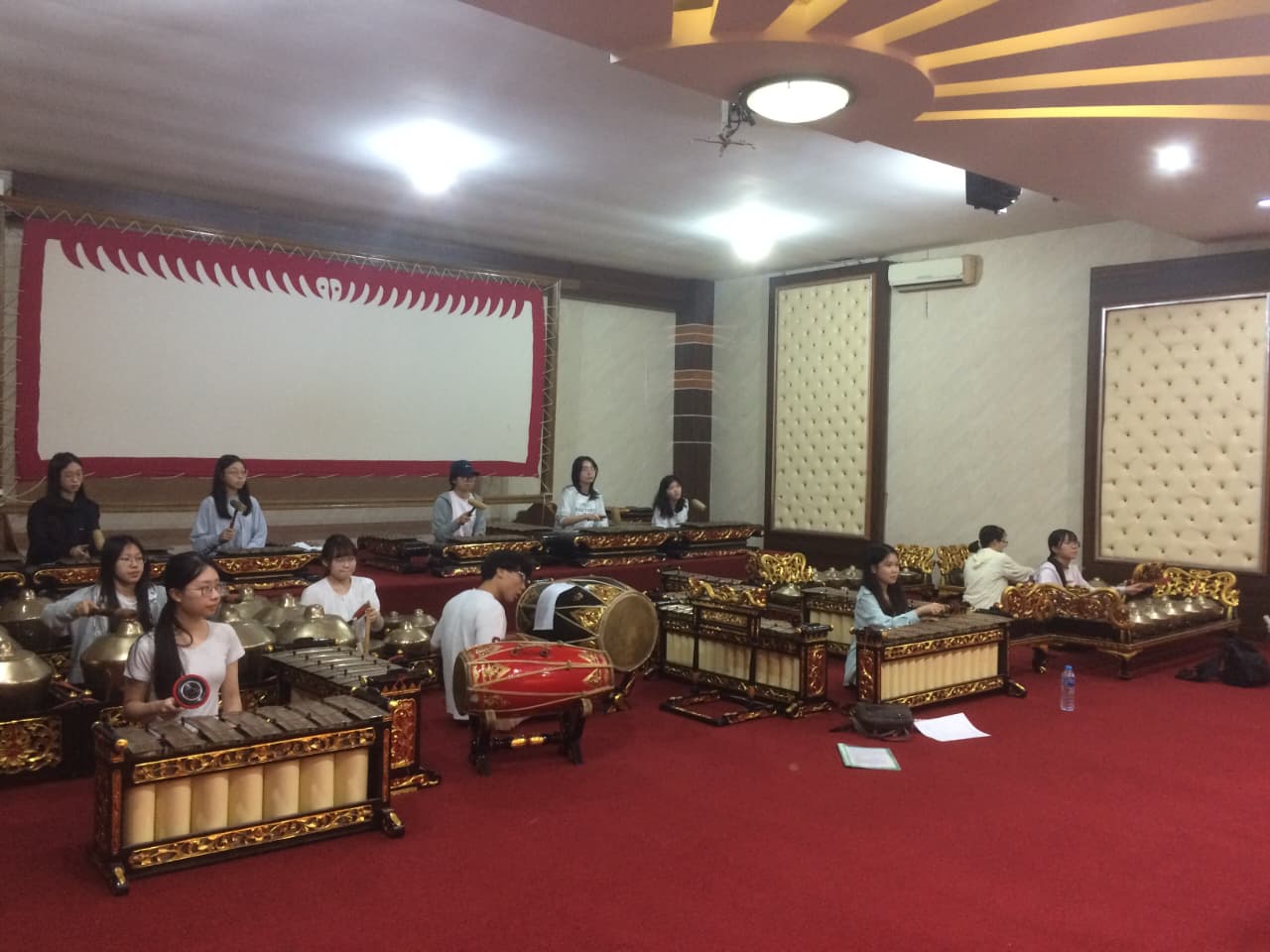
The partnership between the Indonesian Literature Study Program at the Faculty of Languages and Arts (FBS), Universitas Negeri Semarang (UNNES), and Fujian Polytechnic Normal University (FPNU), China, continues to move beyond institutional agreements into tangible academic experiences. One of its latest implementations takes place in the classroom, where FPNU students are introduced to Javanese culture through hands-on gamelan lessons led by Indrawan Nur Cahyono, S.Sn.
The gamelan class is part of a semester-long academic and credit transfer program involving 15 FPNU students at the Indonesian Literature Study Program of FBS UNNES. The students were officially welcomed to UNNES on September 4, 2026. Their arrival marked the continuation of the partnership between the two universities, following the participation of six FPNU students in the previous semester.
This year’s increase from six to 15 participants reflects the growing academic mobility between UNNES and FPNU. The program is designed not only to strengthen students’ proficiency in Indonesian but also to give them first-hand experience of Indonesian culture and academic life.
Within that framework, Javanese culture becomes part of the students’ learning experience. The gamelan sessions led by Indrawan Nur Cahyono, S.Sn. allow FPNU students to encounter traditional Javanese music beyond textbooks and classroom explanations. Students become directly involved with the instruments, sounds, rhythms, and collaborative nature of gamelan performance.
The classroom, therefore, becomes more than a place for learning about culture. It turns into a space where culture is experienced. Students listen, observe, practise, and gradually discover how individual instruments contribute to a larger musical structure.
Acting Dean of FBS UNNES, Prof. Dr. Heri Yanto, M.B.A., Ph.D., said the activity demonstrates how internationalisation can be translated into meaningful academic experiences for students. International partnerships, he noted, become particularly valuable when they create opportunities for students from different cultural backgrounds to learn from one another.
“International cooperation becomes more meaningful when it is translated into academic experiences that students can directly engage with. Through the study of Javanese culture, including gamelan, FPNU students do not learn about Indonesia only from books or classroom discussions. They encounter a living cultural practice. Experiences like this are important for developing cross-cultural understanding while strengthening the international academic environment at FBS UNNES,” Prof. Heri Yanto said.
The approach also reflects the interdisciplinary character of the program. Language learning is placed alongside cultural experience, allowing students to understand Indonesian not merely as a linguistic system but as a language embedded in communities, traditions, artistic expressions, and everyday social life.
Coordinator of the Indonesian Literature Study Program at FBS UNNES, Dr. Suseno, S.Pd., M.A., said cultural learning is an integral part of the academic program developed for FPNU students. Understanding a language, he said, becomes more meaningful when learners are also introduced to the social and cultural contexts in which it is used.
“Language cannot be completely separated from culture. That is why we encourage FPNU students not only to study Indonesian academically but also to experience aspects of Indonesian culture directly. Gamelan offers an interesting entry point because students learn through sound, movement, interaction, and collaboration. Such experiences can provide cultural understanding that may be difficult to achieve through texts alone,” Dr. Suseno said.
He added that classroom-based activities are important in ensuring that international partnerships produce concrete academic outcomes rather than remaining at the level of institutional documents.
“The continuity of this program shows that the partnership between UNNES and FPNU is developing further. We hope FPNU students return home not only with stronger Indonesian language skills, but also with memories and experiences of interacting with Indonesian students, communities, and cultures. At the same time, their presence brings an international learning experience to our own students and academic community,” Dr. Suseno added.
Beyond classroom activities, the FPNU students are supported by UNNES student companions and a host family scheme. These arrangements give them further opportunities to interact with local communities, participate in cultural activities, experience Indonesian food, and use Indonesian in everyday situations.
The initiative brings together two priorities pursued by FBS UNNES: internationalisation and cultural sustainability. In this context, gamelan is not treated simply as cultural material to be introduced to international students. It becomes a medium for interaction, allowing students from different cultural backgrounds to learn together while bringing Javanese cultural heritage into an international educational setting.
The program also contributes to the United Nations Sustainable Development Goals (SDGs), particularly SDG 4: Quality Education. Combining language learning with direct cultural experience broadens the learning process beyond conventional classroom instruction and encourages intercultural competence as part of students’ academic development.
The continuing partnership between UNNES and FPNU also aligns with SDG 17: Partnerships for the Goals. Student mobility, credit transfer, cultural learning, and academic interaction demonstrate how an international partnership can be translated into concrete educational activities that directly benefit students and academic communities.
From a gamelan classroom at FBS UNNES, international cooperation finds a distinctly human rhythm. FPNU students are not simply spending a semester in Semarang to study Indonesian. They are listening to its culture, learning to play it together, and experiencing the people and traditions in which the language lives. In that encounter, internationalisation moves beyond agreements and mobility figures, becoming a genuine exchange of language, knowledge, and culture.