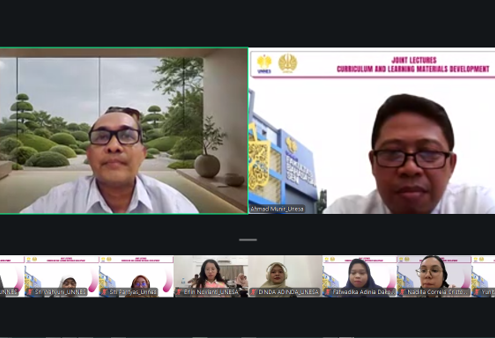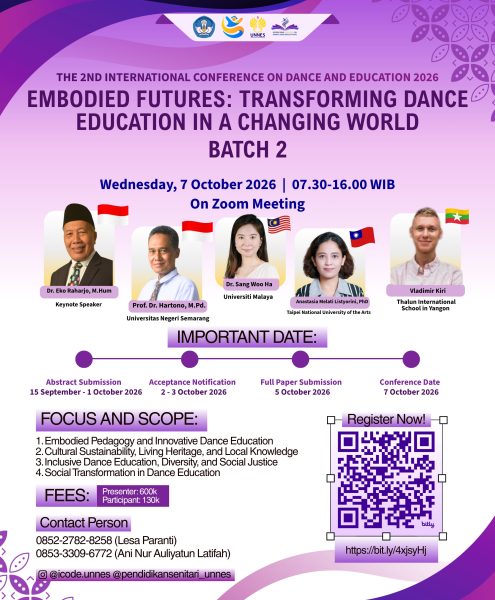


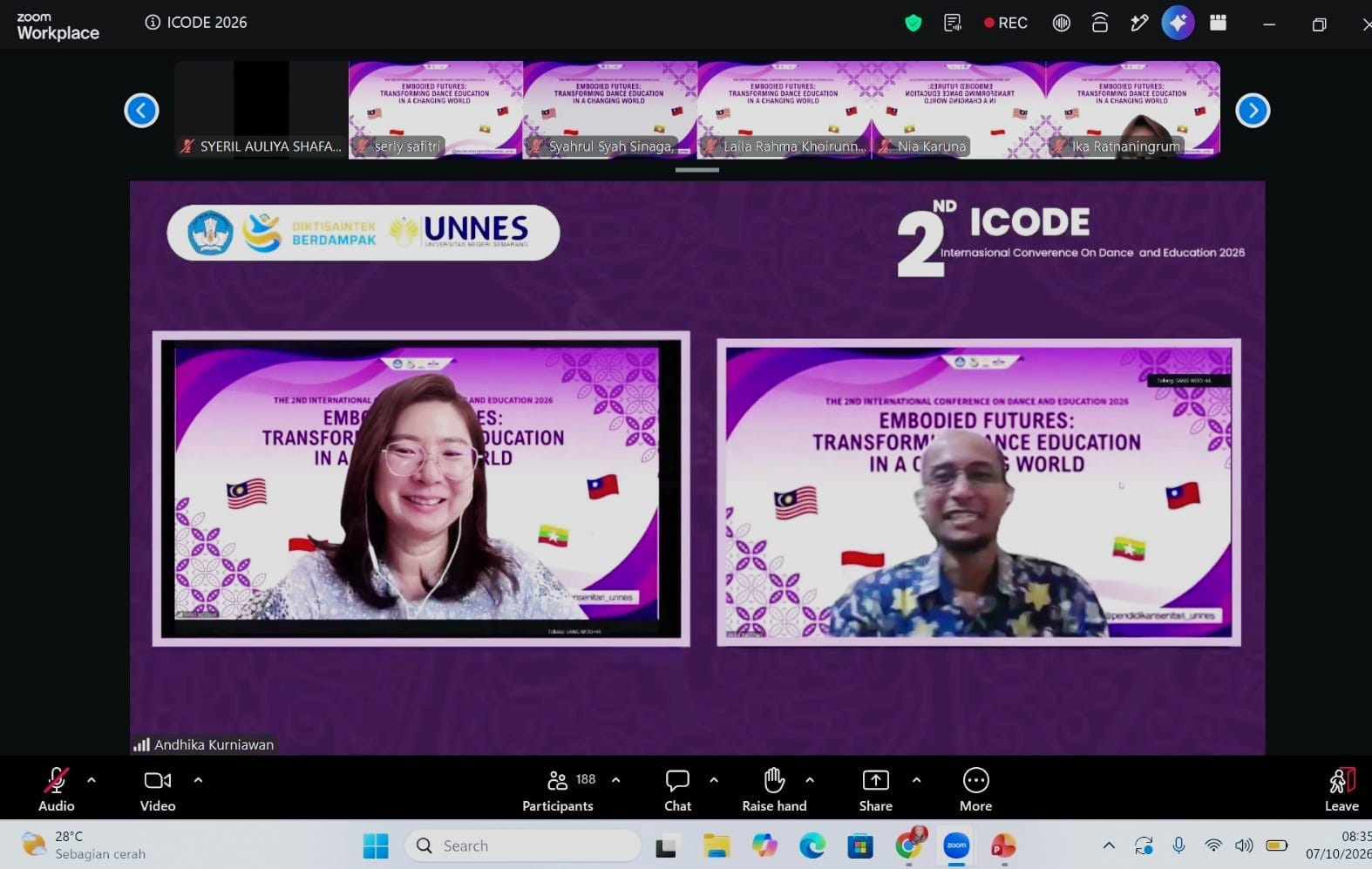
The Dance Education Study Program at the Faculty of Languages and Arts (FBS), Universitas Negeri Semarang (UNNES), hosted the 2nd International Conference on Dance and Education (ICODE) 2026 on Wednesday, October 7, bringing together academics, researchers, educators, and arts practitioners from various countries in a virtual forum.
Under the theme “Embodied Futures: Transforming Dance Education in a Changing World,” the conference provided a platform for exchanging ideas on the future of dance education amid technological advancements, social change, and evolving global cultural dynamics.
Now in its second year, ICODE continues to foster international academic dialogue on innovative approaches to dance education, cultural heritage sustainability, and the role of arts education in building inclusive and sustainable societies.
The conference featured Dr. Eko Raharjo, M.Hum., Vice Dean for Academic and Student Affairs at FBS UNNES, as the keynote speaker. International perspectives were presented by Dr. Sang Woo Ha from Universiti Malaya, Malaysia; Dr. Anastasia Melati Lystiorini, Ph.D., from Taipei National University of the Arts, Taiwan; and Vladimir Kiri from Thalun International School in Yangon, Myanmar. Prof. Dr. Hartono, M.Pd., from Universitas Negeri Semarang also joined the distinguished lineup of speakers.
In his keynote address, Dr. Eko Raharjo emphasized the importance of developing arts education that responds to contemporary challenges while remaining firmly grounded in cultural values.
“Dance education plays a strategic role in nurturing creative, critical, and culturally sensitive generations. As the world continues to change, universities must develop innovative and relevant approaches to teaching and learning. Through ICODE, we seek to encourage fresh perspectives that can enhance the quality of arts education while creating new opportunities for international academic collaboration,” he said.
The conference theme, Embodied Futures, highlighted the significance of the body and movement-based experiences as sources of knowledge in dance education. This perspective encourages more participatory, creative, and inclusive learning approaches that recognize the diverse backgrounds and abilities of students.
Discussions centered on four major areas: Embodied Pedagogy and Innovative Dance Education; Cultural Sustainability, Living Heritage, and Local Knowledge; Inclusive Dance Education, Diversity, and Social Justice; and Social Transformation in Dance Education.
Together, these themes underscored the interconnected roles of dance education in addressing educational innovation, cultural identity, diversity, and broader social transformation.
Advancing the Sustainable Development Goals Through Arts Education
The 2nd ICODE 2026 also reflected UNNES’s commitment to advancing the United Nations Sustainable Development Goals (SDGs), particularly SDG 4 (Quality Education), SDG 10 (Reduced Inequalities), SDG 11 (Sustainable Cities and Communities), and SDG 17 (Partnerships for the Goals).
The conference contributed to SDG 4 by facilitating knowledge exchange and promoting innovative dance pedagogy that supports high-quality, inclusive, and socially relevant education. Its emphasis on diversity, accessibility, and equal opportunities in arts education also aligned with SDG 10.
Discussions on cultural heritage preservation, local knowledge, and the sustainability of traditional dance practices reinforced SDG 11, particularly its commitment to safeguarding cultural heritage as an essential component of sustainable communities.
Meanwhile, the participation of academics and practitioners from Indonesia, Malaysia, Taiwan, and Myanmar supported SDG 17 by strengthening international academic networks, encouraging knowledge exchange, and opening opportunities for cross-border collaboration in arts education and research.
Dr. Eny Kusumastuti, M.Pd., Coordinator of the Dance Education Study Program at FBS UNNES, described ICODE as an ongoing academic initiative aimed at strengthening the contribution of dance education to addressing global challenges.
“Through ICODE, we aim to create a space for dialogue that connects local knowledge with global perspectives. Dance education has tremendous potential to foster creativity, strengthen cultural identity, and promote awareness of diversity and sustainability. We hope this conference will generate ideas that can be translated into innovative teaching practices, collaborative research, and stronger international partnerships,” she said.
Eny further emphasized that the involvement of academics and practitioners from different countries offered valuable opportunities for students and faculty members to broaden their understanding of global developments in dance education.
By bringing together diverse perspectives and academic expertise, the conference encouraged participants to explore how dance education can respond to emerging challenges while preserving cultural knowledge and promoting meaningful social engagement.
Through the 2nd ICODE 2026, the Dance Education Study Program at FBS UNNES continues to strengthen its position as a platform for advancing dance scholarship, educational innovation, and intercultural collaboration.
The conference is expected to lay the groundwork for future initiatives that promote high-quality, inclusive, and culturally responsive dance education while contributing to sustainable development at both local and global levels.