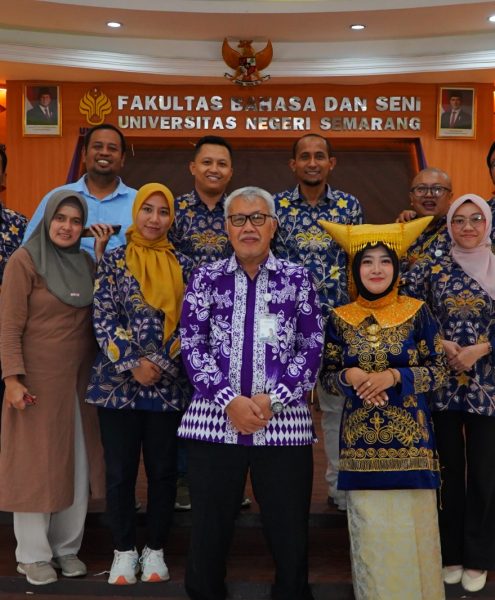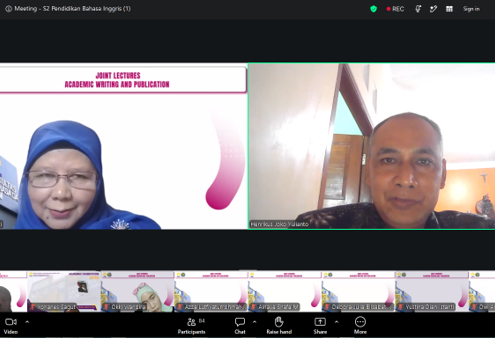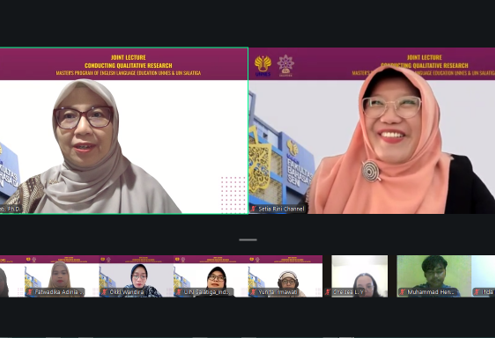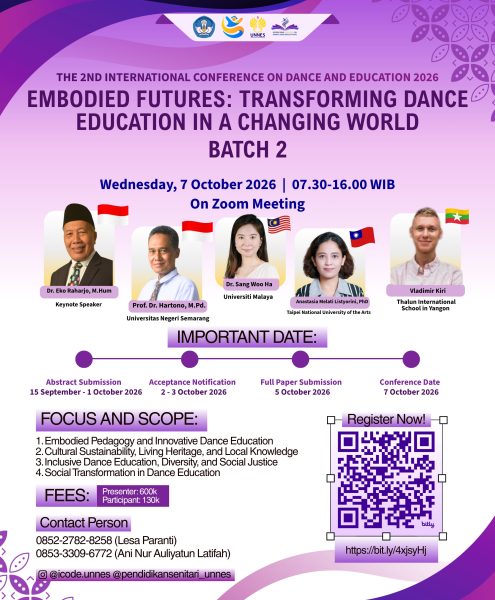


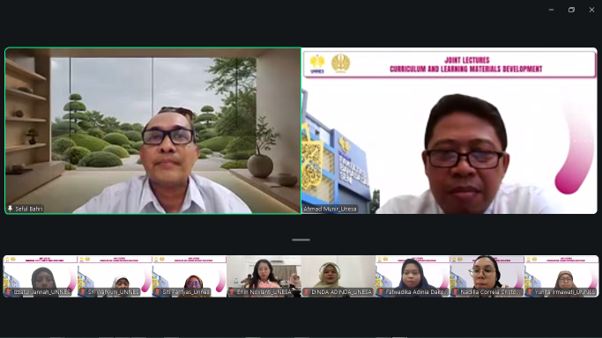
The Master’s Program in English Language Education at the Faculty of Languages and Arts (FBS), Universitas Negeri Semarang (UNNES), collaborated with Universitas Negeri Surabaya (UNESA) to organize a joint lecture titled “Curriculum and Learning Materials Development” on October 6, 2026. The event explored innovative approaches to English language curriculum and instructional materials development in the age of artificial intelligence (AI), emphasizing the importance of pedagogical judgment and learner-centered education.
Held virtually via Zoom from 1:00 p.m. to 3:40 p.m. Western Indonesia Time, the lecture brought together graduate students enrolled in the Curriculum and Learning Materials Development course at UNNES and the Curriculum and Syllabus Development course at UNESA.
The event featured two scholars from the participating universities, offering complementary perspectives on curriculum design, instructional materials, and the integration of emerging technologies into English Language Teaching (ELT).
Ahmad Munir, S.Pd., M.Ed., Ph.D., from UNESA delivered a presentation titled “Learning Objectives Formulation to Link Curriculum and Materials Development,” while Dr. Seful Bahri, S.Pd., M.Pd., from UNNES presented “Rethinking ELT Materials in the Age of AI: Context, Teacher Judgment, and Pedagogical Decision Making.”
In his session, Ahmad Munir highlighted the importance of clearly formulated learning objectives in establishing meaningful connections between curriculum design and instructional materials development.
His presentation explored how learning objectives, curriculum content, instructional activities, and teaching materials should be aligned to ensure coherent and purposeful learning experiences.
The discussion emphasized that effective materials development goes beyond selecting or producing instructional content. It requires careful consideration of intended learning outcomes, learner characteristics, and the broader educational context.
Meanwhile, Dr. Seful Bahri addressed the growing influence of AI on the development of English language teaching materials, encouraging participants to critically examine the opportunities and challenges associated with technology-assisted content creation.
His presentation emphasized that although AI can support teachers in generating, adapting, and organizing instructional resources, professional judgment remains essential in determining their educational relevance, accuracy, and suitability.
The session also highlighted the importance of evaluating AI-generated materials against learning objectives, classroom contexts, and students’ diverse needs. Rather than relying solely on technological efficiency, educators were encouraged to adopt a critical and responsible approach to AI integration.
Promoting Learner-Centered Pedagogical Innovation
Together, the two presentations demonstrated that effective curriculum and materials development requires more than technical expertise. It also demands analytical thinking, a strong understanding of educational theory, and sensitivity to technological change.
As AI becomes increasingly integrated into education, teachers and curriculum developers must be equipped to evaluate, adapt, and contextualize instructional resources. Technology-generated materials require careful review to ensure that they support meaningful learning experiences and align with established pedagogical principles.
For graduate students, the lecture provided valuable perspectives on developing professional competencies as educators, researchers, and curriculum developers capable of integrating emerging technologies into language education.
The initiative also reflected the vision of the Master’s Program in English Language Education at UNNES to become a leading program in advancing innovative English language education through the integration of language education theories, linguistics, and literacy approaches, with a strong research orientation and a commitment to character development and quality education.
Beyond strengthening conceptual knowledge, the joint lecture provided opportunities for students to engage with academics and peers from another university, broadening their scholarly perspectives and fostering a collaborative academic environment.
The collaboration between UNNES and UNESA also highlighted the value of interuniversity academic exchange in promoting educational innovation and strengthening research-oriented graduate education.
Advancing SDG 4 and SDG 17 Through Educational Innovation and Academic Partnerships
The joint lecture reinforced FBS UNNES’s commitment to advancing the United Nations Sustainable Development Goals (SDGs), particularly SDG 4 (Quality Education) and SDG 17 (Partnerships for the Goals).
Its contribution to SDG 4 was reflected in efforts to strengthen graduate students’ academic competencies, promote innovation in curriculum and instructional materials development, and enhance technological literacy in English language education.
The discussions on the critical and responsible use of AI also encouraged the development of high-quality, adaptive, and learner-centered educational practices that respond to contemporary teaching and learning needs.
Meanwhile, the collaboration between UNNES and UNESA supported SDG 17 by facilitating interuniversity knowledge exchange, strengthening academic networks, and creating opportunities for continued cooperation in teaching, research, and professional development.
Through this initiative, the Master’s Program in English Language Education at FBS UNNES reaffirmed its commitment to advancing innovative, research-oriented graduate education that responds to technological developments while maintaining strong pedagogical foundations.
The joint lecture is expected to inspire further development of English language curricula and instructional materials that embrace technological innovation without compromising educational quality, teacher professionalism, or learner needs.
The partnership between UNNES and UNESA also represents an important step toward building a more collaborative and adaptive academic ecosystem that contributes to the continued improvement of English language education in Indonesia.