



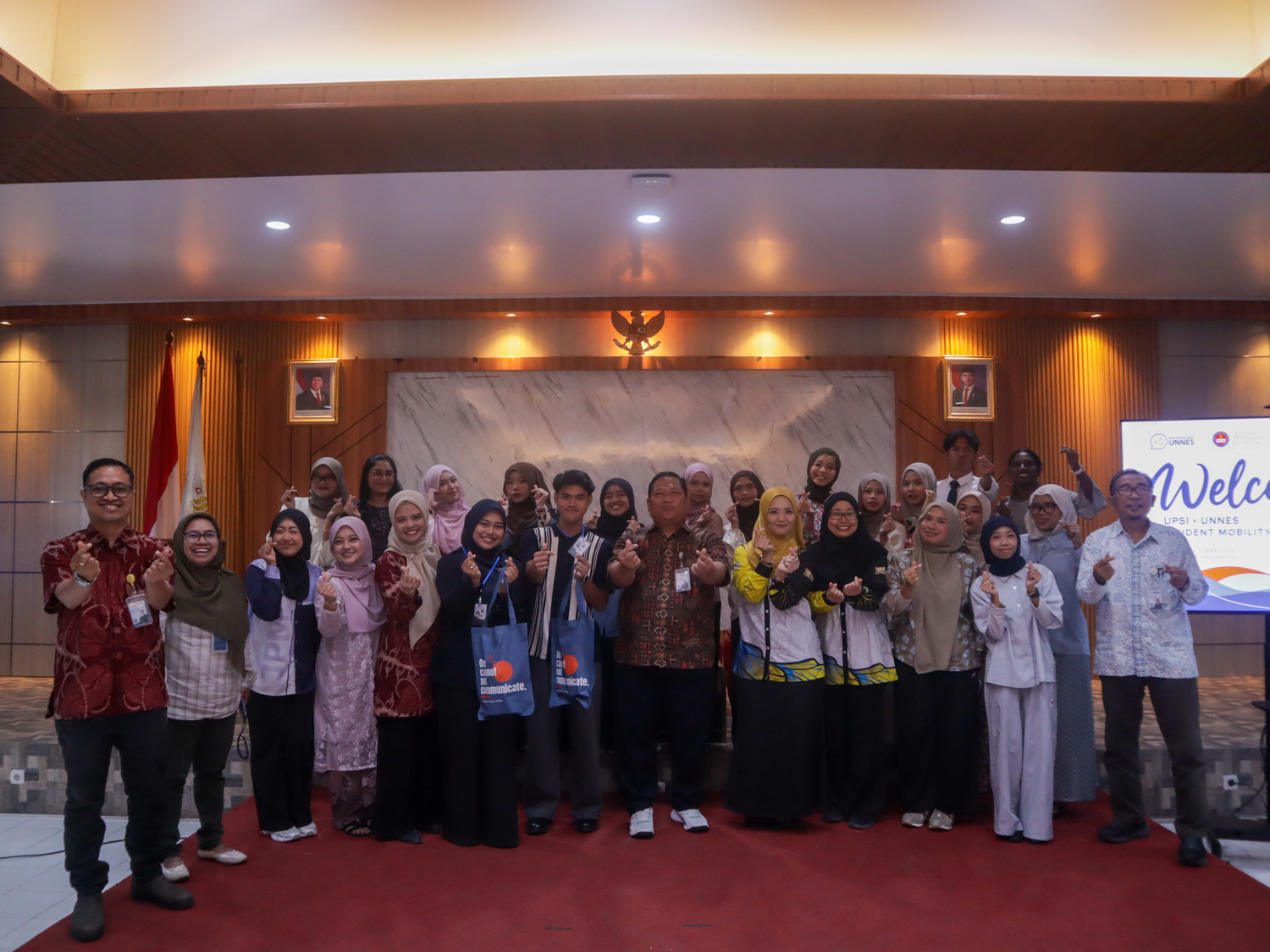
The Faculty of Social and Political Sciences (FISIP) at Universitas Negeri Semarang (UNNES) welcomed a delegation from Universiti Pendidikan Sultan Idris (UPSI), Malaysia, on Tuesday, October 20, 2026, as part of the UPSI–UNNES Student Mobility 2026 programme. The visit served as an opportunity to strengthen academic cooperation, collaborative research, international publications, and student mobility between the two universities.
FISIP UNNES Dean Prof. Arif Purnomo welcomed the visiting lecturers and students at the faculty’s campus in Sekaran, Gunungpati, Semarang. The programme is organised by the Communication Studies Programme at FISIP UNNES in collaboration with the Department of Communication and Media, Faculty of Languages and Communication, UPSI.
During the meeting, FISIP UNNES Vice Dean I Fadly Husain emphasised that international partnerships offer opportunities for lecturers to develop collaborative research and community engagement initiatives. He highlighted the importance of building sustainable partnerships that deliver meaningful academic outcomes.
He also stressed the significance of publishing research in Scopus-indexed journals as part of efforts to strengthen UNNES and FISIP’s international recognition. Both institutions could also explore matching-grant schemes to support joint research projects.
“Research and community engagement collaborations can be developed in the coming years. We welcome opportunities for lecturers to conduct collaborative research, including through matching-grant schemes,” Fadly said.
He added that research collaboration at the university level would require further coordination to ensure that potential partnerships could be developed in a structured and sustainable manner.
Meanwhile, Dr. Serina Yusuf, a senior lecturer at UPSI’s Department of Communication and Media, explained that the visit was intended not only to facilitate student mobility but also to establish broader research partnerships between universities.
According to Serina, the proposed collaboration could involve several universities, including Universitas Brawijaya and UNNES. One of the opportunities being explored is joint research supported by collaborative funding schemes, with expected outputs including international scholarly publications and book chapters.
Serina also outlined the idea of organising a global conference involving participants from approximately 12 countries, covering communication, media, and education. The multidisciplinary approach is expected to expand academic networks and encourage knowledge exchange among researchers from different backgrounds.
Looking ahead to 2027, the two institutions are exploring collaborative research projects with three planned outputs: conference proceedings, book chapters, and journal articles. These initiatives are expected to provide a foundation for more structured and sustainable research cooperation.
One of the issues raised during discussions on potential research collaboration was student mental health amid the growing use of digital technology. The topic offers opportunities for research from the perspectives of communication, communication psychology, and media behaviour.
Potential research could examine the relationship between students’ digital device use, online content consumption, and mental well-being. Cross-disciplinary collaboration could also support the development of measurement instruments to help researchers understand students’ media habits and their relationship with psychological well-being.
The issue presents an opportunity to develop digital communication research that brings together social, educational, and mental health perspectives. However, the relationship between technology use and psychological conditions would need to be examined through systematic research to produce academically sound conclusions.
The UPSI–UNNES Student Mobility 2026 programme runs from October 19 to 28, 2026, at UNNES. According to the programme booklet, it involves 20 UPSI students accompanied by two lecturers.
Over the ten-day programme, participants take part in a range of academic and cultural activities, including guest lectures, academic sharing sessions, classroom observations, collaborative photo essay workshops, and a visit to UNNES TV for podcast production. Students are also scheduled to participate in sports activities, cultural introductions, and the FISIP EXPO.
Muhammad Zul’ Ashryn, a fifth-semester student at UPSI, expressed his enthusiasm about visiting UNNES and experiencing the learning environment at an Indonesian university firsthand. He was also interested in observing differences in campus facilities and transportation systems between the two institutions.
The experience provides students with opportunities to explore different academic environments while building friendships across national and cultural boundaries.
A similar view was expressed by Nur Adlina Aiman, a fifth-semester Social Communication student at UPSI. She said she wanted to learn more about university life in Indonesia, including how students participate in classes, how lecturers teach, and what subjects students study.
For her, attending classes and observing the learning process directly would broaden her knowledge and provide a valuable new learning experience.
Nur Nadia Abd Mubin, a senior lecturer at UPSI and one of the accompanying lecturers, also praised the welcome and facilities provided by UNNES. She appreciated the hospitality of the host institution and the support available to help students adapt during their stay in Semarang.
Through the student mobility programme, FISIP UNNES and UPSI aim not only to strengthen the exchange of learning experiences but also to expand collaboration in research, academic publishing, and international academic networking.
The exploration of matching-grant schemes, plans for inter-university research, and opportunities for joint publications represent initial steps towards strengthening ties between the two institutions. Meanwhile, classroom interactions and collaborative activities allow students to understand different cultural backgrounds and academic practices.
The programme is expected to lay the foundation for sustainable cooperation between UNNES and UPSI, contributing to student development and strengthening both institutions’ academic engagement at the international level.