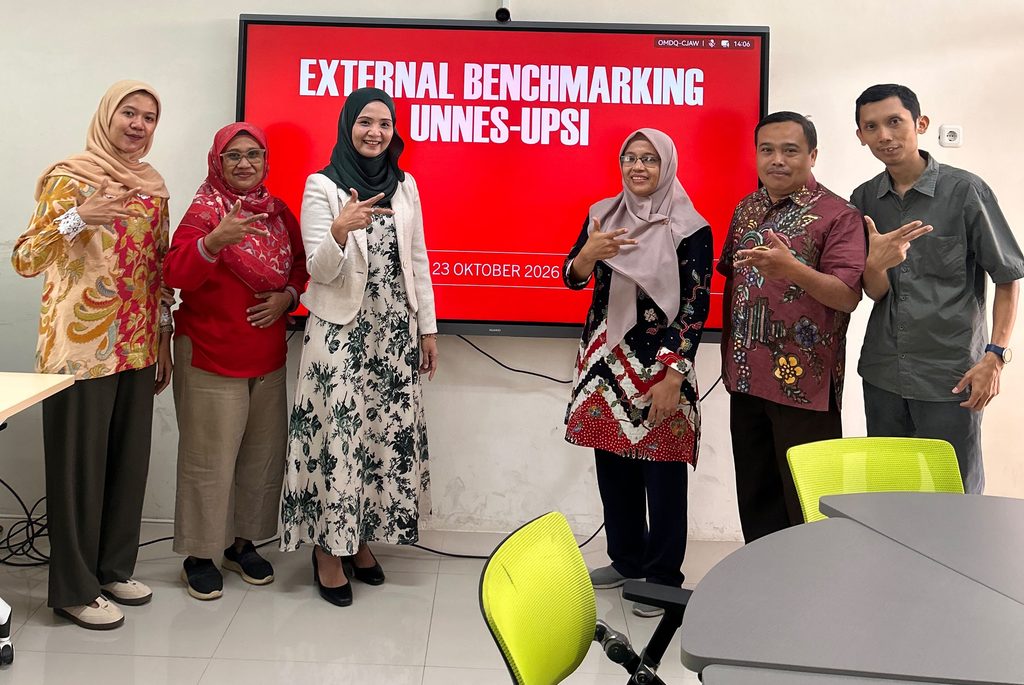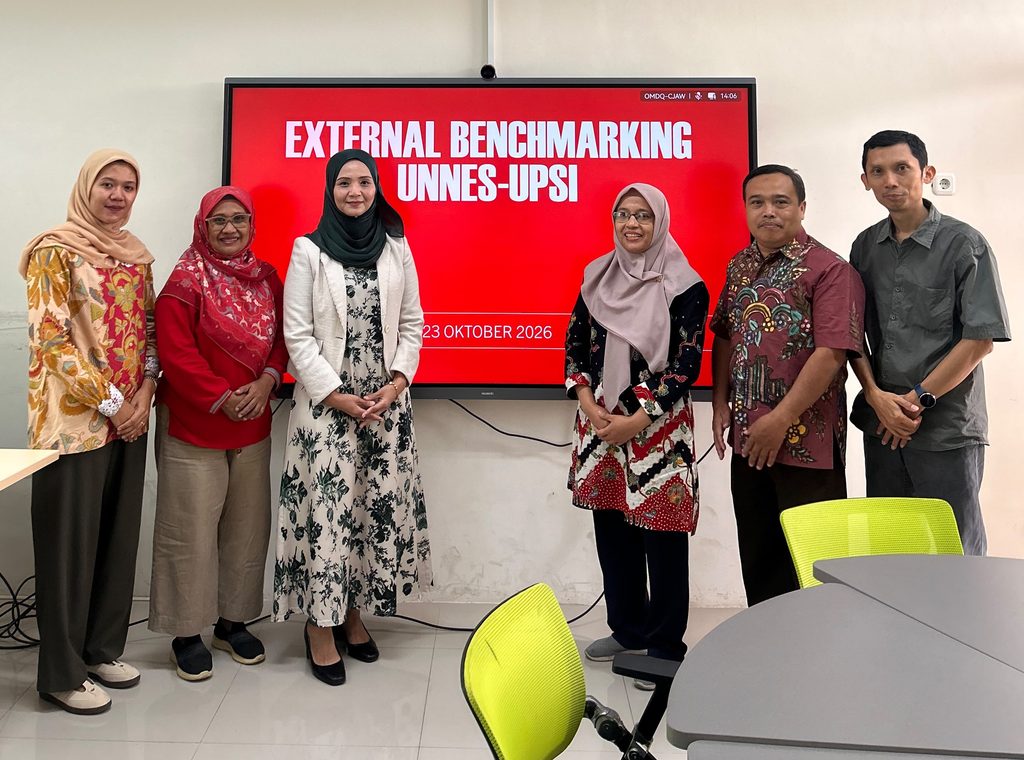




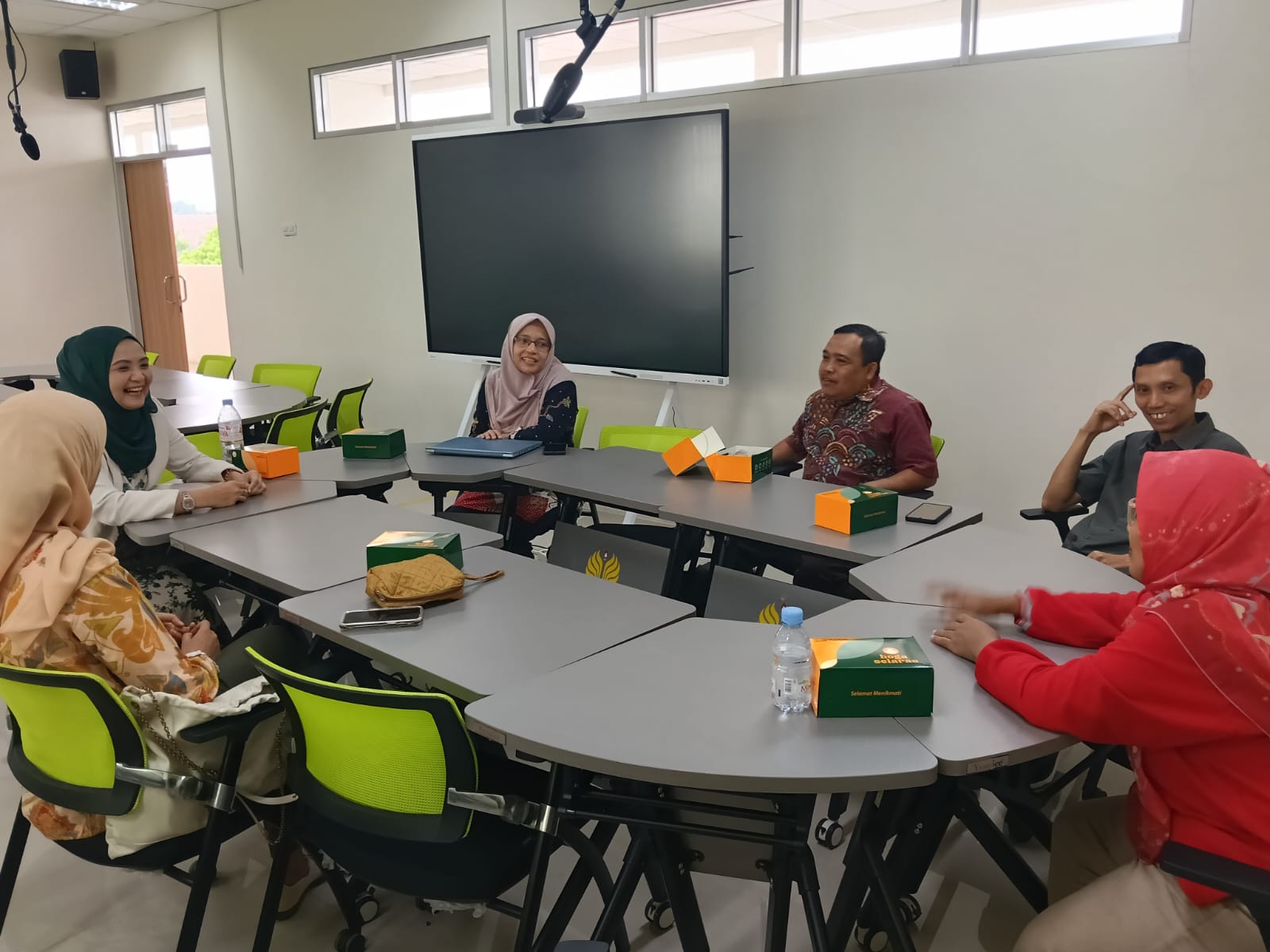
SEMARANG – The Faculty of Social and Political Sciences (FISIP) of Universitas Negeri Semarang (UNNES) held a benchmarking session on quality assurance with Universiti Pendidikan Sultan Idris (UPSI), Malaysia, on Friday, October 23, 2026. The event, which took place in the Smart Classroom on the fifth floor of Building C1 at FISIP UNNES, served as a forum for exchanging information and experiences regarding quality assurance governance, audit systems, academic management, and strategies for improving the quality of higher education.
The session featured Dr. Sarina binti Yusup, Ph.D., M.Sc., B.A., Head of the Department of Communication and Media at UPSI Malaysia, as the speaker. FISIP UNNES was represented by Dr. Nurul Fatimah, S.Pd., M.Si.; Dr. Kuncoro Bayu Prasetyo, S.Ant., M.A.; Romadi, S.Pd., M.Hum.; Asma Luthfi, S.Th.I., M.Hum.; and Hany Nurpratiwi, M.Pd. The meeting provided an opportunity for both institutions to share quality management practices and identify approaches that could inform the further development of quality assurance systems in higher education.
One of the key topics discussed was UPSI’s quality management and audit system at both faculty and university levels. The discussion covered sample-based audits, document reviews across faculties, and the division of responsibilities in audit implementation. The benchmarking notes also highlighted the separation of academic and financial management, including administrative procedures for research funding and reporting requirements related to lecturers’ responsibilities.
In addition to governance, the discussion addressed academic quality development in relation to student needs and the world of work. Practices of particular interest included regular curriculum reviews involving alumni, industry representatives, lecturers, and assessors from other universities. The development of programs that provide direct industry experience, such as learning schemes combining coursework and internships, was also part of the information exchange. These approaches underscore the importance of aligning curricula with labor market needs and students’ learning experiences.
Student and alumni development was another important focus of the session. The discussion covered graduate tracer studies, labor market surveys, employment support for alumni, student scholarships and loans, and the development of soft skills through student activities. In addition, the use of artificial intelligence (AI), electronic journalism (e-journalism), big data, and data analytics formed part of the discussion on academic development in response to changing higher education needs.
Through this benchmarking activity, FISIP UNNES gained insights to help strengthen its quality assurance governance in a systematic and sustainable manner. The exchange of experiences also created opportunities to evaluate academic processes, administration, curriculum development, and services for students and alumni. Practices from the partner institution can serve as references for further consideration in accordance with UNNES’s needs and applicable policies.
The activity aligns with the Sustainable Development Goals (SDGs), particularly SDG 4: Quality Education, through efforts to improve governance quality, curriculum development, and learning competencies in higher education. A well-structured quality assurance system can support the delivery of education that is more relevant, accountable, and focused on improving learning outcomes.
Furthermore, the activity relates to SDG 9: Industry, Innovation and Infrastructure, particularly through discussions on learning innovation, the use of digital technology, and the alignment of education with industry needs. The exchange of experiences between UNNES and UPSI also reflects the spirit of SDG 17: Partnerships for the Goals, by promoting collaboration and knowledge exchange between higher education institutions as part of efforts to improve educational quality sustainably.
By strengthening quality assurance practices and learning from its institutional partner, FISIP UNNES is expected to continue developing academic governance that is adaptive, transparent, and focused on quality improvement. These efforts are an important part of building a higher education system capable of responding to developments in science, digital transformation, and societal needs.