

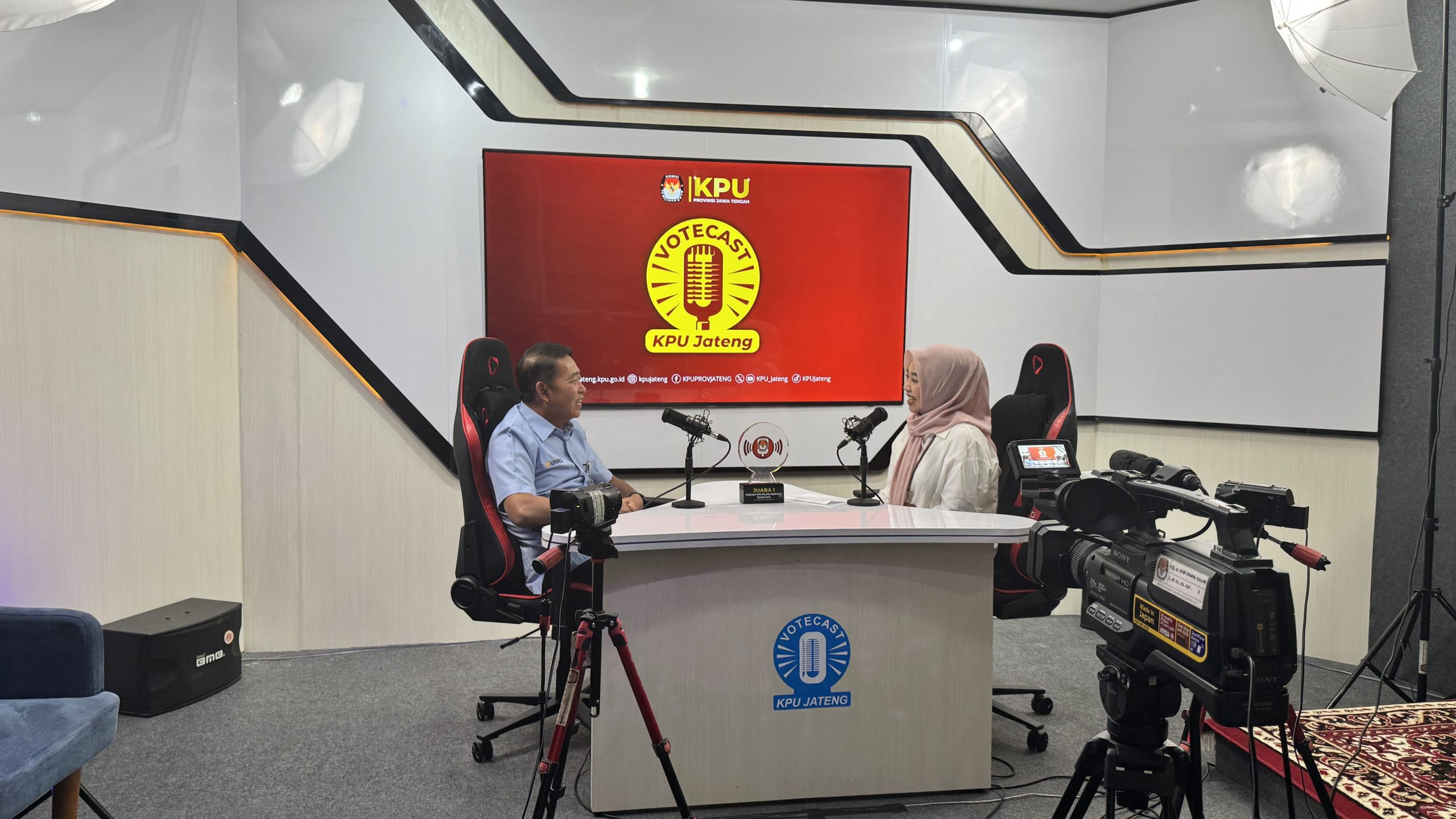
Semarang — Higher education institutions play a strategic role in shaping quality voters through political education, strengthening democratic literacy, and raising students’ awareness of the importance of participation in political life. This was conveyed by Prof. Dr. Ngabiyanto, M.Si., a Political Science lecturer and Vice Rector for Research, Innovation, and Information Systems (Vice Rector III) at Universitas Negeri Semarang (UNNES), during the Votecast podcast hosted by the General Elections Commission (KPU) of Central Java.
The podcast, which focused on the topic “The Role of Higher Education in Producing Quality Voters,” was held on Thursday, August 20, 2026, at the KPU Central Java Podcast Studio. Prof. Dr. Ngabiyanto, M.Si. participated as a guest speaker and discussed the contribution of higher education institutions to improving the quality of voters, particularly among the younger generation. The discussion was hosted by Nunung.
In his presentation, Prof. Dr. Ngabiyanto emphasized that higher education institutions do not merely function as educational institutions that produce academically qualified graduates. They also have a responsibility to develop citizens with political awareness who are capable of exercising their rights and fulfilling their responsibilities as voters.
According to him, university students are a strategic group in strengthening democracy because they are at a stage of developing critical thinking and have the ability to access and process diverse sources of information. Therefore, political education in higher education institutions should not be limited to understanding electoral processes. It should also develop students’ ability to evaluate information, understand public issues, and make political choices rationally and responsibly.
Prof. Dr. Ngabiyanto also highlighted the importance of digital literacy in shaping quality voters. The development of social media has made it easier for the public, particularly younger generations, to access political information. However, the rapid flow of information also presents challenges, including the spread of disinformation, misinformation, propaganda, and various forms of political content whose accuracy and credibility cannot always be guaranteed.
In this context, higher education institutions have an important role in equipping students with critical thinking skills so that they are not easily influenced by circulating political information. Students are expected to be able to verify information, understand different perspectives, and rely on credible sources before forming political opinions or making political decisions.
Furthermore, political education in higher education should encourage students to understand that the quality of democracy is determined not only by high voter turnout but also by the quality of political participation itself. Quality voters are those who understand their rights and responsibilities, possess adequate knowledge about the candidates and issues they are voting on, and are able to make choices based on rational and responsible considerations.
Through the involvement of higher education institutions, political education can be developed through various academic and non-academic activities, including Political Science courses, public discussions, seminars, research, community engagement, and collaboration with election management bodies. Such synergy is expected to strengthen the democratic ecosystem while improving the quality of political participation among the public.
Prof. Dr. Ngabiyanto’s participation in KPU Central Java’s Votecast is part of an effort to expand dialogue between higher education institutions and election management bodies. The forum provided an opportunity to exchange perspectives while strengthening a shared commitment to developing voters who are intelligent, critical, ethical, and responsible. Through this role, higher education institutions are expected to continue serving as an important pillar in building a healthy democratic culture. Sustainable political education, supported by digital literacy and critical thinking skills, is an essential foundation for developing a generation of voters capable of contributing to the strengthening of democracy in Indonesia.