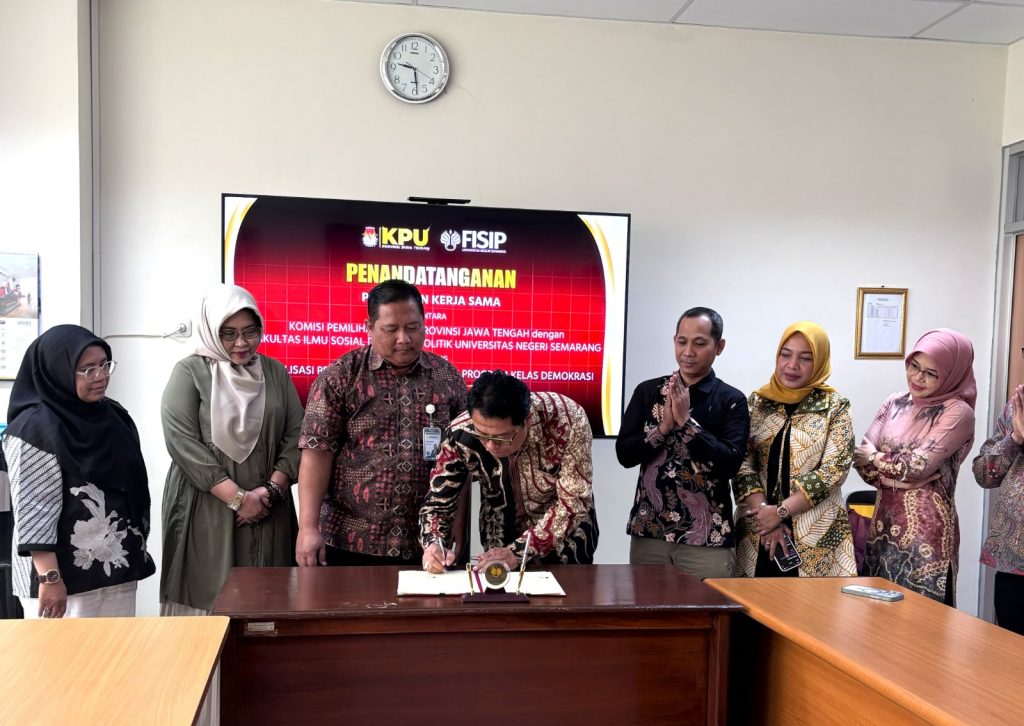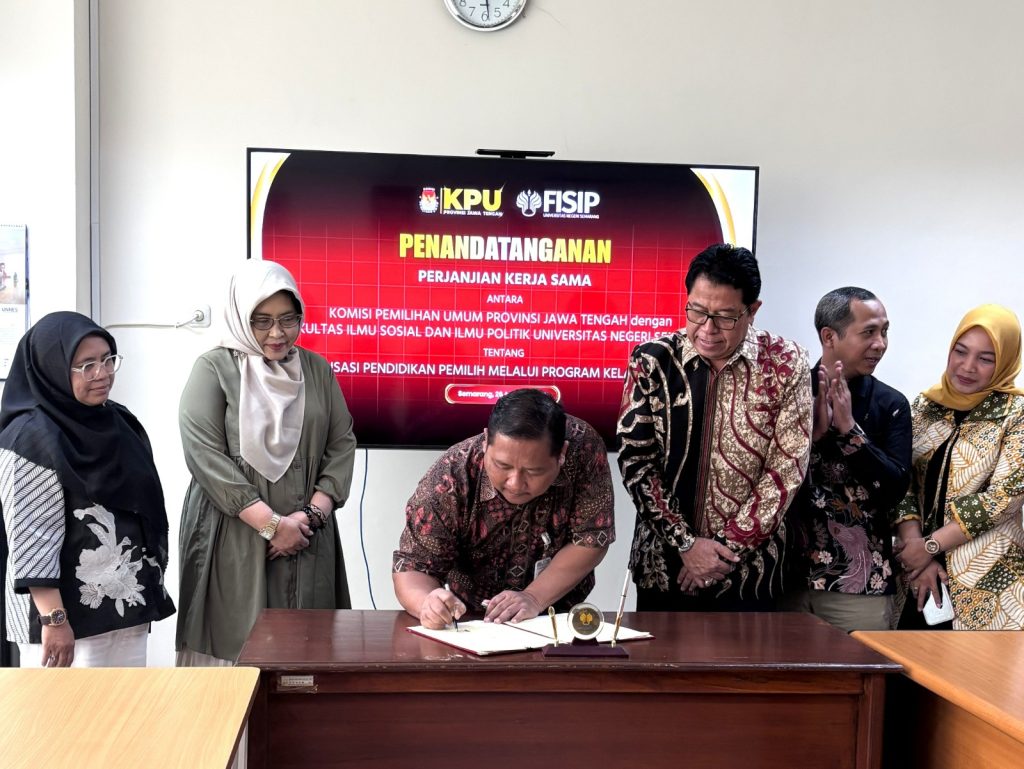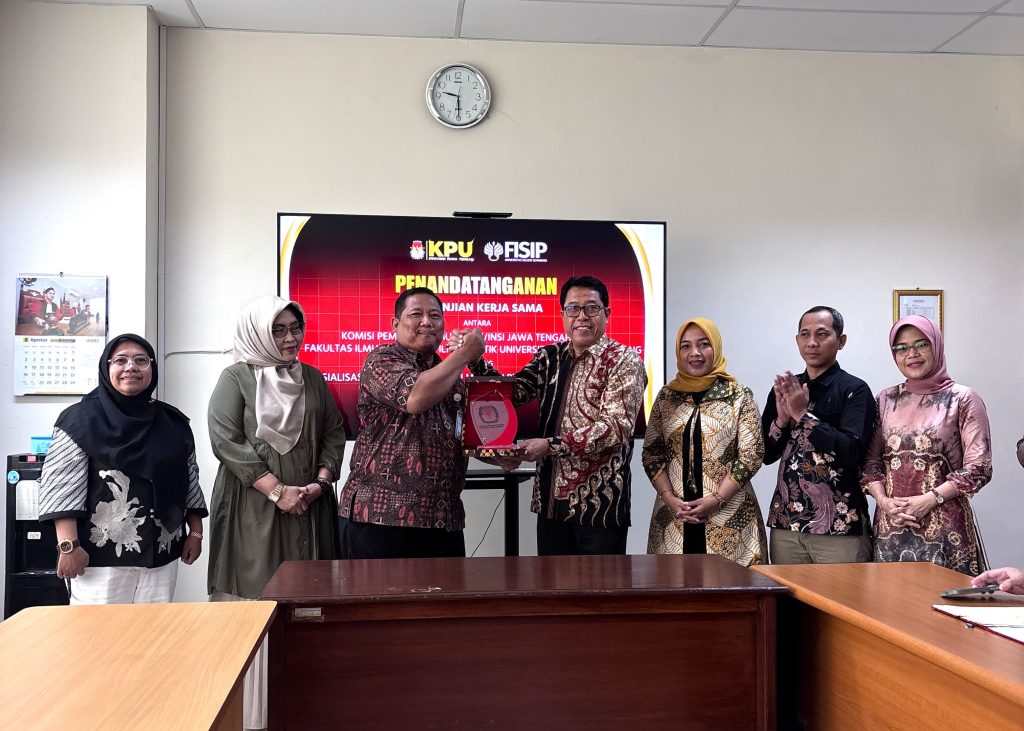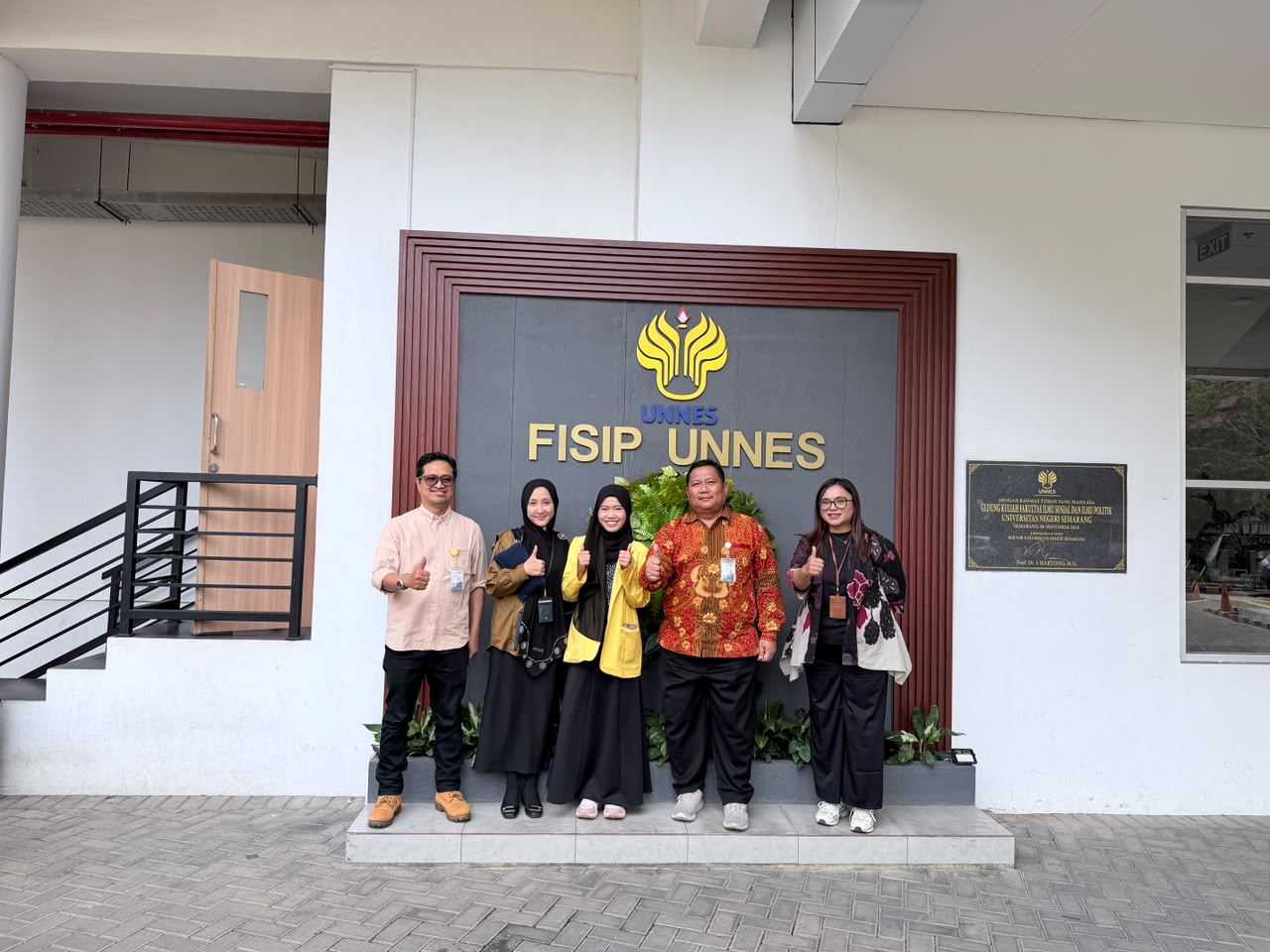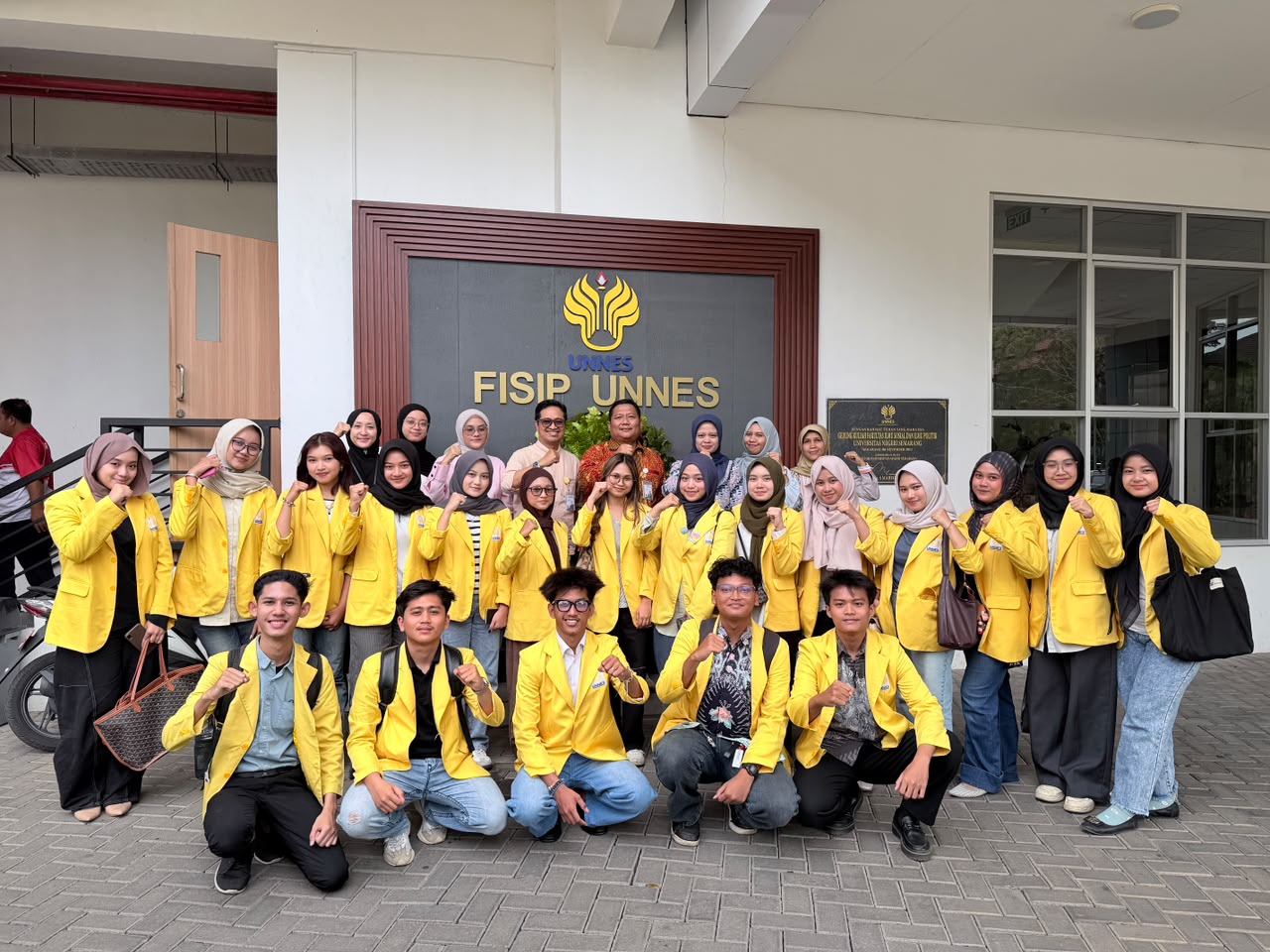


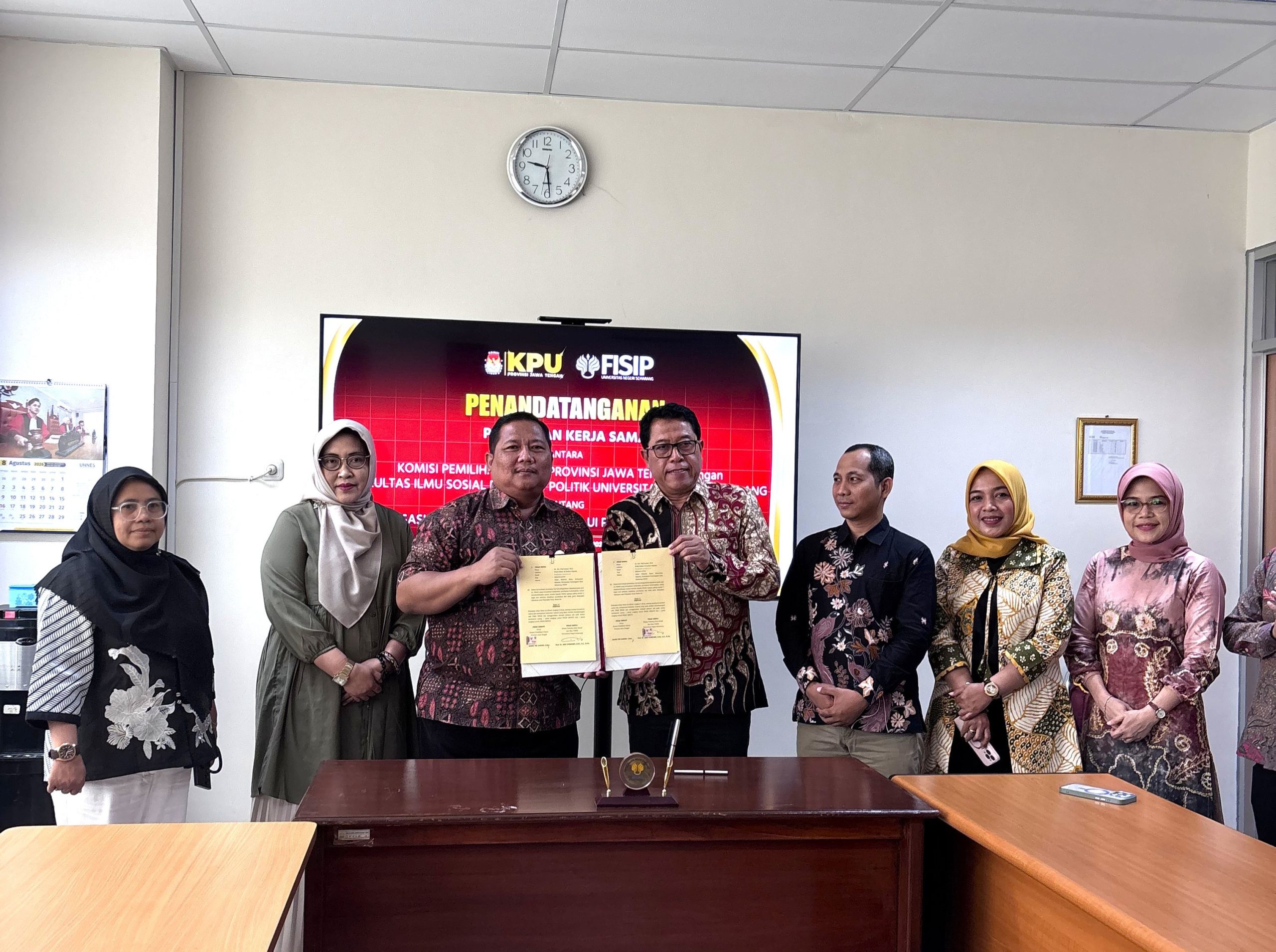
Semarang – The Faculty of Social and Political Sciences (FISIP) of Universitas Negeri Semarang (UNNES) has strengthened its commitment to improving democracy education and electoral literacy among students through a partnership with the General Elections Commission (KPU) of Central Java Province. The partnership was formalized through a Cooperation Agreement (PKS) on Voter Education Socialization through the 2026 Democracy Class Program, signed on Wednesday, August 26, 2026, in Semarang.
The agreement involves the Central Java Provincial KPU as the First Party and FISIP UNNES as the Second Party. The Central Java KPU was represented by its Chair, Handi Tri Ujiono, S.Sos., while FISIP UNNES was represented by its Dean, Prof. Dr. Arif Purnomo, S.Pd., S.S., M.Pd. The partnership follows up on a Memorandum of Understanding between UNNES and the General Elections Commission of the Republic of Indonesia concerning the implementation of the university’s Three Pillars of Higher Education (Tri Dharma Perguruan Tinggi) in the fields of elections and democracy education.
Through the Democracy Class Program, the two institutions have agreed to provide democracy education to FISIP UNNES students as young voters. The program is designed to improve students’ political knowledge, awareness, and participation while strengthening democracy education within the higher education environment. The partnership also serves as an effort to develop collaboration between higher education institutions and election management bodies as part of the implementation of the Three Pillars of Higher Education.
The scope of the partnership extends beyond the organization of Democracy Classes. According to the agreement, activities include electoral socialization and voter education, seminars, webinars and public discussions, provision of resource persons, student internships and research, as well as the development of information media and democracy literacy. The two parties may also conduct other mutually agreed activities as long as they comply with applicable regulations.
In its implementation, the Central Java KPU is responsible for providing voter education materials, assigning resource persons, facilitating publication materials, and providing support for the implementation of activities. Meanwhile, FISIP UNNES is responsible for providing schedules and venues, coordinating students as participants, supporting publication activities, and integrating the partnership’s programs into student activities.
The two parties also have flexibility in developing the programs. An implementation team may be established independently or jointly according to the needs and scope of the partnership. Each follow-up activity may be regulated through a derivative cooperation document or Implementation of Arrangement, which forms an integral part of the cooperation agreement. Joint activities may also be promoted through each institution’s social media platforms by displaying the logos of both parties.
The cooperation agreement will remain in effect for three years from the date of signing and may be extended based on mutual agreement. Regarding funding, the agreement stipulates that costs arising from the implementation of the partnership will be borne by the respective parties according to their duties, functions, and budgetary capacity, in accordance with applicable laws and regulations.
For FISIP UNNES, the partnership is strategically important because students constitute a significant segment of young voters who play an important role in the sustainability of democratic life. Through structured voter education, students are expected not only to understand electoral processes but also to develop the awareness to participate critically, responsibly, and based on adequate information.
The Democracy Class Program also provides broader learning opportunities for students. Participation in seminars, public discussions, research, internships, and the development of democracy literacy media enables students to gain direct experience of democratic practices and electoral processes. Thus, democracy education is not confined to classroom learning but is also developed through academic experiences and collaborative activities.
The cooperation between FISIP UNNES and the Central Java KPU also contributes to the achievement of the Sustainable Development Goals (SDGs). From an educational perspective, the program contributes to SDG 4: Quality Education, particularly by strengthening students’ knowledge, literacy, and competencies related to democracy and elections. Quality education not only develops academic capabilities but also equips students with the capacity to participate actively in social life.
The partnership is also strongly relevant to SDG 16: Peace, Justice and Strong Institutions, particularly in strengthening effective, accountable, and inclusive institutions and increasing public participation in decision-making processes. Voter education for students as young voters can serve as an important foundation for developing a healthy and participatory democratic culture.
Meanwhile, the collaboration between FISIP UNNES and the Central Java KPU directly reflects the spirit of SDG 17: Partnerships for the Goals. The partnership between a higher education institution and an election management body demonstrates the importance of institutional synergy in strengthening democracy education, expanding electoral literacy, and preparing young people to actively participate in democratic life.
Through the cooperation agreement, FISIP UNNES and the Central Java KPU have positioned democracy education as a continuous learning process. The Democracy Class Program is expected to provide students with a platform to strengthen their political knowledge, awareness, and participation while fostering a generation of young voters who are critical, responsible, and committed to integrity