

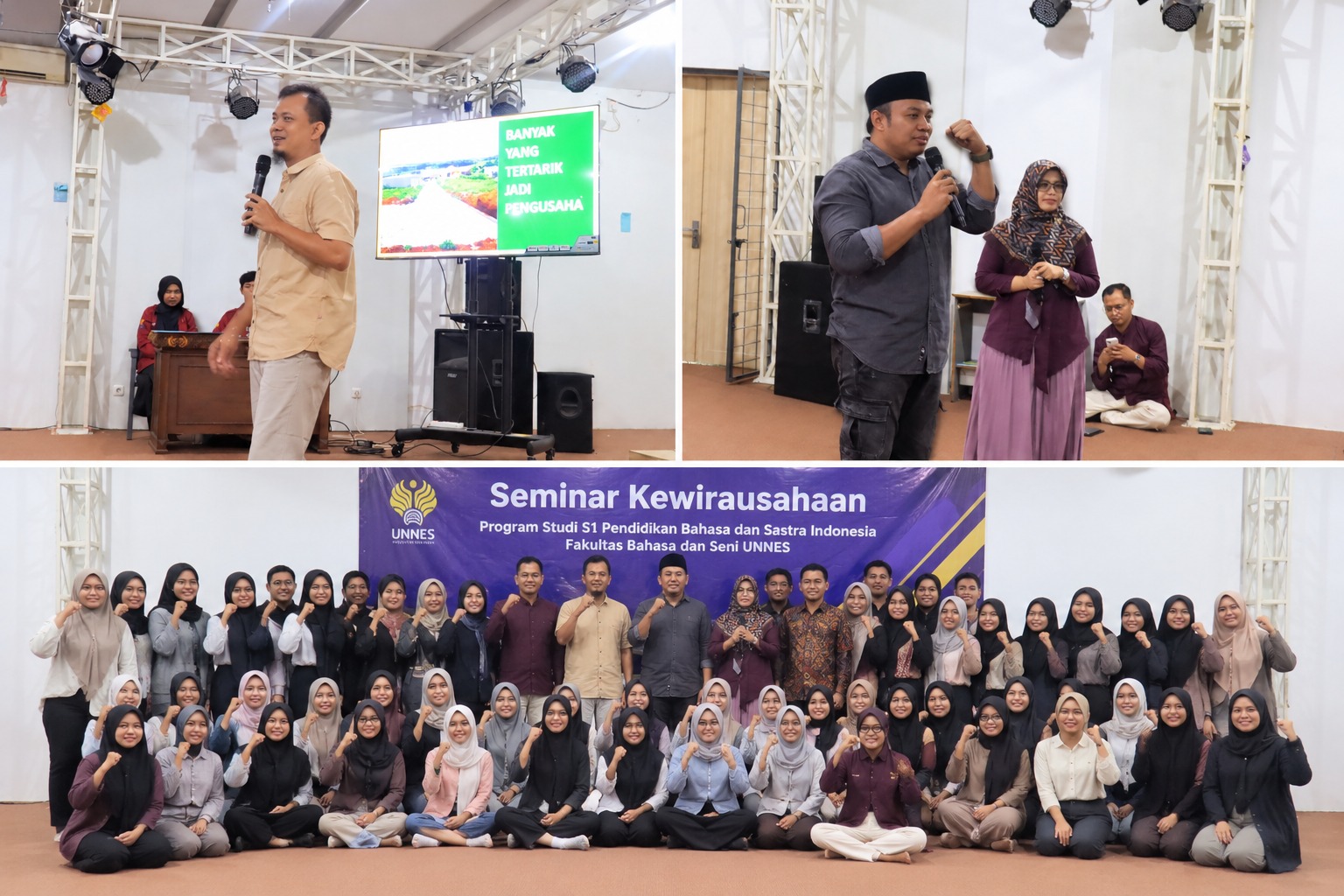
The Indonesian Language and Literature Education Study Program at the Faculty of Languages and Arts (FBS), Universitas Negeri Semarang (UNNES), held an entrepreneurship seminar on Wednesday, October 28, 2026, to strengthen students’ entrepreneurial mindset, creativity, and readiness to explore business opportunities in the creative economy.
Held in Room 106 of Building B1 at FBS UNNES, the seminar formed part of the Indonesian Language and Literature Entrepreneurship course. It brought together students from the 2024 cohort and two experienced business practitioners who shared practical insights into starting and developing a business.
The speakers were Rahmat Kurniadi, S.E., of Topland Property, and Silahuddin, S.Ag., owner of AJM and Serambi Alam Resto. The event was facilitated by course lecturers Diyamon Prasandha, S.Pd., M.Pd., and Dr. Uum Qomariyah, S.Pd., M.Hum.
Beginning at 1 p.m., the seminar featured presentations, an interactive question-and-answer session, and discussions that allowed students to explore the challenges and opportunities of entrepreneurship beyond the classroom.
The initiative reflected the study program’s efforts to connect academic knowledge with practical skills while encouraging students to recognize the entrepreneurial potential of their expertise in language, literature, literacy, and education.
Taking the First Step and Learning from Experienced Mentors
During his presentation, Rahmat Kurniadi emphasized that one of the greatest challenges aspiring entrepreneurs face is finding the courage to take their first step.
He encouraged students not to wait for ideal circumstances before launching a business, highlighting the importance of learning from experienced mentors and building professional relationships.
“You don’t need to wait for perfect conditions to become an entrepreneur. Just get started. If you want to succeed, you need a mentor. Learn from your mentor, partner with your mentor, and work alongside your mentor,” Rahmat said.
He stressed that mentorship can provide aspiring entrepreneurs with practical guidance, valuable experience, and a better understanding of the challenges involved in managing a business.
His message encouraged students to view entrepreneurship as a continuous learning process that requires initiative, adaptability, and a willingness to seek advice from those with greater experience.
Meanwhile, Silahuddin highlighted the importance of determination, self-confidence, and a positive mindset in developing entrepreneurial ambitions.
He explained that starting a business does not necessarily require substantial financial capital. A strong commitment, the willingness to learn, and confidence in one’s abilities can also play an important role in taking the first step.
Drawing on his personal experience, Silahuddin shared how positive self-affirmation had become part of his daily motivation. He encouraged students to develop confidence in their potential, using the phrase “I will succeed” as an example of maintaining an optimistic outlook.
Together, the two speakers offered complementary perspectives on entrepreneurship, combining the importance of practical action and mentorship with personal motivation and resilience.
Exploring Business Opportunities in Language, Literature, and Literacy
For students of Indonesian Language and Literature Education, entrepreneurship offers opportunities that extend beyond conventional business activities.
Their academic competencies in language, literature, communication, literacy, and education can provide a foundation for developing products and services with commercial and social value.
Potential opportunities include creative writing services, manuscript editing, publishing, digital content development, literacy programs, and educational products based on Indonesian language and literature.
Students with strong writing skills, for example, may explore opportunities in content production, editing, and publishing. Those specializing in language education can develop innovative teaching materials, literacy resources, and educational services.
As Indonesia’s creative economy continues to evolve, digital platforms also offer new opportunities for language and literature graduates to transform their academic expertise into entrepreneurial ventures.
The seminar encouraged students to recognize that knowledge acquired during their studies can be applied beyond traditional career pathways, including teaching and academic research.
By identifying community needs and developing relevant products or services, students can use their disciplinary knowledge to create economic opportunities while contributing to education and literacy development.
Celebrating Youth Pledge Day and Language and Arts Month 2026
The seminar held particular significance as it coincided with Indonesia’s Youth Pledge Day, commemorated annually on October 28, and took place during FBS UNNES’s Language and Arts Month 2026 celebrations.
The occasion connected the spirit of youth empowerment and national identity with the importance of creativity, independence, and entrepreneurship among university students.
While Youth Pledge Day is closely associated with Indonesia’s national unity and the recognition of Indonesian as a unifying language, its spirit also provides an opportunity to encourage younger generations to take initiative and contribute meaningfully to society.
In this context, entrepreneurship represents more than the buying and selling of products. It involves recognizing opportunities, responding to community needs, developing innovative ideas, and creating added value.
For Indonesian Language and Literature Education students, entrepreneurial thinking can help bridge the gap between academic learning and the practical application of linguistic, literary, and educational competencies.
The seminar therefore provided an opportunity to connect the celebration of language and national identity with the development of skills needed for professional independence and participation in the creative economy.
Connecting Classroom Learning with Professional Experience
The entrepreneurship seminar demonstrated the value of contextual learning by bringing business practitioners into the university classroom.
Through the experiences shared by professionals from the property and culinary sectors, students gained perspectives on business development, decision-making, personal motivation, and the importance of professional networks.
Although the speakers represented industries outside the students’ primary academic discipline, their insights offered broader lessons that could be applied to entrepreneurial initiatives in language, literature, and education.
The interactive discussion also encouraged students to reflect on their interests and consider how their knowledge and abilities might be developed into viable business ideas.
The event concluded with the presentation of certificates and tokens of appreciation to the speakers in recognition of their contributions to students’ learning experiences.
Through such activities, the study program seeks to complement theoretical instruction with practical exposure to professional challenges and opportunities.
Supporting Quality Education and Creative Economic Development
The seminar also aligned with FBS UNNES’s commitment to advancing the United Nations Sustainable Development Goals (SDGs), particularly SDG 4 (Quality Education) and SDG 8 (Decent Work and Economic Growth).
Its contribution to SDG 4 was reflected in the provision of experiential learning opportunities that connected students with business practitioners and strengthened their understanding of entrepreneurship.
By engaging directly with experienced entrepreneurs, students were encouraged to develop creativity, initiative, problem-solving skills, and a greater awareness of professional opportunities.
The event also supported SDG 8 by promoting entrepreneurial awareness and introducing potential pathways for self-employment and business development, particularly in language-based services, literacy, publishing, and the creative industries.
Through the seminar, the Indonesian Language and Literature Education Study Program at FBS UNNES reaffirmed its commitment to preparing graduates who possess not only academic and pedagogical competencies but also the creativity, independence, and adaptability needed in a changing professional environment.
The knowledge and experiences shared by the speakers are expected to inspire students to explore innovative business ideas, develop their entrepreneurial potential, and create meaningful contributions to society through their expertise in language, literature, and education.