

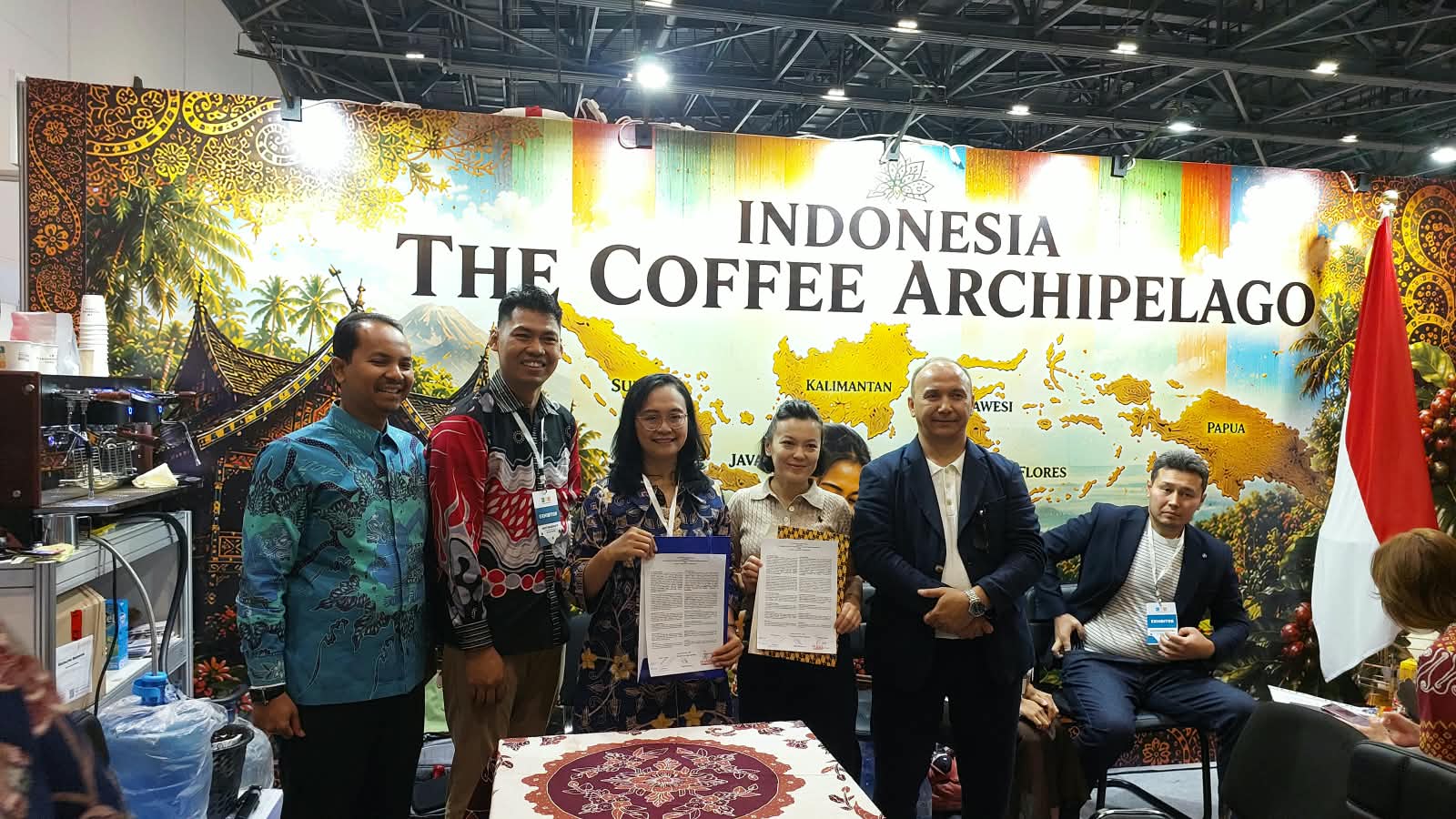
ASTANA, KAZAKHSTAN – Universitas Negeri Semarang (UNNES) is strengthening the global reach of its research and innovation through the participation of its Center of Excellence for Coffee and Spice Postharvest Technology (PUI-PT Co-Spice) and Nestra Kottama Indonesia in the Astana Coffee Expo 2026, held from September 3 to 5, 2026, at the EXPO International Exhibition Center in Astana, Kazakhstan.
Facilitated by the Embassy of the Republic of Indonesia in Astana, the participation forms part of broader efforts to strengthen economic diplomacy, accelerate the commercialization of university research, and open international market access for Indonesian innovation-driven products.
Bringing the spirit of “from academic research to global market,” Co-Spice UNNES showcased how university research can move beyond laboratories and academic publications to engage directly with consumers, industries, and potential international partners.
Astana Coffee Expo brings together coffee industry players, roasters, importers, HoReCa businesses, raw-material suppliers, and prospective partners from Kazakhstan and across Central Asia. Alongside the exhibition, the event features business programs, cupping sessions, workshops, and professional networking activities, creating opportunities for Indonesian products to gain direct exposure to regional market actors.
From Research to the Global Market
At the expo, Co-Spice UNNES introduced Indonesian coffee and spice-based products, including innovations in the growing wellness beverage segment.
Rather than serving merely as exhibition products, the innovations were also used to gather market responses and explore the organoleptic preferences of Kazakh consumers. Feedback covered several attributes, including taste, aroma, color, bitterness, sweetness, and overall consumer acceptance of coffee and spice-based beverages.
The findings will provide valuable input for further refinement of product formulations, flavor profiles, packaging, market positioning, and marketing strategies before broader expansion into the Eurasian market.
This approach places research commercialization within a continuous cycle, beginning with research and product development, followed by consumer validation and market adaptation, and eventually moving toward commercialization.
The initiative particularly contributes to Sustainable Development Goal (SDG) 9: Industry, Innovation and Infrastructure by demonstrating how research-based innovation can be connected with industrial development and international markets. Cross-sector collaboration behind the initiative also reflects SDG 17: Partnerships for the Goals, bringing together academia, business, government, communities, and international partners.
Around 100 Indonesian Spices Showcased Virtually
Indonesia’s rich spice heritage was also presented through digital innovation.
Co-Spice, together with Nestra Indonesia, Politeknik Sains Seni Rekakreasi, and the Indonesian Ministry of Industry, introduced Virtual Rempah Indonesia, a digital gallery featuring around 100 varieties of Indonesian spices.
The virtual gallery presents Indonesian spices as more than trade commodities. It highlights their place within Indonesia’s biodiversity, traditional knowledge, culture, gastronomy, and growing potential for nature-based innovation.
Through an interactive digital platform, international visitors can explore the diversity of Indonesian spices while discovering their potential applications across food and beverages, wellness products, cosmetics, gastronomy, and other nature-based industries.
The initiative also resonates with SDG 12: Responsible Consumption and Production and SDG 15: Life on Land, particularly through efforts to transform biodiversity resources into knowledge-based and value-added innovations while keeping sustainability within the broader development agenda.
Two Letters of Intent Mark a Step Toward Commercial Cooperation
One of the strategic outcomes of Co-Spice UNNES and Nestra Indonesia’s participation in Astana Coffee Expo 2026 was the signing of two Letters of Intent (LoIs) for potential coffee and spice export cooperation with Jibek Joly Co LPP and Navien-Turkestan.
The LoIs mark an initial step toward more concrete commercial partnerships. Further discussions are expected to address product specifications and standardization, quality testing, volume and pricing, packaging, certification requirements, and eventually the possibility of export contracts.
The achievement demonstrates how university-based innovation can find pathways into global value chains when research is supported by collaboration among academic institutions, businesses, government, communities, and international partners.
It also illustrates a wider shift in the role of university research. Knowledge does not necessarily end with a scientific publication or prototype. When connected to industry and market ecosystems, research can travel further, becoming a product, meeting consumers, and generating new knowledge through market feedback.
ABCG Collaboration Strengthens the Innovation Ecosystem
Indonesian Ambassador to Kazakhstan and Tajikistan Dr. M. Fadjroel Rachman welcomed the achievement of Co-Spice UNNES and Nestra Kottama Indonesia, highlighting the importance of the ABCG model, comprising Academic, Business, Community, and Government, in bringing Indonesian innovations to international markets.
“ABCG synergy is the key to realizing from academic research to global market,” he said.
Within this collaborative model, universities serve as sources of knowledge and innovation, businesses drive downstream development and commercialization, communities act as users while providing valuable feedback, and governments help create an enabling ecosystem and facilitate international market access.
Such collaboration is particularly relevant to the coffee and spice sector. Competing in global markets requires more than production capacity. Product quality, standardization, innovation, consumer insight, postharvest technology, branding, and international trade networks are increasingly intertwined.
Kazakhstan as a Gateway to Wider Eurasian Networks
Building partnerships in Kazakhstan also carries strategic significance for Indonesia’s efforts to diversify its international markets.
Kazakhstan is one of the five members of the Eurasian Economic Union (EAEU), alongside Armenia, Belarus, Kyrgyzstan, and Russia. Its position therefore offers opportunities for Indonesia to explore broader networks for coffee, spices, and wellness beverages across the Eurasian region.
The strategy may also help Indonesian coffee and spices move beyond conventional commodity trade. Through research and innovation, these resources can be transformed into higher-value products that combine postharvest technology, branding, wellness, gastronomy, and Indonesia’s cultural heritage.
Turning Research into Economic Diplomacy
Head of the PUI-PT Center for Coffee and Spice Postharvest Technology (Co-Spice) UNNES, Dr. Eka Yuli Astuti, said participation in Astana Coffee Expo 2026 demonstrated how university research could generate economic value while contributing to Indonesia’s broader economic diplomacy.
“We want to build an ecosystem that moves from research to product, from product to market, and from market to global commercialization. Indonesian coffee and spices are not merely commodities. They also carry knowledge, culture, innovation, and health values that can become part of Indonesia’s economic diplomacy,” she said.
According to Dr. Astuti, feedback from Kazakh consumers will provide important insights for refining the products before their potential expansion into wider Eurasian markets.
Looking ahead, Co-Spice UNNES and Nestra Kottama Indonesia plan to develop Indonesia Coffee & Spices Wellness Innovation, a platform designed to integrate research, product innovation, sustainable agriculture, wellness, gastronomic diplomacy, and international trade.
The participation in Astana Coffee Expo 2026 ultimately tells a larger story about how knowledge can travel. Research generates innovation, innovation encounters consumers, and market responses return to the university as new knowledge for further development.
With two LoIs secured and around 100 Indonesian spices introduced through Virtual Rempah Indonesia, the expo marks another step in connecting research to product, product to market, and market to global commercialization.
From Astana, Indonesia brought more than coffee and spices to the international stage. It brought its biodiversity, knowledge, culture, innovation, and collaborative spirit, opening new possibilities for Indonesian research-based products in the Eurasian market.