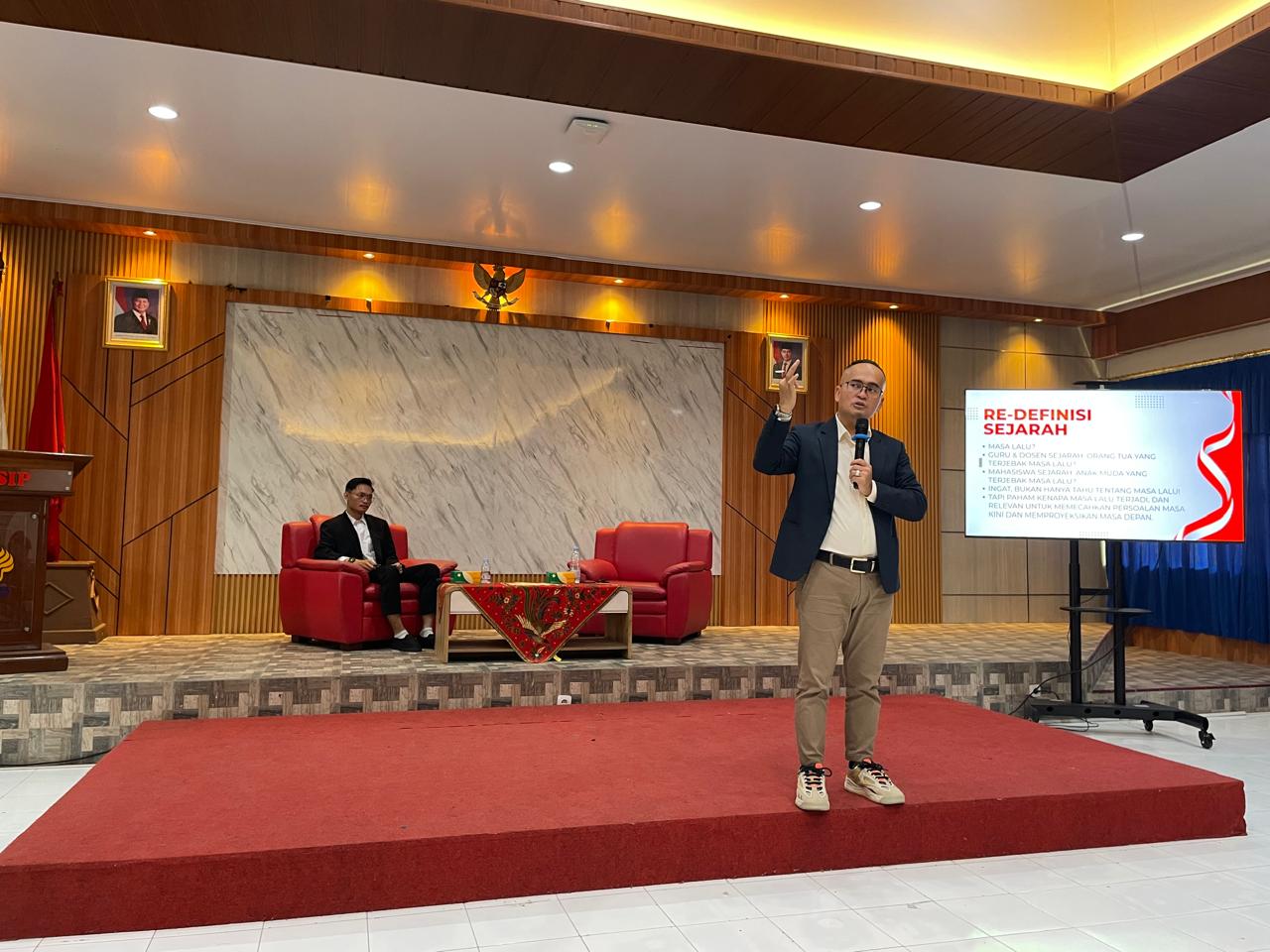


Four days before the start of the new academic semester, the Faculty of Social and Political Sciences (FISIP) of Universitas Negeri Semarang (UNNES) equipped its lecturers and administrative staff with skills in utilizing artificial intelligence (AI).
The training, held on August 12, 2026, on the fifth floor of the FISIP Building in Sekaran, Gunungpati, Semarang, was attended by approximately 90 participants. Of these, 60 were lecturers and 30 were administrative staff.
The training was designed not merely to introduce AI, but also to demonstrate how the technology can be utilized to support academic and administrative work, as well as the development of teaching materials. Through this approach, lecturers are expected to reduce the amount of time spent on administrative tasks.
Vice Dean for Academic and Student Affairs of FISIP UNNES, Fadly Husain, said that AI should be understood as a tool that can make the work of lecturers and administrative staff easier. “AI can serve as a technology-based tool to facilitate the learning process,” Fadly said during the training.
According to him, improving AI literacy is increasingly important as the needs of higher education continue to evolve. Lecturers should not merely be aware of the existence of AI but also understand how to use it appropriately to support their academic responsibilities.
In the Gemini Academy for Faculty materials used as one of the references for the training, AI is positioned as a partner that helps enhance human focus, capacity, and understanding rather than as a replacement for human expertise.
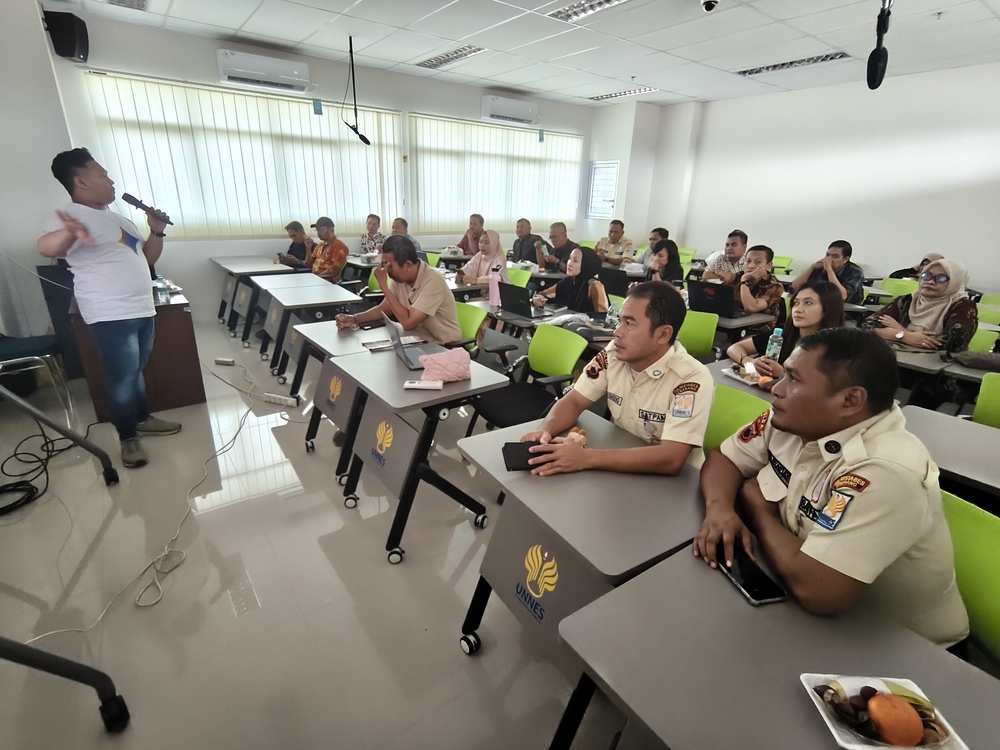
For lecturers, one of the areas in which AI can provide assistance is administrative work. Preparing documents, processing information, drafting materials, and handling various academic communication needs often require additional time beyond lecturers’ primary teaching responsibilities.
The use of AI is expected to make such tasks more efficient. The training materials explained that Gemini can help teaching staff become more productive by creating presentations, writing emails, generating images for slides, preparing drafts of course materials, and designing discussion questions aligned with learning objectives.
With such assistance, lecturers remain responsible for determining the substance and quality of their work. AI is used to accelerate initial processes, develop ideas, organize structures, or generate alternatives, which are then reviewed and adapted by the lecturers.
Prof. Tjaturahono Budi Sanjoto said that AI also provides opportunities for lecturers to explore course materials more extensively before developing them into presentation materials. “AI can help explore course materials and then develop them into PowerPoint presentations and learning resources. It can also provide benefits in supporting lecturers’ work, including their BKD requirements,” he said.
According to Tjaturahono, training programs of this kind are important for broadening perspectives and improving AI literacy among members of the academic community. Technological developments require lecturers to gain new insights so that they can adapt their teaching to students’ changing needs.
One of the features introduced during the training was Gemini Canvas. The feature provides an interactive workspace that allows users to transform prompts into materials or documents that can be edited and developed directly. Canvas can be used to create document drafts, lesson plans, study guides, quizzes, and flashcards. The results can also be exported to Google Docs for further development or sharing.
For lecturers, Canvas can be one way to reduce repetitive tasks. For example, when lecturers already have an idea or basic teaching materials, those materials can be developed into a structured lesson, learning guide, or supporting document without having to start from a blank page every time.
The feature can also be used to make teaching materials more engaging. Lecturers can ask AI to develop existing materials and then edit the style, length, format, and content before using them in the learning process.
Learning Consultant at REFO, Theofilus Lewi Yosafat, who served as one of the training speakers, said that participants were also introduced to AI’s ability to transform basic materials into content that is more ready for use. “Basic materials can be uploaded to Gemini and then developed into ready-to-use materials using specific prompts,” Theofilus said.
According to him, AI skills are ultimately not limited to the ability to generate text. The technology can also serve as a thinking partner for lecturers when designing more interactive and engaging learning experiences. “AI can help accelerate administrative work related to teaching while also serving as a thinking partner for lecturers in developing interactive and engaging learning,” he said.
In addition to Canvas, participants were introduced to the Guided Learning feature. This feature takes a different approach from a chatbot that simply provides answers. Guided Learning is designed to build deeper understanding through open-ended questions, discussion, and a gradual thinking process.
During the process, Gemini does not immediately provide an instant answer. Instead, it first explains the basic concepts and then poses questions that encourage users to engage in discussion and critical thinking.
For lecturers, this approach can serve as an alternative way of supporting students in independent learning. AI is not intended to replace students’ thinking processes but rather to help them understand learning materials through a more structured sequence of learning activities.
The training also emphasized that AI must be used critically. The Gemini Academy materials remind users that generative AI can produce inaccurate information, meaning that its responses still need to be checked and verified.
Therefore, the use of AI in academic settings goes beyond the ability to create effective prompts. Lecturers are still required to verify the accuracy of information, adapt AI-generated outputs to the learning context, and consider ethical aspects and academic integrity.
With the new academic semester scheduled to begin on August 18, 2026, the training is expected to serve as one of FISIP UNNES’s efforts to prepare lecturers for work and learning environments that are increasingly intertwined with AI technology.
For lecturers, the ultimate goal is not simply to work faster. AI is expected to help reduce the burden of administrative tasks so that more attention and energy can be directed toward the core responsibilities of the teaching profession: preparing learning materials, designing meaningful learning experiences, interacting with students, and ensuring that the learning process remains purposeful and impactful.