

The cultural diversity found along the border between Central Java and West Java became the starting point of Didik Tri Setiyoko’s doctoral research. Drawing inspiration from the socio-cultural realities of the Javanese-Sundanese (Jasun) community in Brebes Regency, Didik developed a multicultural educational comic as an instructional medium designed to cultivate tolerance among elementary school students from an early age.
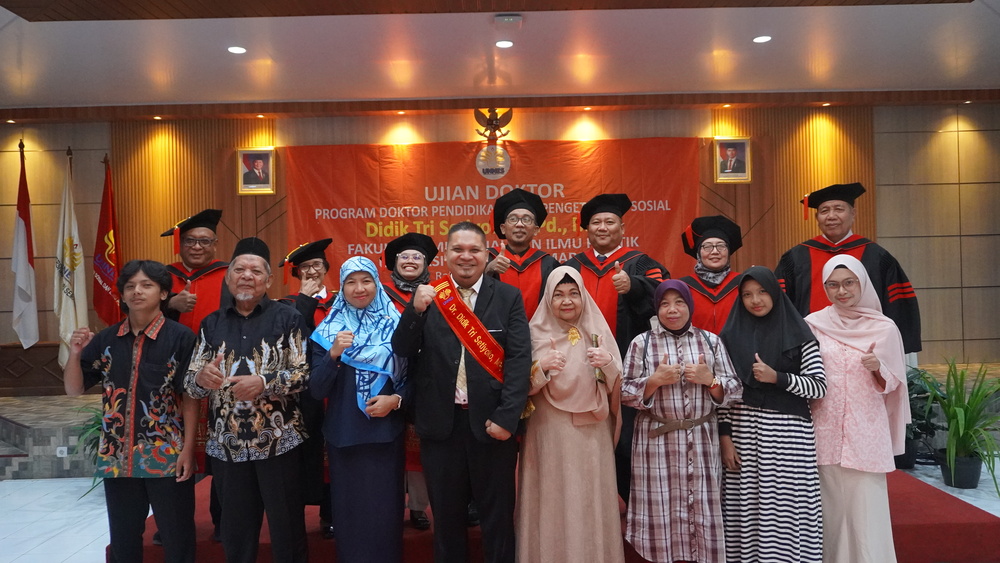
The research earned him a Doctorate in Social Studies Education (PIPS) from the Faculty of Social and Political Sciences (FISIP), Universitas Negeri Semarang (UNNES). During his doctoral defense, Didik successfully defended his dissertation entitled “The Development of Multicultural Educational Comics for the Javanese-Sundanese (Jasun) Community in Elementary Schools to Foster Students’ Tolerance.”
The study was motivated by the finding that elementary schools in border areas still face a shortage of instructional materials capable of representing local cultural diversity while simultaneously instilling values of tolerance among students. Didik explained that comics were chosen not merely as a form of entertainment but as a learning medium that is engaging, accessible, and closely connected to children’s everyday experiences. He presented his findings on Wednesday, August 5, at the FISIP Auditorium, Sekaran Campus, Gunungpati, Semarang.
The comic’s storyline, illustrations, and dialogues were carefully designed to portray the harmonious interactions between Javanese and Sundanese communities living side by side, allowing students to experience cultural diversity through authentic and contextual narratives. Local wisdom values—including unggah-ungguh (Javanese etiquette), sabilulungan (Sundanese spirit of mutual cooperation), gotong royong (collective collaboration), and mutual respect—serve as the foundation of the story.
The comic features characters from different cultural backgrounds to represent the everyday life of the Jasun community. Through the interactions among these characters, students are encouraged to understand that differences in language, family traditions, and cultural practices are not sources of conflict but valuable social assets that strengthen unity and social cohesion.
The instructional approach was developed based on Albert Bandura’s Social Learning Theory, which emphasizes learning through observing the behaviors of role models. The findings revealed that the use of multicultural educational comics significantly improved students’ attitudes toward tolerance.
Students who learned using the comic demonstrated an increase in their average tolerance score from 29.57 to 34.80. In contrast, students who received conventional instruction showed only a modest improvement, from 29.37 to 30.73. These findings indicate that culturally responsive learning media rooted in local wisdom can make a meaningful contribution to students’ character development.
Chair of the Examination Committee, Prof. Heri Cahyono, provided several recommendations for further refining the comic. He acknowledged that the integration of cultural values throughout the storyline constituted one of the study’s greatest strengths but suggested that the characters could be further enriched to reinforce their cultural identities.
According to Prof. Heri, the main characters, Sekar and Wira, should exhibit stronger cultural representations through symbolic costumes, language use, and family backgrounds reflecting different cultural traditions. He also recommended that the supporting characters display more exemplary attitudes so they could serve as stronger role models for elementary school students.
Prof. Heri additionally addressed the selection of fifth-grade elementary students as the research participants. The researcher explained that this grade level was chosen because it provided parallel classes, making it feasible to conduct an experimental study involving both treatment and comparison groups.
At the conclusion of the defense, Didik was officially awarded the degree of Doctor of Social Studies Education. He became the 15th doctoral graduate of the Doctoral Program in Social Studies Education (PIPS), FISIP UNNES, completing his studies within three years and eleven months. His dissertation received an A grade, and he graduated with a Grade Point Average (GPA) of 3.60.
His supervisor, Prof. Eva Banowati, expressed her appreciation for Didik’s dedication throughout his doctoral journey. She highlighted his enthusiasm for learning, discipline in following academic guidance, and perseverance in regularly traveling between Brebes and Semarang as clear evidence of his commitment to completing the research.
“Throughout the supervision process, Didik consistently demonstrated remarkable enthusiasm for learning. His determination to travel back and forth between Brebes and Semarang reflects his genuine commitment as a lifelong learner. I hope this passion for learning continues to guide him even after earning his doctoral degree,” Prof. Eva stated.
This research aligns closely with the United Nations Sustainable Development Goals (SDGs), particularly SDG 4 (Quality Education) by developing inclusive, contextual, and culturally responsive learning media, and SDG 16 (Peace, Justice, and Strong Institutions) by fostering tolerance, respect for diversity, and a culture of peaceful coexistence from an early age. Through educational materials grounded in local wisdom, the multicultural comic is expected to serve as a meaningful foundation for nurturing future generations capable of living harmoniously within Indonesia’s diverse and multicultural society.