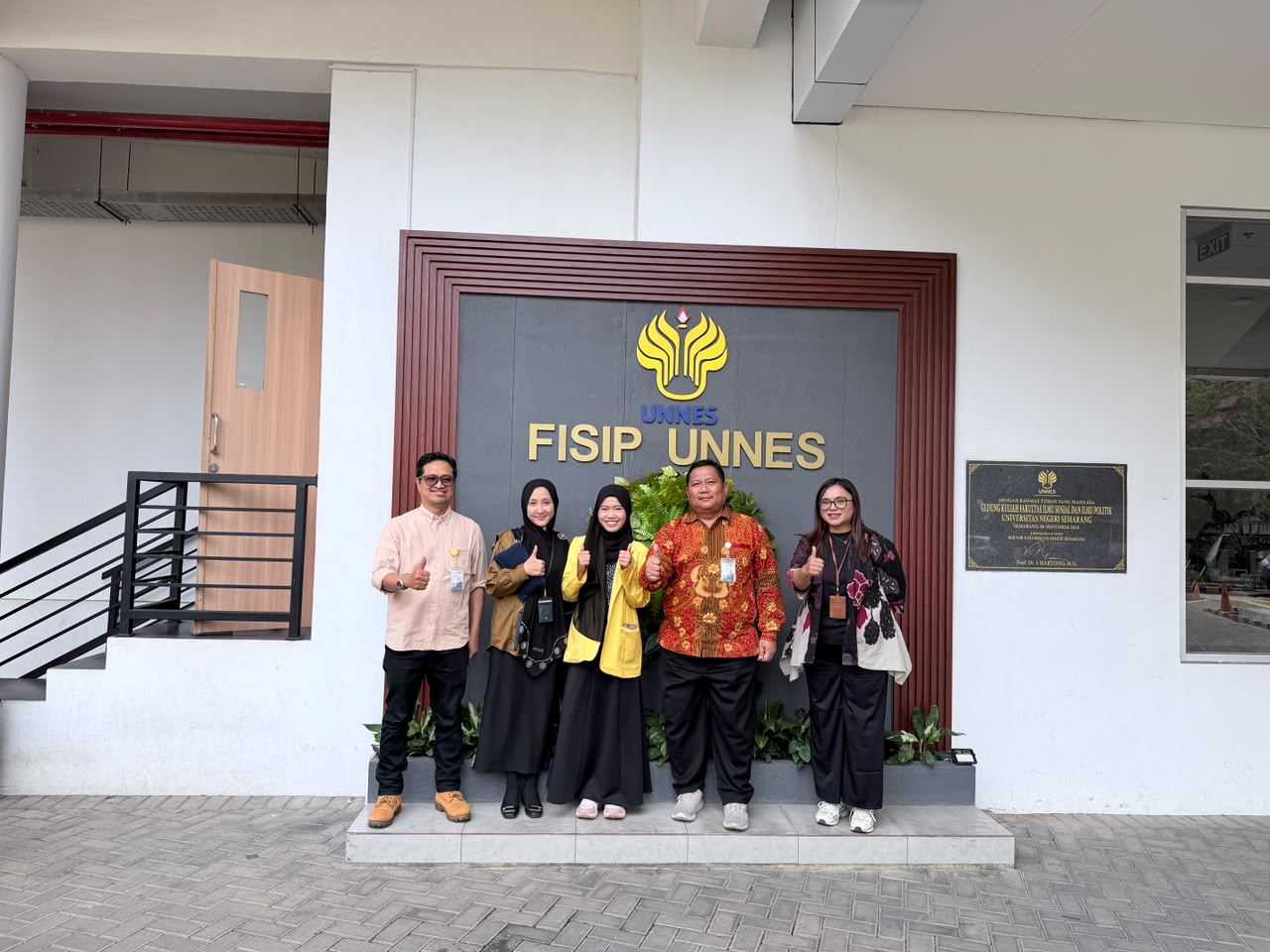


Surakarta – Students from the Faculty of Social and Political Sciences (FISIP), Universitas Negeri Semarang (UNNES), have once again earned a remarkable national achievement. A team from the Sociology and Anthropology Education Study Program consisting of Hilma Dzafira, Jumiati, and Decelsa Gracia Septigita Gaho won Second Place in the Scientific Paper Competition with their research entitled “TRASA: An Interactive Micro-Drama Animation Based on Choice-Driven Storytelling to Enhance Generation Z’s Mental Health Literacy.” The award was presented during the National Student Competition of the Indonesian Association of Sociology and Anthropology Education Study Programs (APPSANTI) x CARVENOS 2026.
The winners were announced on Saturday, August 1, 2026, as part of the National Working Meeting of the Indonesian Association of Sociology and Anthropology Education Study Programs (APPSANTI) held at the Faculty of Teacher Training and Education (FKIP), Universitas Sebelas Maret (UNS), Surakarta. The competition brought together students from Sociology and Anthropology Education programs across Indonesia to present innovative scientific ideas offering practical solutions to contemporary social issues.
Through their scientific paper, TRASA, the team introduced an innovative educational medium in the form of an interactive micro-drama animation utilizing a choice-driven storytelling approach. This interactive narrative model allows users to make decisions throughout the storyline and experience the consequences of each choice. The innovation was specifically designed to improve Generation Z’s mental health literacy by delivering educational messages in a more engaging, participatory, and contextually relevant manner.
The achievement was accomplished under the supervision of Eka Yuniati, S.Pd., M.A., who guided the students throughout the research process, from developing the initial concept and preparing the scientific manuscript to refining its academic substance and presentation. Her mentorship reflects the Sociology and Anthropology Education Study Program’s commitment to encouraging students to develop research-based innovations capable of addressing contemporary social challenges.
Eka Yuniati expressed her appreciation for the team’s dedication and creativity throughout the competition. According to her, the achievement demonstrates that students are capable of integrating perspectives from sociology, education, and digital technology to develop innovative solutions to mental health issues, which have become increasingly significant among today’s younger generation.
“This achievement proves that our students are capable of producing scientific ideas that are not only academically rigorous but also highly relevant to society’s needs. I hope this accomplishment inspires other students to continue conducting research, innovating, and contributing meaningful solutions through scholarly work,” she said.
This success further strengthens the culture of academic excellence, research, innovation, and social responsibility within FISIP UNNES. Beyond bringing pride to the Sociology and Anthropology Education Study Program, the achievement demonstrates that UNNES students are highly competitive at the national level by combining creativity, technology, and social science perspectives to address real-world challenges.
The achievement is also aligned with Universitas Negeri Semarang’s commitment to supporting the Sustainable Development Goals (SDGs). The TRASA innovation contributes directly to SDG 3 (Good Health and Well-being) by promoting mental health literacy among Generation Z. It also supports SDG 4 (Quality Education) through the development of creative, interactive, technology-based learning media, and SDG 9 (Industry, Innovation and Infrastructure) by advancing digital innovation in education. Furthermore, the collaboration among the students, their academic supervisor, and APPSANTI reflects the implementation of SDG 17 (Partnerships for the Goals) by strengthening national academic networks that encourage research and innovation to address sustainable development challenges. Through this achievement, FISIP UNNES students have once again demonstrated that the integration of social sciences, technology, and creativity can generate innovative solutions that create meaningful and lasting benefits for society.