

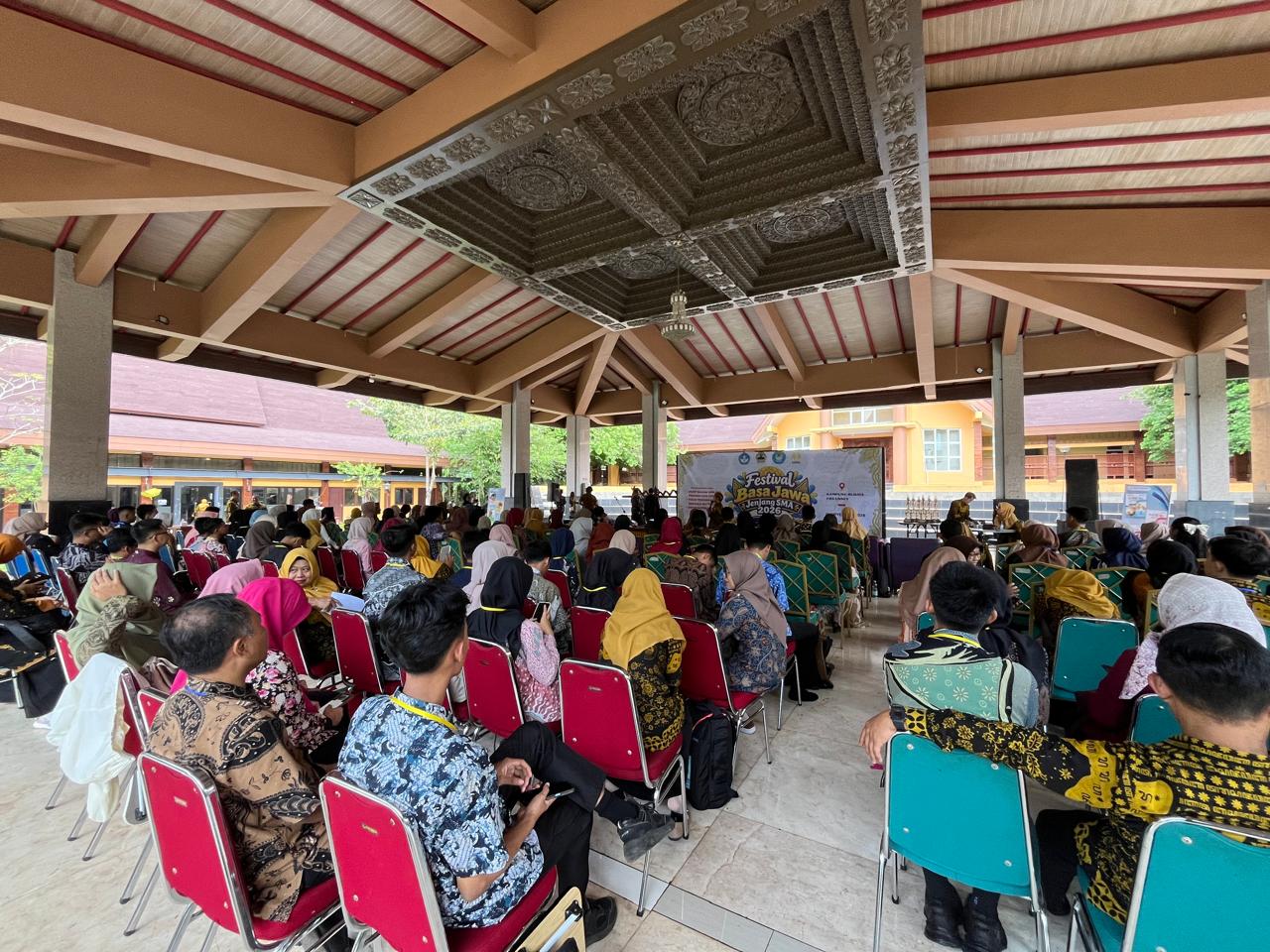
The Central Java Senior High School Javanese Language Teachers’ Association (MGMP), in collaboration with the Javanese Language and Literature Education and Javanese Literature Study Programs at the Faculty of Languages and Arts (FBS), Universitas Negeri Semarang (UNNES), held the 2026 Central Java Senior High School Javanese Language Festival (Festival Basa Jawa) on Thursday, November 19, 2026.
Held at the FBS UNNES Cultural Village (Kampung Budaya), the inaugural festival brought together 62 high school students representing districts and cities across Central Java. The event aimed to strengthen Javanese language proficiency, encourage younger generations to appreciate their cultural heritage, and support the preservation of regional languages amid ongoing social and cultural change.
The festival featured two competition categories: Maos lan Nyerat Aksara Jawa (Reading and Writing Javanese Script) and Sesorah (Javanese Public Speaking), each attracting 31 participants.
Dressed in traditional batik attire, the students participated enthusiastically in the competitions held around the Cultural Village’s traditional Javanese pavilion.
The event provided a platform for young people to demonstrate their linguistic abilities while reinforcing the importance of Javanese language, literature, and cultural traditions in contemporary education.
Encouraging a New Generation of Javanese Language Speakers
The 2026 Javanese Language Festival was organized in response to the growing importance of creating meaningful opportunities for young people to learn, use, and develop their regional language skills.
Through the Javanese script reading and writing competition, participants demonstrated their ability to recognize, interpret, and write traditional Javanese characters.
Proficiency in Javanese script plays an important role in preserving traditional literacy and maintaining access to cultural knowledge transmitted through manuscripts, literary works, and historical documents.
Meanwhile, the Sesorah competition challenged students to develop their public speaking skills in Javanese while demonstrating appropriate language use, speech organization, and an understanding of cultural communication practices.
Both categories encouraged students to strengthen their linguistic competencies while developing confidence, creativity, and appreciation for the cultural values embedded in the Javanese language.
The festival also provided recognition for students who have continued to develop their Javanese language skills through classroom learning and cultural activities in their respective communities.
By bringing together students from different parts of Central Java, the competition created opportunities for cultural exchange and encouraged young participants to view their regional language as a living form of communication and cultural expression.
Strengthening Collaboration Between Schools, Universities, and Education Authorities
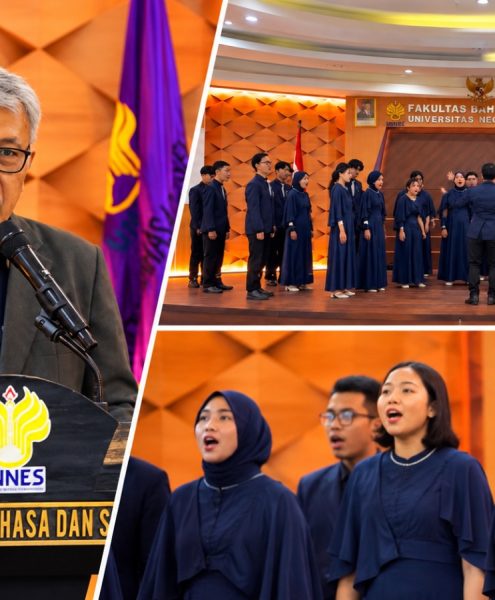
The festival was officially opened by Ircham Junaedi, M.Pd., Chair of the School Principals’ Working Group (MKKS), who attended on behalf of the Central Java Provincial Education Office.
In his opening remarks, Ircham welcomed the festival as a positive initiative that enables students to develop their language skills while strengthening their appreciation of Javanese culture.
He also expressed appreciation for the collaboration between the Central Java Javanese Language Teachers’ Association and UNNES in providing an educational and competitive platform for students from across the province.
Vice Dean III of FBS UNNES, Mohamad Yusuf Ahmad Hasyim, Lc., M.A., Ph.D., similarly welcomed the initiative and highlighted the importance of sustained cooperation in preserving regional languages.
He emphasized that collaboration between educational communities and higher education institutions is essential to ensuring that regional languages remain relevant and actively used by younger generations.
Hosting the festival at FBS UNNES also demonstrated the university’s role as a strategic partner in language education and cultural preservation.
Through the involvement of the Javanese Language and Literature Education and Javanese Literature Study Programs, the event strengthened connections between secondary and higher education institutions in developing sustainable Javanese language learning opportunities.
The partnership among MGMP, MKKS, UNNES, and government institutions highlighted the value of cross-sector cooperation in supporting cultural preservation initiatives that reach students from diverse educational backgrounds.
Central Java Language Office Calls for Sustainable Programs and Stronger Learning Support
Head of the Central Java Provincial Language Office (BBPJT), Dwi Laili Sukmawati, S.Pd., M.Hum., reaffirmed the institution’s support for regional language preservation initiatives, including the 2026 Javanese Language Festival.
She expressed hope that the festival would become a regular event, with more competition categories and broader student participation in the coming years.
According to Dwi Laili, future editions should go beyond seminars and competitions by incorporating structured learning support for participants and teachers.
One of her recommendations was to introduce technical training workshops before the competitions.
These workshops could support the development of official learning modules or competition guidelines, providing teachers and students with clearer references for preparation and assessment.
She noted that systematic learning resources would help improve students’ proficiency in Javanese script and public speaking while strengthening the overall quality of Javanese language education at the senior high school level.
Such developments would allow the festival to evolve beyond a competition into a broader educational initiative that promotes sustained learning and cultural engagement.
Students Hope for a More Creative and Inclusive Festival
The festival also received an enthusiastic response from participating students.
A participant from SMA Negeri 1 Bulu in Sukoharjo Regency expressed appreciation for the opportunity to take part in the event at FBS UNNES.
The student described the festival as a welcoming platform for young people interested in Javanese language and culture.
The participant also hoped that future editions would adopt increasingly creative and inclusive formats to encourage greater participation from students across Central Java.
This response reflected the importance of developing cultural preservation activities that remain relevant and engaging for younger generations.
Through educational, creative, and competitive approaches, the festival sought to encourage students to use Javanese not only during formal events and competitions but also as part of their everyday communication and cultural expression.
Advancing the Sustainable Development Goals Through Language and Cultural Preservation
The 2026 Javanese Language Festival also aligned with UNNES’s commitment to advancing the United Nations Sustainable Development Goals (SDGs), particularly SDG 4 (Quality Education), SDG 10 (Reduced Inequalities), SDG 11 (Sustainable Cities and Communities), and SDG 17 (Partnerships for the Goals).
The festival supported SDG 4 by promoting Javanese script literacy, public speaking skills, and educational experiences that encourage appreciation of linguistic and cultural diversity.
Its relevance to SDG 10 was reflected in the opportunity for students representing different districts and cities across Central Java to participate in a province-wide competition.
By providing a shared platform for students from various regions, the initiative sought to promote broader participation in educational and cultural activities.
The festival also contributed to the objectives of SDG 11, particularly the preservation of cultural heritage, by encouraging younger generations to maintain their knowledge and use of Javanese language and script.
Meanwhile, its connection to SDG 17 was demonstrated through collaboration among teachers’ associations, universities, school leadership organizations, and government institutions.
These partnerships highlighted the importance of collective efforts in developing sustainable cultural preservation programs.
As the festival concluded, the Central Java Javanese Language Teachers’ Association and FBS UNNES expressed hope that the inaugural event would lay the foundation for continued student development and cultural appreciation.
The 2026 Javanese Language Festival reaffirmed that preserving regional languages requires sustained commitment from educational institutions, cultural organizations, and younger generations.
By integrating competition, education, and institutional collaboration, the festival represented an important step toward nurturing a new generation of Javanese language speakers and safeguarding Indonesia’s rich linguistic and cultural heritage.