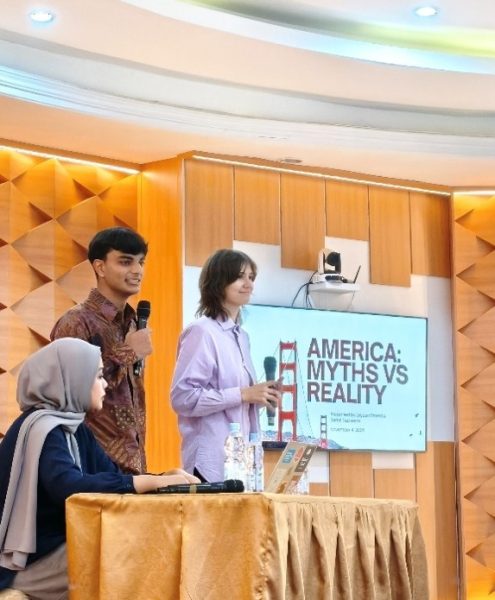


The English Literature Study Program at the Faculty of Languages and Arts (FBS), Universitas Negeri Semarang (UNNES), expanded students’ academic perspectives through an international guest lecture titled “An Introduction to Memory Studies” on Tuesday, October 27, 2026.
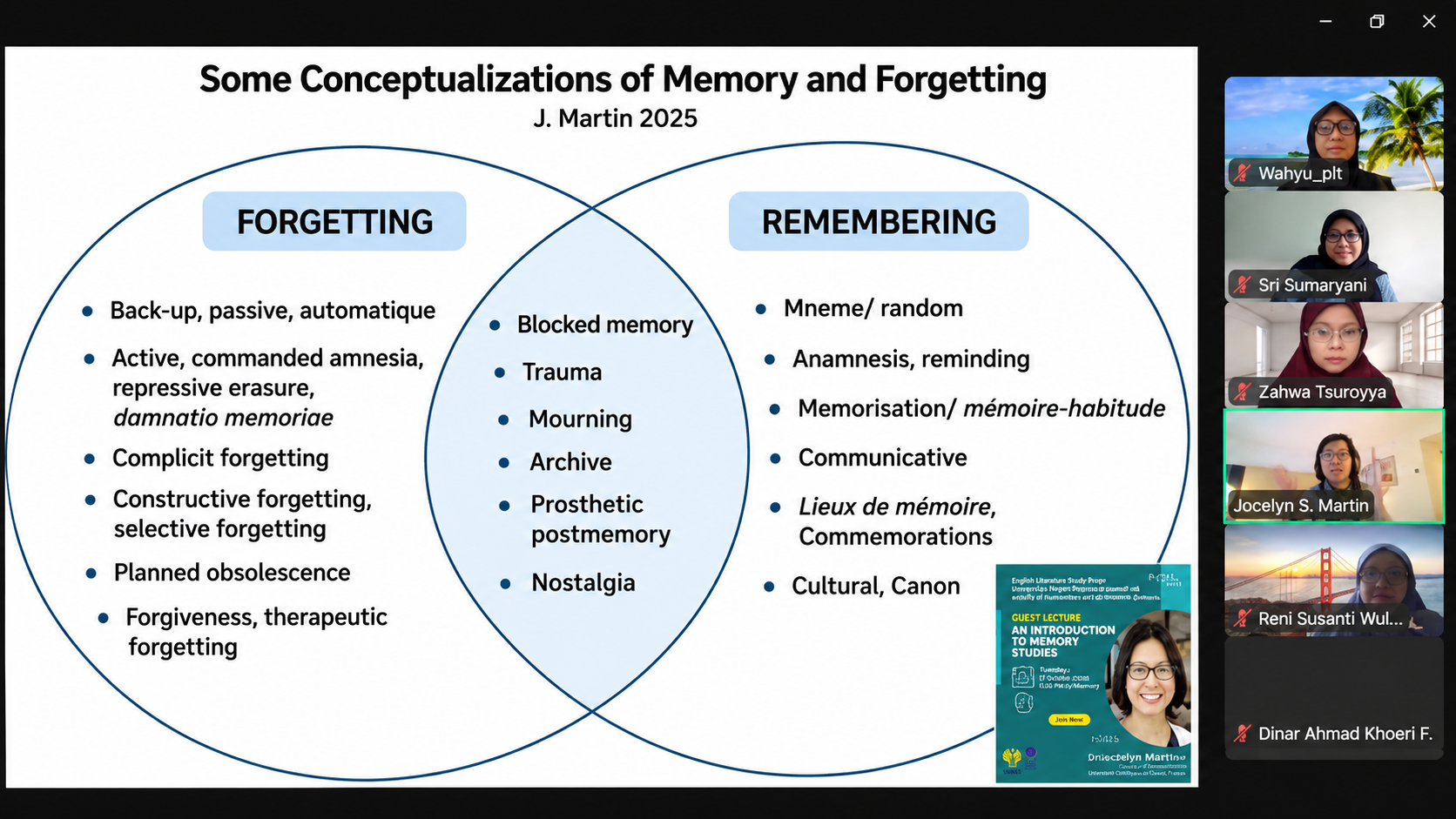
The lecture featured Dr. Jocelyn Martin from the Faculty of Humanities at Université Catholique de l’Ouest, France, who introduced memory studies as an interdisciplinary approach to understanding the relationships among memory, identity, personal experience, and contemporary social issues.
Lasting approximately two hours, the session began with an introduction to the significance of memory studies in literary and humanities scholarship, followed by an interactive discussion and question-and-answer session.
The event formed part of the English Literature Study Program’s efforts to introduce students to emerging theoretical perspectives in international literary scholarship and strengthen their academic experience through engagement with overseas scholars.
Exploring Memory Studies in Literary and Cultural Research
During her presentation, Martin introduced memory studies as an interdisciplinary field concerned with how past experiences are remembered, represented, and interpreted by individuals and communities.
The field draws on perspectives from literature, history, cultural studies, psychology, and the social sciences to examine the complex relationship between memory and human experience.
In literary research, memory studies provides a framework for exploring how personal and collective memories are represented through narratives, characters’ experiences, and connections between past events and present circumstances.
From this perspective, literary works can be understood not only as forms of artistic expression but also as spaces in which individuals and communities reconstruct experiences, negotiate identities, and reflect on their relationships with history.
Memory studies is also relevant to contemporary social issues, including conflict, trauma, reconciliation, and the experiences of different social groups.
Rather than treating memory as a fixed record of the past, the approach recognizes remembering as a dynamic process shaped by individual experiences, social relationships, and cultural change.
This perspective offers students opportunities to develop literary research that engages more critically with the relationship between texts, human experiences, and broader social dynamics.
Opening New Directions for Literary Research
Introducing memory studies to students is particularly valuable because the approach offers additional perspectives beyond those traditionally emphasized in literary education.
Through the guest lecture, students gained insights into theoretical frameworks that could broaden their research interests, particularly in areas involving representations of the past, collective memory, cultural identity, and social reconciliation.
Memory studies can also be applied to literary works exploring historical experiences, social transformation, migration, and intergenerational relationships.
The approach therefore provides opportunities for students to move beyond textual interpretation and examine how literature participates in the construction and transmission of cultural and historical memory.
The discussion session following Martin’s presentation allowed participants to explore potential applications of memory studies in literary and humanities research.
By engaging with an international scholar, students were encouraged to consider new research questions and examine literary works through interdisciplinary perspectives.
Acting Dean Emphasizes the Importance of Global Academic Perspectives
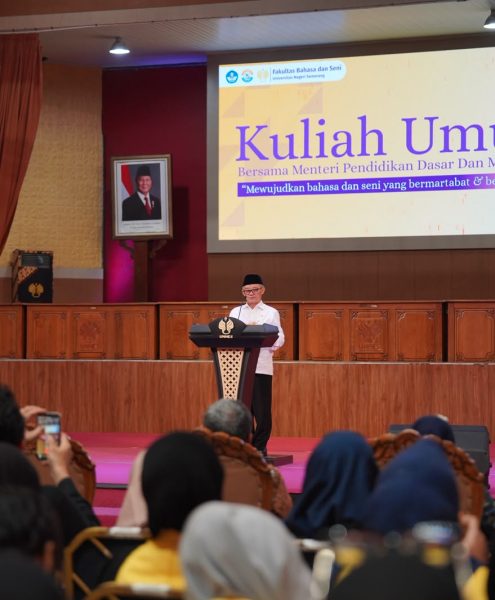
Acting Dean of FBS UNNES, Prof. Heri Yanto, M.B.A., Ph.D., emphasized that international academic engagement is essential to strengthening educational quality and fostering an academic environment responsive to developments in global scholarship.
“Literary and humanities scholarship continues to evolve rapidly. Students therefore need opportunities to explore theoretical approaches and research perspectives emerging internationally. This guest lecture featuring a scholar from France provides an important platform for broadening academic perspectives, enriching scholarly discussions, and encouraging research that addresses contemporary social issues,” he said.
According to Heri, improving the quality of higher education requires more than mastering established theories. Students must also develop the ability to understand emerging research approaches and methodological developments.
He noted that memory studies offers considerable potential for enriching literary scholarship by connecting human experiences, cultural representations, and social transformations.
“We hope students will use opportunities like this to develop more critical and interdisciplinary ways of thinking. Literary studies can make significant contributions to understanding human experiences, including how societies remember the past, construct identities, and respond to social change,” he added.
English Literature Program Coordinator Encourages Interdisciplinary Research
Coordinator of the English Literature Study Program at FBS UNNES, Dr. Rahayu Puji Haryanti, M.Hum., highlighted the importance of introducing students to contemporary approaches in literary and humanities scholarship.
“Memory studies offers a valuable perspective for understanding literary works because it enables students to explore the relationships among memory, identity, history, and social experience. Through this guest lecture, we aim to introduce an approach that can enrich literary analysis while encouraging students to develop research that is more critical, interdisciplinary, and relevant to contemporary issues,” she said.
According to Rahayu, introducing emerging theoretical approaches is essential to ensuring that students remain informed about developments in international academic discourse.
She explained that memory studies opens opportunities for research into a wide range of issues represented in literature, including traumatic experiences, collective memory, cultural identity, social conflict, and reconciliation.
Beyond expanding students’ theoretical understanding, the participation of a scholar from Université Catholique de l’Ouest provided an opportunity to engage with research traditions and academic perspectives developed in an international university setting.
“We hope this lecture will inspire students to explore a wider range of research topics and develop stronger academic arguments. Direct interaction with international scholars also provides valuable experience in building students’ confidence and preparing them to participate in global academic discussions,” she added.
Rahayu reaffirmed the study program’s commitment to organizing academic activities that expose students to diverse scholarly perspectives while strengthening teaching, research, and international engagement.
Supporting Quality Education and International Academic Engagement
The international guest lecture represented another step in the English Literature Study Program’s efforts to provide learning experiences responsive to developments in literary and humanities scholarship.
The event demonstrated how internationalization in higher education can be advanced through knowledge exchange and direct interaction between students and scholars from different countries.
By introducing memory studies, the program encouraged students to examine contemporary issues through critical and interdisciplinary approaches.
The initiative also aligned with the United Nations Sustainable Development Goals (SDGs), particularly SDG 4 (Quality Education), by enhancing learning opportunities and expanding access to international academic knowledge.
In addition, the lecture supported the broader objectives of SDG 17 (Partnerships for the Goals) by creating opportunities to strengthen academic connections with overseas universities.
Through this international academic initiative, the English Literature Study Program at FBS UNNES reaffirmed its commitment to broadening students’ intellectual horizons, improving educational quality, and fostering an academic environment open to international collaboration.
The introduction of memory studies is expected to encourage literary research that combines theoretical depth with a stronger understanding of social and cultural experiences, enabling students to make meaningful contributions to contemporary humanities scholarship.