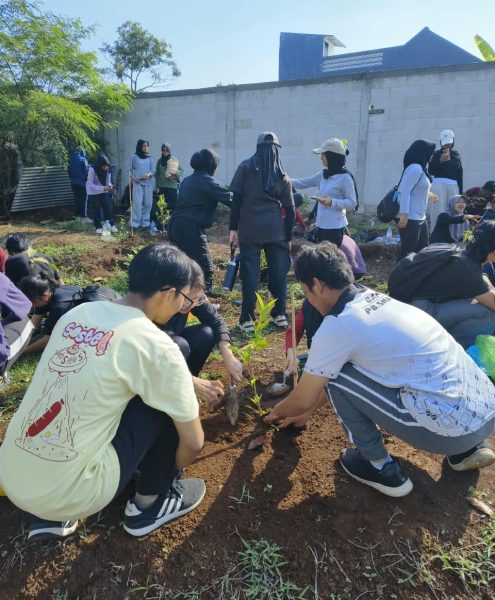


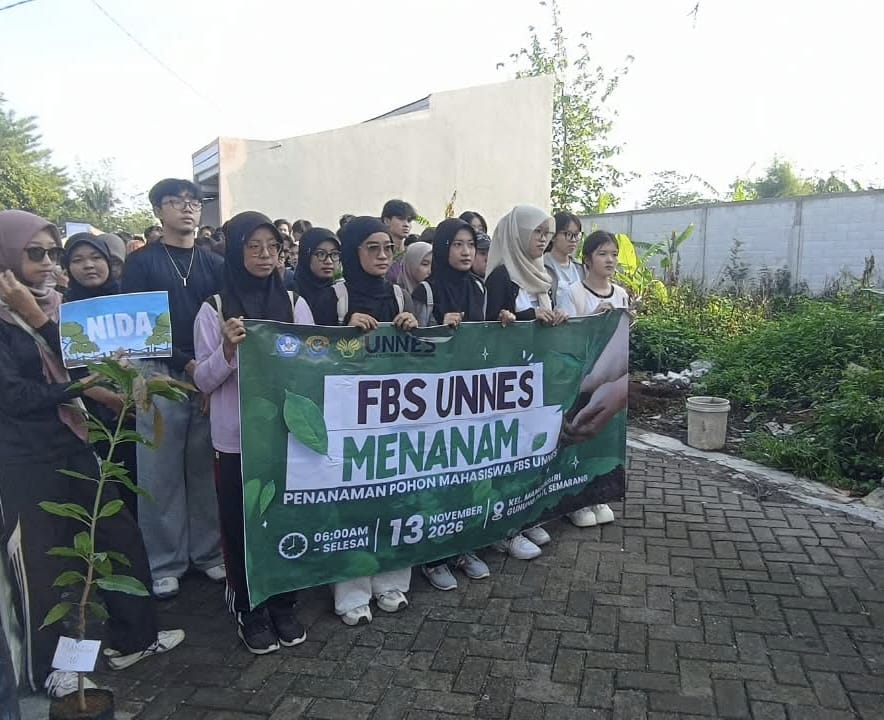
A total of 825 students from the Faculty of Languages and Arts (FBS) at Universitas Negeri Semarang (UNNES) took part in a tree-planting initiative in Mangunsari, Gunungpati District, Semarang, on Friday, November 13, 2026, planting 250 saplings as part of the university’s commitment to environmental conservation and sustainability.
The initiative brought together students from various study programs across the faculty, demonstrating how environmental awareness can be translated into collective action beyond the classroom.
The students planted 250 saplings representing 25 species of fruit-bearing, economically valuable, and shade-providing trees. These included banyan, rambutan, petai, mango, sapodilla, clove, agarwood, rosewood, durian, and melinjo.
The selection of diverse tree species was intended to improve vegetation cover while providing potential long-term ecological and economic benefits to the surrounding community.
From early morning, students worked together on open land near local rice fields, digging planting holes, positioning saplings, covering their roots with soil, and installing bamboo stakes to support the young trees.
The activity reflected UNNES’s identity as a Conservation University, where environmental responsibility is integrated into academic life, student development, and community engagement.
Fostering Environmental Responsibility Through Education
Acting Dean of FBS UNNES, Prof. Heri Yanto, M.B.A., Ph.D., emphasized that the tree-planting initiative was part of the faculty’s efforts to cultivate environmental awareness and social responsibility among students.
“As part of Universitas Negeri Semarang, which identifies itself as a Conservation University, FBS is committed to making environmental preservation an integral part of its academic culture. This tree-planting initiative is more than a greening activity; it is a learning experience that encourages students to recognize their individual responsibility for environmental sustainability,” he said.
He noted that the participation of 825 students demonstrated the potential of collective action in strengthening a culture of conservation within the university community.
Rather than limiting environmental education to theoretical discussions, the initiative encouraged students to contribute directly to activities that could benefit local communities.
“FBS students are not only expected to develop competencies in languages, literature, and the arts, but also to become individuals who are responsive to environmental and social challenges. We want conservation values to shape the way students think, behave, and act, both during their studies and after entering professional and community life,” he added.
The initiative also highlighted the importance of experiential learning in higher education, enabling students to connect environmental principles with practical conservation efforts.
By participating directly in tree planting, students gained firsthand experience of how individual and collective contributions can support ecological sustainability.
Ensuring the Long-Term Impact of Conservation Initiatives
Vice Dean II of FBS UNNES, Dr. Muhamad Burhanudin, S.S., M.A., highlighted the importance of ensuring that conservation initiatives generate lasting environmental benefits.
He emphasized that successful tree planting should not be measured solely by the number of saplings planted, but also by their survival and long-term contribution to the surrounding ecosystem.
“The success of a conservation initiative should not be measured only by the number of trees planted, but also by our ability to ensure that they grow and provide lasting benefits. Activities like this must therefore be accompanied by a shared commitment to tree maintenance and environmental sustainability,” he explained.
According to him, planting a diverse range of tree species represents a practical contribution to more sustainable environmental management.
The combination of shade-providing and productive trees is expected to support vegetation development while offering potential benefits to local residents as the trees mature.
“Through this initiative, we hope students will develop a deeper understanding that conservation requires cooperation, commitment, and consistency. Collaboration between universities and local communities is essential to creating greener, healthier, and more sustainable environments,” he added.
The initiative also provided an opportunity to strengthen connections between the university and the surrounding community.
By conducting the activity in Mangunsari, students were encouraged to engage with the local environment and develop a greater appreciation of the relationship between human activities and ecological well-being.
Supporting the Sustainable Development Goals
The tree-planting initiative aligned with UNNES’s commitment to advancing the United Nations Sustainable Development Goals (SDGs), particularly SDG 15 (Life on Land), SDG 13 (Climate Action), and SDG 11 (Sustainable Cities and Communities).
Its contribution to SDG 15 was reflected in efforts to increase vegetation cover and support terrestrial ecosystems through the planting of various tree species.
The activity also supported the broader objectives of SDG 13 by promoting tree planting as a long-term environmental measure that can contribute to climate change mitigation as the trees grow.
Meanwhile, its relevance to SDG 11 was demonstrated through efforts to enhance green spaces and improve environmental quality in areas surrounding residential communities.
Beyond these environmental objectives, the initiative served as a practical educational experience that encouraged students to develop teamwork, civic responsibility, and awareness of sustainability challenges.
The involvement of hundreds of students illustrated how universities can mobilize their academic communities to address environmental concerns through collaborative action.
Strengthening the Culture of Conservation
Through the planting of 250 trees in Mangunsari, FBS UNNES reaffirmed its commitment to translating conservation values into meaningful action.
The participation of students from various academic backgrounds demonstrated that environmental preservation is a shared responsibility extending beyond specific disciplines or areas of expertise.
For students studying languages, literature, and the arts, the activity offered an opportunity to engage with environmental issues through direct community-based action.
The initiative is expected to provide long-term benefits to the Mangunsari environment while encouraging students to remain actively involved in conservation activities.
It also reflected the university’s broader efforts to integrate education, community engagement, and environmental stewardship into its institutional mission.
By fostering environmental awareness and encouraging collective participation, FBS UNNES continues to strengthen its contribution to sustainable development and the realization of UNNES’s vision as a Conservation University.
The tree-planting initiative demonstrated that conservation is not merely an institutional slogan, but a shared commitment that can be practiced through everyday actions and sustained collaboration between the university and society.