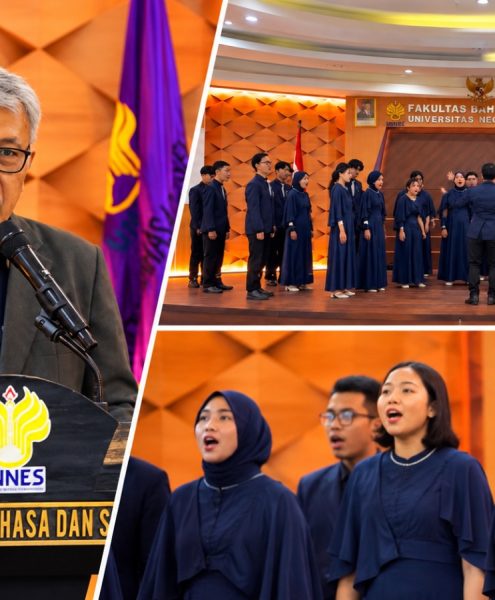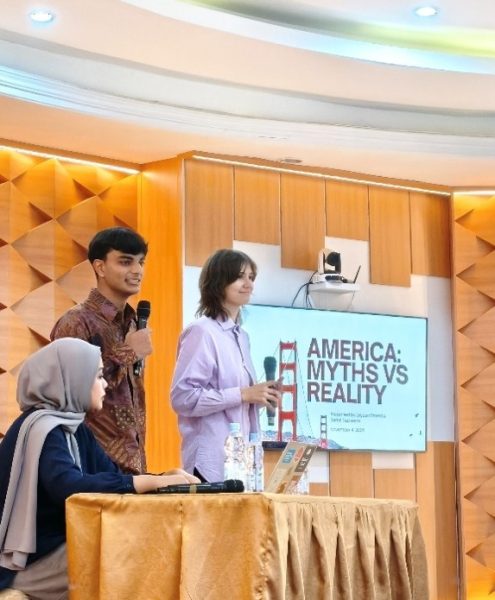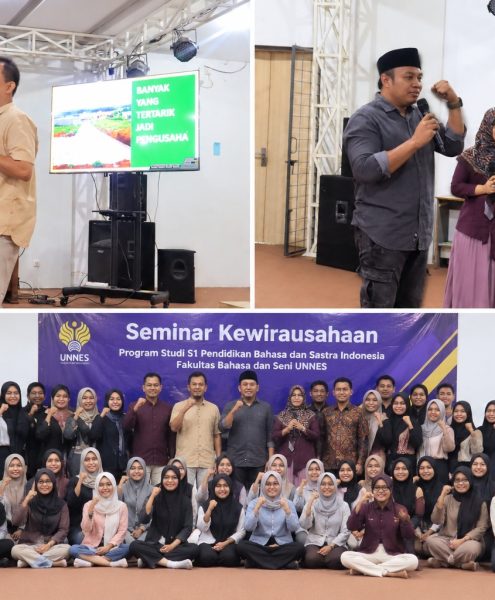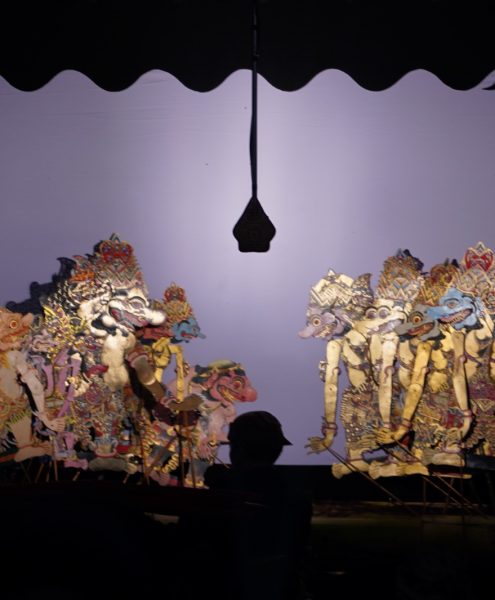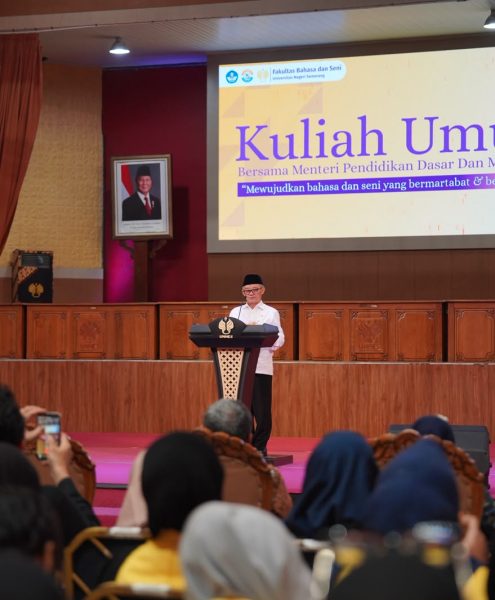


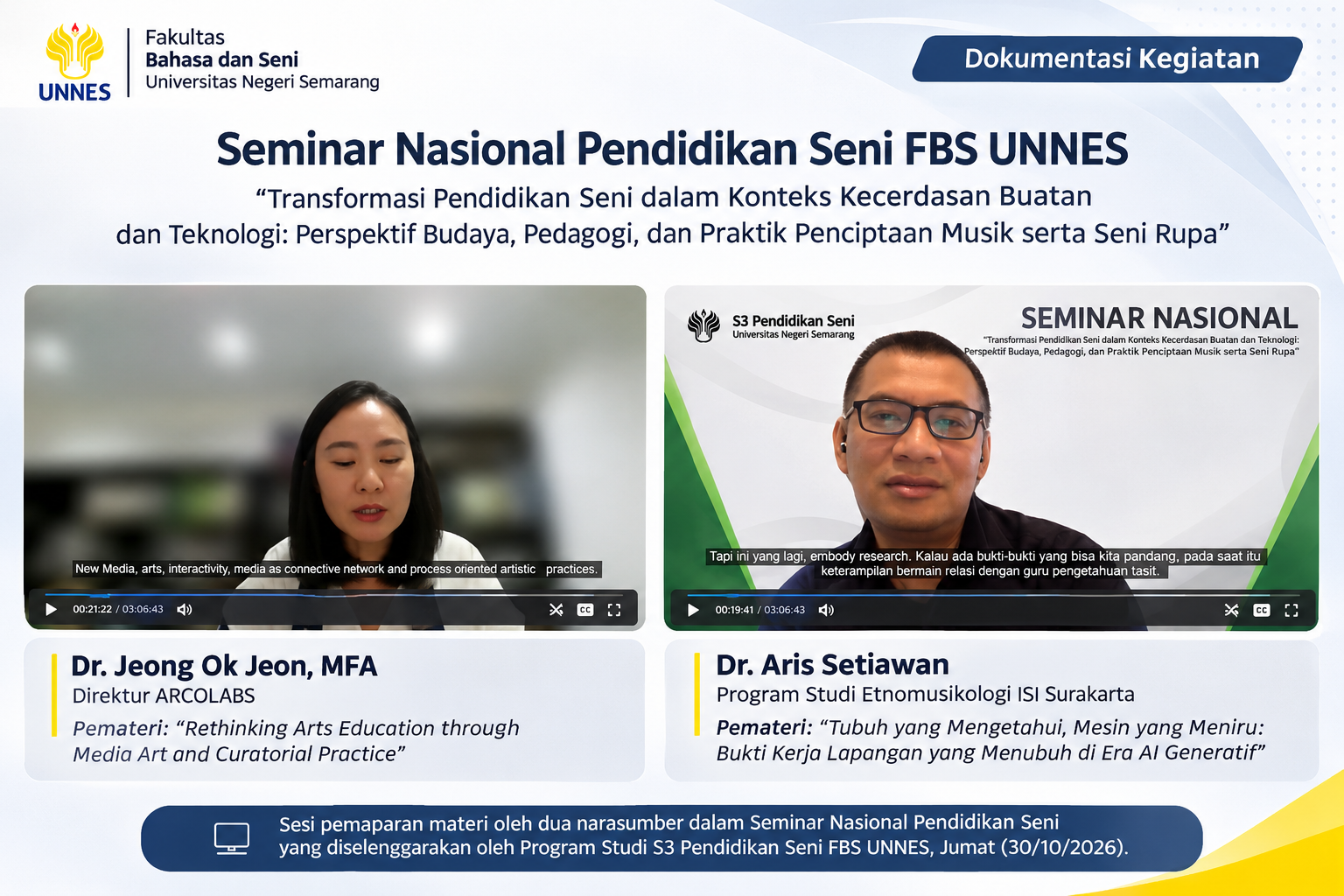
The Doctoral Program in Arts Education at the Faculty of Languages and Arts (FBS), Universitas Negeri Semarang (UNNES), explored the changing landscape of arts education in the age of artificial intelligence (AI) through a national seminar featuring two prominent arts scholars and practitioners, Dr. Aris Setiawan from the Ethnomusicology Study Program at the Indonesian Institute of the Arts (ISI) Surakarta and Dr. Jeong Ok Jeon, MFA, Director of ARCOLABS.
Held on October 30, 2026, the seminar provided an academic forum to examine how artificial intelligence and digital media are reshaping artistic creation, research methodologies, teaching practices, and the ways people experience and interpret art.
The event formed part of the doctoral program’s efforts to foster critical inquiry, encourage innovation, and strengthen its engagement with contemporary developments in arts education.
The two speakers offered complementary perspectives. Aris examined the authenticity of fieldwork and research integrity amid the growing capabilities of generative AI, while Jeon discussed how digital media and curatorial practices are transforming artistic experiences and creating opportunities for more participatory and collaborative approaches to arts education.
Generative AI Raises Questions About Research Authenticity
In his presentation, “The Knowing Body, the Imitating Machine: Embodied Fieldwork Evidence in the Era of Generative AI,” Aris Setiawan addressed emerging challenges in ethnomusicological research, particularly concerning the authenticity of research data and firsthand fieldwork experiences.
He explained that generative AI can now produce convincing field notes, interview transcripts, musical notation, arrangements, and even synthetic audio recordings.
While these capabilities offer new possibilities for research and documentation, they also raise concerns about whether AI-generated materials can be mistaken for evidence of experiences that researchers have never undertaken.
In ethnomusicology, knowledge is developed not only through written records and audiovisual documentation but also through bodily engagement, musical practice, and direct interaction with teachers and artistic communities.
Aris outlined three layers of fieldwork evidence: textual evidence, sonic evidence, and evidence of presence.
Textual evidence includes field notes and interview transcripts, while sonic evidence encompasses audiovisual recordings and musical notation. Evidence of presence, meanwhile, involves instrumental proficiency, learning experiences with teachers, and knowledge acquired through direct participation in musical practices.
He argued that embodied experience is particularly difficult for AI to replicate because it involves tacit knowledge, bodily habits, interpersonal relationships, and skills developed through sustained practice.
To strengthen research integrity, Aris proposed a performative verification approach involving five stages: demonstrating basic skills, responding to musical situations, examining the learning process, obtaining relational testimony from teachers or informants, and reflecting on embodied experiences.
Rather than functioning as a punitive mechanism, the approach is intended to help researchers demonstrate a meaningful relationship between the knowledge they claim and the experiences they have actually undergone.
He also emphasized the importance of distinguishing legitimate uses of AI as a research support tool from attempts to substitute AI-generated materials for fieldwork that has never taken place.
His presentation highlighted the need for arts education institutions to develop assessment systems that evaluate not only written research outputs but also learning processes, practical competencies, lived experiences, and engagement with artistic communities.
Media Art and Curatorial Practice Reshape Arts Education
Offering a different perspective, Jeong Ok Jeon presented “Rethinking Arts Education through Media Art and Curatorial Practice,” inviting participants to reconsider conventional approaches to arts education in response to digital transformation.
As Director of ARCOLABS, Jeon discussed how technological developments are changing relationships among artists, artworks, audiences, and cultural institutions.
She explained that digital technologies do more than introduce new tools for artistic production. They also transform how art is created, presented, experienced, and interpreted.
In contemporary new media art, artistic practices increasingly incorporate electronic images, computer code, data, sound, and interactive systems that allow audiences to engage directly with artworks.
These developments have contributed to a shift from art as a finished object to art as an evolving process, from audiences as passive observers to active participants, and from individual creation to collaborative knowledge production.
Jeon also highlighted changes in curatorial practice.
Rather than serving exclusively as authorities responsible for selecting and interpreting artworks, curators increasingly act as facilitators who create connections among artists, artworks, exhibition spaces, and communities.
To illustrate these developments, she presented examples of media art involving digital projections, interactive installations, sound art, and participatory artistic practices.
One example was Madakaripura, a work by the Indonesian art collective Tromarama that incorporates digital image projection, software, real-time internet data, and sound.
The work demonstrated how technology can generate dynamic artistic experiences that extend beyond conventional physical art objects.
Jeon also discussed several curatorial projects, including Visualizing the Invisible, Five Passages to the Future, Cosmos Chronology, and Media x Space: Beyond Illumination.
These examples illustrated how curatorial practice can function as an educational space where artistic experimentation, technology, public participation, and critical reflection intersect.
In the context of arts education, Jeon identified four important learning approaches: experimentation, participation, collaboration, and critical reflection.
She emphasized that arts education should move beyond technical mastery and the production of finished artworks to provide opportunities for learners to explore ideas, develop experiences, engage with audiences, and critically examine the social and cultural transformations influencing artistic practices.
Doctoral Program Coordinator Calls for Critical and Innovative Research
Coordinator of the Doctoral Program in Arts Education at FBS UNNES, Prof. Dr. Syakir, M.Sn., emphasized that developments in artificial intelligence and digital technologies require arts education institutions to continuously reassess their academic approaches, research methodologies, and teaching practices.
“Artificial intelligence and digital technologies are fundamentally transforming artistic creation, research, and education. Through this seminar, we aim to broaden our doctoral students’ academic perspectives so that they can develop approaches to arts education that are not only responsive to technological change but also critical in safeguarding the authenticity of artistic experiences, cultural values, and academic integrity,” he said.
According to Syakir, the presentations offered valuable perspectives on the relationship between technology, human experience, and the development of artistic knowledge.
On the one hand, advances in AI require researchers to exercise greater care in verifying research data and empirical experiences. On the other, developments in media art create opportunities for more participatory, experimental, and collaborative approaches to teaching and research.
“Doctoral students in Arts Education must be able to critically examine changing artistic paradigms, develop relevant research approaches, and make meaningful theoretical and practical contributions to the advancement of arts education. Engaging with scholars and practitioners from diverse backgrounds provides an important opportunity to enrich these perspectives,” he added.
Syakir further emphasized that doctoral education should contribute to the development of knowledge rather than simply respond to technological trends.
Through academic initiatives involving national and international experts, the doctoral program aims to strengthen a research environment that embraces scientific and technological developments while remaining grounded in cultural knowledge and artistic traditions.
Acting Dean Emphasizes the Balance Between Technology and Human Values
Acting Dean of FBS UNNES, Prof. Heri Yanto, M.B.A., Ph.D., highlighted the importance of responding critically to digital transformation in higher education, particularly in arts education.
“Artificial intelligence offers significant opportunities for innovation in education, research, and artistic creation. However, its application must remain grounded in human values, academic integrity, and respect for the creative process. Technology should expand human capacity for artistic expression rather than replace the experiences and sensitivities that form the foundation of arts education,” he said.
According to Heri, arts education is closely connected to lived experience, creative expression, social interaction, and cultural contexts.
Technological innovation should therefore be positioned as a means of enriching educational practices without diminishing the human dimensions of artistic learning and creativity.
He also welcomed the seminar’s involvement of national and international experts, describing it as an important contribution to strengthening the faculty’s academic environment and international engagement.
“Bringing together national and international experts through academic forums such as this provides valuable opportunities to expand scholarly networks and enhance the quality of doctoral education. We hope these discussions will inspire research, educational innovation, and artistic works that make meaningful contributions to society and the advancement of knowledge,” he added.
Heri reaffirmed FBS UNNES’s commitment to developing educational practices that respond to global changes while maintaining cultural identity and conservation values as integral elements of the university’s institutional character.
Advancing Adaptive and Sustainable Arts Education
The seminar demonstrated that transforming arts education in the digital era involves more than introducing new technologies into classrooms and artistic practices.
It also requires reconsidering how artistic knowledge is produced, how creative experiences are understood, and how relationships among artists, educators, researchers, and communities are developed.
Aris’s perspective underscored the importance of firsthand experience and research integrity at a time when generative AI can produce increasingly sophisticated representations of knowledge.
Meanwhile, Jeon’s presentation demonstrated how digital technologies can open new possibilities for artistic creation, curatorial practice, and participatory learning.
Together, the presentations highlighted the importance of balancing technological innovation with respect for human experience and artistic authenticity.
For doctoral students, the discussions provided opportunities to strengthen their academic perspectives, formulate relevant research questions, refine methodological approaches, and develop studies that respond to contemporary developments in arts and education.
The seminar also aligned with UNNES’s commitment to advancing the United Nations Sustainable Development Goals (SDGs), particularly SDG 4 (Quality Education), SDG 9 (Industry, Innovation and Infrastructure), and SDG 17 (Partnerships for the Goals).
Its contribution to SDG 4 was reflected in efforts to enhance higher education quality and strengthen research competencies.
The seminar’s relevance to SDG 9 was demonstrated through discussions of technological innovation and digital artistic practices, while its contribution to SDG 17 was reflected in academic exchanges and opportunities to strengthen connections with experts from different institutions.
Through the seminar, the Doctoral Program in Arts Education at FBS UNNES reaffirmed its commitment to fostering critical inquiry, innovation, and international academic engagement.
By bringing together ethnomusicology, artificial intelligence, media art, and curatorial practice, the event encouraged the development of arts education research that remains responsive to technological change while preserving cultural values, embodied artistic knowledge, and academic integrity.