

October 6, 2026
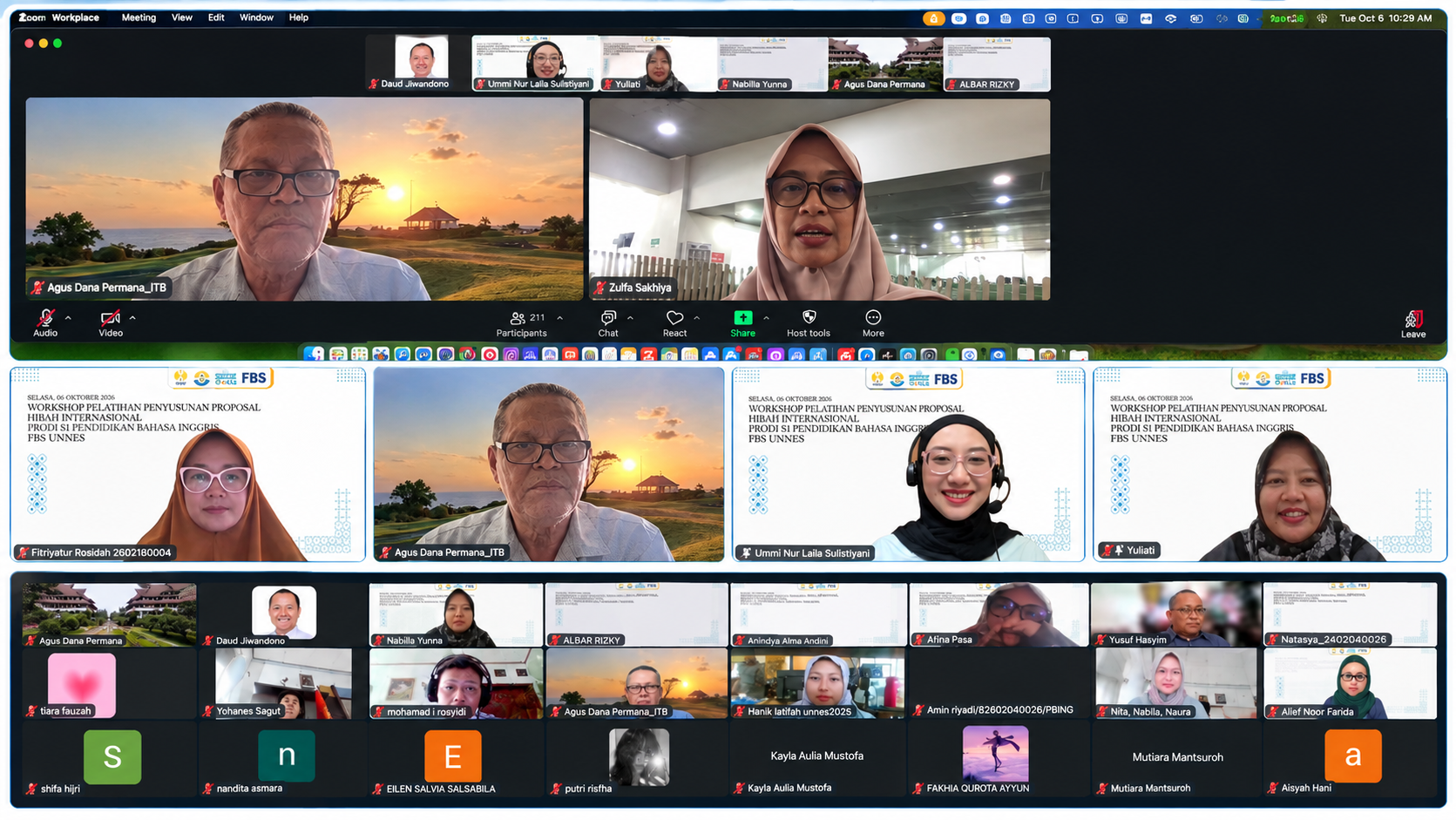
SEMARANG – The Undergraduate Study Program in English Education, Faculty of Languages and Arts (FBS), Universitas Negeri Semarang (UNNES), held a Workshop on Developing International Grant Proposals to Support the Achievement of Sustainable Development Goals (SDGs) 1, 4, 5, 10, 11, and 17 in 2026 on Tuesday, October 6, 2026. Conducted online via Zoom, the workshop attracted more than 200 participants, including lecturers and students. The event aimed to strengthen the academic community’s capacity to develop internationally competitive research and community service proposals.
Experts Share Insights to Strengthen Researchers’ Capacity
The workshop featured two speakers: Prof. Dr. Agus Dana Permana from the Bandung Institute of Technology (ITB) and Zulfa Sakhiyya, M.TESOL., Ph.D. from UNNES. The session was moderated by Ummi Nur Laila Sulistyani, S.Pd., M.Li.
Through this event, participants gained insights into strategies for securing international funding, effective proposal-writing techniques, and the importance of building collaborative partnerships to increase the likelihood of successful grant applications.
Strategies for Developing Competitive International Grant Proposals
In their presentations, Prof. Dr. Agus Dana Permana and Zulfa Sakhiyya, M.TESOL., Ph.D., explained that success in securing international grants depends not only on the quality of research ideas but also on strategic planning, alignment with funding agencies’ priorities, and the team’s readiness to implement the proposed project.
They emphasized the importance of identifying funding opportunities early by considering funding agencies’ missions, eligibility requirements, geographic scope, funding mechanisms, and application deadlines. Researchers also need to develop realistic plans with objectives that are specific, measurable, achievable, relevant, and time-bound.
The workshop also covered the main components of a grant proposal, including the abstract, problem statement and research gap, objectives, methodology, and budget. A strong proposal should clearly articulate the research problem, demonstrate its novelty and intended contribution, and explain how the selected methods will produce credible outcomes.
Project timelines, the division of responsibilities, and budget requirements must also be developed realistically to demonstrate the feasibility of the proposed project. In addition, participants explored common reasons for grant rejection, including failure to meet funding agencies’ requirements, unconvincing methodologies, excessive use of technical jargon, and non-compliance with administrative requirements.
To improve proposal quality, researchers were encouraged to revise their drafts thoroughly and seek feedback from peers before submission.
International Collaboration and SDG Integration
Beyond academic quality, a strong research track record and international partnerships are essential elements of successful grant proposals. Collaboration should be built on complementary expertise and clearly defined roles rather than simply listing partners from other institutions. Administrative preparedness, institutional support, and the team’s ability to implement the proposed activities also enhance a proposal’s competitiveness at the global level.
The workshop specifically supported the achievement of six Sustainable Development Goals: SDG 1 (No Poverty), SDG 4 (Quality Education), SDG 5 (Gender Equality), SDG 10 (Reduced Inequalities), SDG 11 (Sustainable Cities and Communities), and SDG 17 (Partnerships for the Goals).
The integration of SDGs into grant proposals is expected to go beyond merely mentioning the relevant goals. Instead, it should be reflected in problem identification, objective formulation, outcome selection, success indicators, impact assessment, and program sustainability strategies. This approach will help ensure that research and community service initiatives are academically relevant while also addressing societal needs.
Promoting High-Quality Proposals with Meaningful Societal Impact
Through this workshop, the Undergraduate Study Program in English Education at FBS UNNES aims to improve participants’ understanding of international grant opportunities and selection criteria, strengthen their proposal-writing skills, and establish communication networks to support future research and community service collaborations. The initial proposal drafts developed by participants are expected to be further refined through mentoring and by identifying suitable funding schemes.
This initiative represents one of FBS UNNES’s efforts to foster a collaborative research culture, expand international academic networks, and strengthen the academic community’s contribution to sustainable development. By enhancing its capacity to develop international grant proposals, UNNES is expected to further expand global partnerships and produce competitive research and community service programs that deliver tangible benefits to society.
Ummi Nur Laila Sulistyani & Yuliati