

Universitas Negeri Semarang (UNNES) once again held its annual UNNES Mantu 2026 event on Friday and Saturday, June 19-20, 2026, at the Pendopo Kampung Budaya, Faculty of Languages and Arts (FBS), Gunungpati Campus, Semarang. This year, the event—which originally served as a practical examination for the Panatacara (Master of Ceremonies) course in the Javanese Literature and Javanese Language Education Study Programs—has undergone a significant transformation by offering a free mass wedding service for the general public, alongside a traditional Javanese wedding pageant featuring five styles from the Surakarta and Yogyakarta traditions.
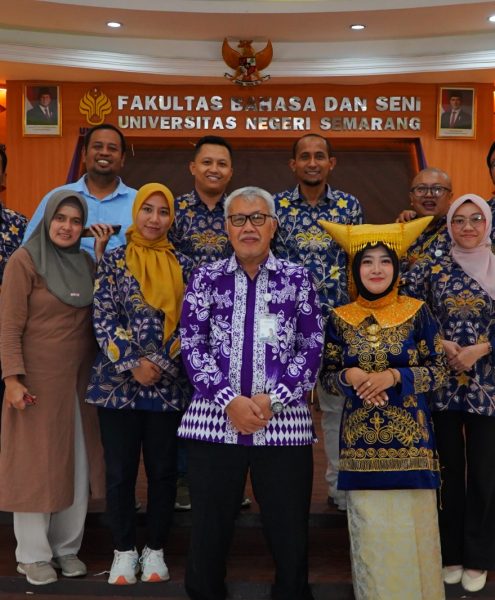
The event was officially opened by the Vice Dean III for Research, Innovation, and Information Systems at FBS UNNES, Mohamad Yusuf Ahmad Hasyim, Lc., M.A., Ph.D. It serves as the final project for the Panatacara course, taught by Dr. Widodo, M.Hum., and Didik Supriadi, S.Pd., M.Pd. A total of 96 students were involved as organizing committee members, acting as professional wedding coordinators managing the entire technical, administrative, and documentation processes.
Mass Wedding: An Economic Solution for the Community
Nine couples from various regions, including Semarang, Demak, and Salatiga, were officially married in a mass wedding ceremony held on Friday (19/6) from 8:00 AM to 11:00 AM local time. The entire wedding process was provided free of charge by the committee, from administration and assistance to dowry and documentation, thereby eliminating the financial burden of marriage for the participants.
One couple that drew particular attention was Muhammad Ali (69) and Catur Orbasal Prihati (59), residents of Semarang City, who finally formalized their relationship after a more than 20-year wait due to economic constraints. “Due to our financial situation, we chose to join the mass wedding. The campus facilitated everything,” Ali said. Similar happiness was expressed by a couple from Salatiga, Muhammad Slamet (43) and Komariah (51). “Aside from being free, we are also proud to have been selected after going through a selection process,” Komariah said.
Didik Supriadi, a lecturer for the Panatacara course, explained that UNNES Mantu has been held 14 times since previous years. However, until 2025, the event was still conducted as a student examination for the Javanese Language and Literature Education Study Program as well as the Javanese Literature Study Program. “This year we added an innovation in the form of a mass wedding involving the community,” he said.
Pageant of Five Javanese Wedding Styles
The series of events continued on Saturday (20/6) with a traditional Javanese wedding pageant featuring five styles of Javanese tradition, running from 8:00 AM to 10:00 PM. The five styles include Gagrag Surakarta Karaton, Sentana Dalem, Saudagar, Pabrayatan, and Yogyakarta Pabrayatan. Each style possesses distinctive characteristics, makeup, attire, and rich cultural philosophy.
“The wedding pageant features five styles. From the Surakarta style, there are four: Sentana Dalem, Karaton Surakarta, Saudagar, and the commoners’ style. Then one more is the Yogyakarta style,” Didik explained.
Students were not only involved as committee members but also as bridal models and event supporters. They conducted in-depth research on various sources, including classical manuscripts such as Serat Centhini written in the 1800s, to ensure that the processions performed were in accordance with historical and cultural references of Javanese tradition.
Educational Transformation and Social Concern
The Vice Dean III of FBS UNNES, Mohamad Yusuf Ahmad Hasyim, Lc., M.A., Ph.D., in his speech, expressed high appreciation for the organization of UNNES Mantu 2026. According to him, this event is not merely an academic evaluation but also a tangible manifestation of the campus’s concern for the community.
“UNNES Mantu 2026 has transformed into an activity that no longer focuses solely on learning evaluation but also provides social solutions for the community, especially for couples facing economic limitations. This is a real embodiment of the three pillars of higher education, particularly in community service,” said Mohamad Yusuf Ahmad Hasyim.
He also emphasized that this event reflects UNNES’s commitment as a conservation campus that not only preserves culture but also actively contributes to addressing social issues in society.
The UNNES Mantu 2026 event aligns with the Sustainable Development Goals (SDGs). Through the provision of free mass wedding services for underprivileged community members, the event supports efforts to reduce economic disparities and improve access to proper marriage administrative services. Furthermore, the preservation and performance of traditional Javanese wedding customs contribute to safeguarding cultural heritage as part of the nation’s identity. The collaboration between students, lecturers, and the community in this event also reflects the spirit of inclusive partnerships in achieving sustainable development goals.