

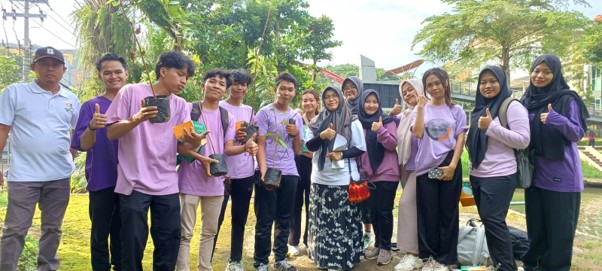
Friday morning, September 26, 2026, witnessed a collective action that transformed the atmosphere across several vacant plots and residential riverbanks in Mangunsari Village, Semarang. The usual morning roar of vehicles was replaced by the cheerful clatter of hoes, shovels, and youthful laughter. A total of 401 students from the Faculty of Languages and Arts (FBS) at Universitas Negeri Semarang (UNNES) poured into the area, working side-by-side to plant 135 fruit-tree seedlings in a movement designed not merely to green the environment, but also to serve as a serious strategy for carbon management and reducing carbon dioxide emissions both on campus and in its surrounding areas.
This activity, which involved students from 15 study programs within FBS, was by no means a spontaneous project. Prior to determining the planting sites, the organizing committee conducted thorough field observations and in-depth interviews with local neighborhood unit (RT) and community unit (RW) leaders. This participatory approach was taken to ensure that the land utilized was genuinely productive, did not disrupt residential spatial planning, and precisely met the urgent need for green open spaces in an increasingly dense urban area.
That morning, the event was officially opened by a representative of the UNNES Conservation Task Force, Teguh Prihanto, S.T., M.T. In his rousing address, he emphasized that planting trees is a tangible demonstration of academics’ commitment to critical environmental issues.
“This is not merely an annual ceremonial ritual or a community service project that ends with a group photo. This is a long-term ecological investment. Every seedling we plant today represents new lungs for the city of Semarang. It will absorb carbon, produce oxygen, and stand as silent witness that the younger generation truly cares about the future of our planet,” Teguh Prihanto stated with palpable optimism before the crowd.
The field coordinator who directly led the planting operations, Dr. U’um Qomariyah, S.Pd., M.Hum., further conveyed that this collective spirit was built upon cross-disciplinary awareness. “We at FBS may primarily work in the fields of language and the arts, but environmental stewardship is a universal language. Students from 15 different study programs can unite here, digging soil and tending seedlings together. This is a field classroom experience that they simply cannot obtain within lecture halls,” she remarked while accompanying her students as they interacted with local residents.
What makes this program particularly special is the selection of tree species. Instead of merely planting hardwoods or shade trees, all 135 seedlings planted this time are productive fruit-bearing varieties, namely mango, longan, sapodilla, durian, and avocado. A concept of one tree cared for by three students was implemented to ensure a high survival rate. This choice carries a dual mission. Ecologically, the dense canopies of fruit trees serve as natural carbon sinks that effectively mitigate greenhouse gas emissions. Socially and economically, in a few years, the residents of Mangunsari Village will be able to harvest these fruits, providing food security and added economic value to the local community.
Beyond the mere act of planting, this green movement by FBS UNNES students is intrinsically linked to the broader global development agenda, namely the Sustainable Development Goals (SDGs) proclaimed by the United Nations. Upon closer examination, at least five SDG pillars are directly addressed through this activity.
In terms of education, involving 401 students who directly engage with the community turns this program into a living social laboratory. They learn about environmental awareness, responsibility, and teamwork outside the campus walls—a tangible manifestation of efforts to provide quality education that is relevant to the challenges of our time, aligning with the spirit of SDG 4. On the other hand, determining the location through deliberation with RT and RW leaders exemplifies how a university can contribute to creating sustainable cities and communities, in line with SDG 11, where public spaces are reclaimed as inclusive and safe green areas for residents.
However, the main driving force of this activity is undoubtedly its response to the climate crisis. Amid the increasingly tangible threat of global warming, planting 135 trees is no small feat. Every leaf on the planted mango, durian, and avocado trees will work tirelessly to absorb carbon dioxide, making this activity a concrete contribution to climate action (SDG 13) as well as to preserving terrestrial ecosystems (SDG 15). The micro-biodiversity in Mangunsari’s soil will also recover as tree roots grow, strengthening soil structure and preventing land degradation.
Dr. U’um Qomariyah emphasized that all of this would not have been possible without solid collaboration. “We cannot work alone. The support from the UNNES Conservation Task Force, the enthusiasm of the students, and the warm welcome from the residents and village officials are the keys to today’s success. This is proof that to achieve great goals, we need strong partnerships between the academic world, institutions, and civil society,” she concluded. This spirit of partnership serves as the final foundational element, reminding us that the sustainable development agenda can only be achieved if all elements move together—which is the core essence of SDG 17.
By midday, the activity proceeded smoothly and harmoniously. The once-barren plots of land now stood neatly adorned with rows of fruit seedlings, promising a greener future. Through this program, FBS UNNES is not only planting trees but also planting the belief that significant change always begins with small steps taken collectively. UNNES reaffirms its position as a conservation-oriented university that not only produces intelligent generations but also generations that are responsible for the sustainability of nature and humanity.