



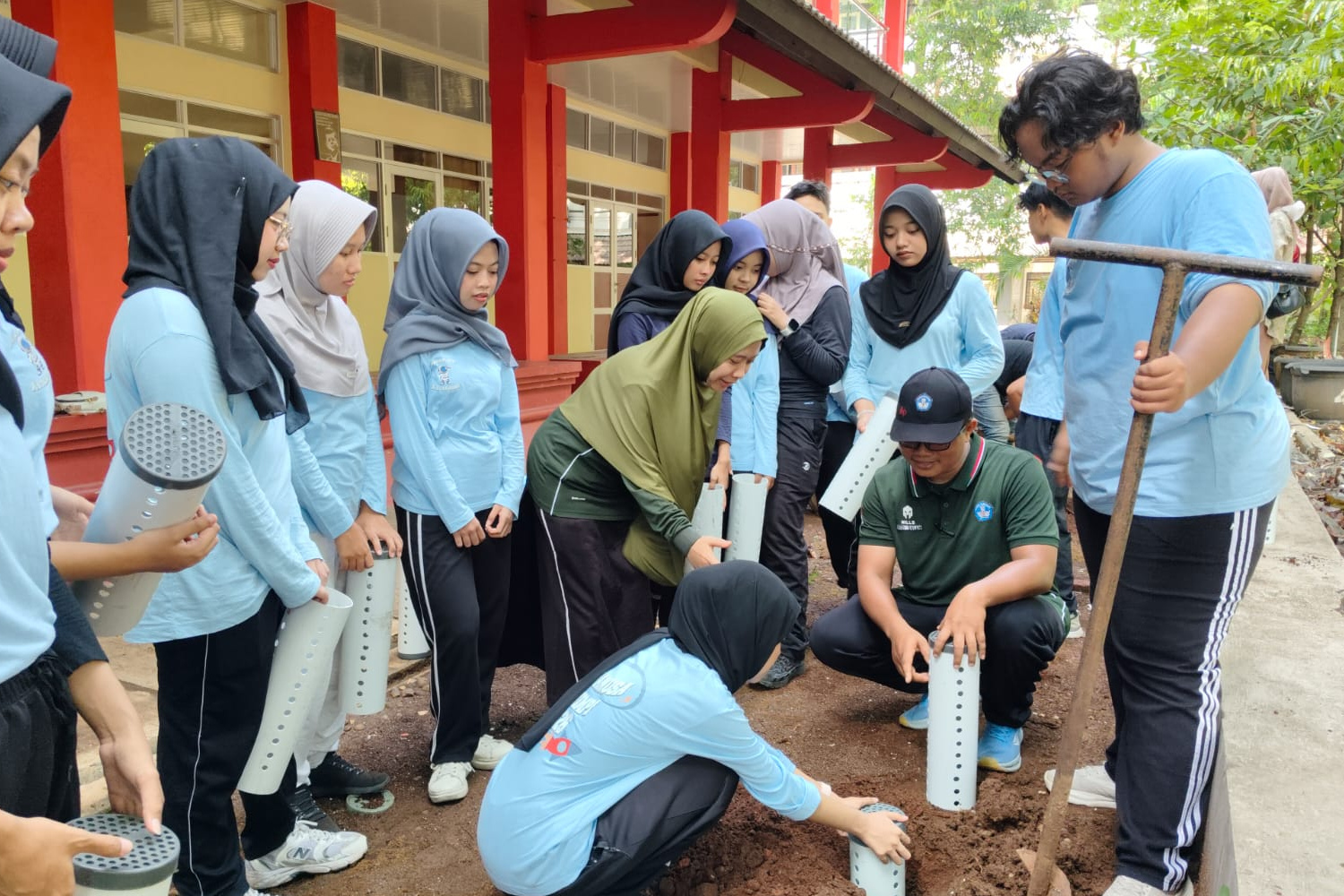
SEMARANG, November 6, 2026 – Fifty fifth-semester students from the Undergraduate Social Studies Education Program at the Faculty of Social and Political Sciences (FISIP), Universitas Negeri Semarang (UNNES), installed 50 biopore infiltration holes in front of Building C4 on Friday (November 6). Each student was responsible for installing one biopore as part of an initiative to improve soil infiltration and reduce standing water during the rainy season.
Organized by FISIP UNNES, the activity forms part of the faculty’s ongoing water conservation efforts. The biopore infiltration holes are designed to allow more rainwater to penetrate the soil rather than flow across the surface into drainage systems. By improving infiltration, the initiative is expected to help reduce surface runoff while supporting groundwater recharge.
Before the installation began, the students received practical guidance from Rudi Salam, S.Pd., M.Pd., Head of the Conservation and Sustainable Development Goals (SDGs) Working Group at FISIP UNNES. He explained the functions of biopores, introduced the equipment required, and demonstrated the installation procedures to help ensure that the infiltration holes function effectively.
During the activity, students installed perforated pipes vertically into the ground. These holes provide pathways for rainwater to enter the soil and can also accommodate organic materials. As soil organisms decompose the organic matter, they help create additional pores and channels, potentially improving the soil’s capacity to absorb water.
Working under on-site supervision, the students prepared the necessary tools, excavated the soil, and installed the biopore pipes at designated locations. The hands-on activity provided an opportunity to apply environmental conservation principles beyond the classroom while developing practical experience in sustainable water management.
FISIP UNNES fully funded the activity, including the provision of equipment coordinated by Nining Wahyuningsih, S.E., M.Si., from the faculty’s Finance and Business Administration unit. This support enabled all participating students to take part directly in the installation process.
The November initiative builds on previous biopore conservation activities undertaken by the faculty. In May 2026, approximately 150 Social Studies Education students participated in the revitalization and installation of around 50 biopore infiltration holes near Buildings C2, C5, C6, and C8. With another 50 holes installed in November, the two activities have collectively addressed approximately 100 biopore installation and revitalization points throughout 2026.
During the earlier activity, the Dean of FISIP UNNES, Prof. Dr. Arif Purnomo, S.Pd., S.S., M.Pd., emphasized the importance of infiltration holes in managing rainwater and reducing water accumulation across the campus.
“We hope that installing these biopore infiltration holes will improve the soil’s ability to absorb rainwater, thereby reducing standing water during the rainy season,” he said during the previous biopore revitalization activity.
The faculty’s conservation efforts also extend to earlier initiatives. In June 2025, FISIP UNNES collaborated with students from Scout Training Unit 3 to create hundreds of biopore infiltration holes on the Sekaran campus in Gunungpati. The continued implementation of such activities highlights the faculty’s sustained attention to rainwater management and environmental maintenance.
Beyond reducing the risk of standing water, biopore infiltration holes are expected to help maintain soil moisture and improve rainwater absorption. These functions are particularly relevant during periods of heavy rainfall, especially in campus areas where buildings and paved surfaces limit the amount of exposed soil available for natural infiltration.
Maintaining existing biopores and involving students in future conservation activities will be essential to sustaining these benefits. Regular maintenance is necessary to prevent blockages and ensure that the infiltration holes continue to function effectively, particularly throughout the rainy season.