

GROBOGAN — A long-standing clean water shortage in Jambangan Village, Geyer District, Grobogan Regency, is being addressed through the development of a Rainwater Harvesting Installation (Instalasi Pemanenan Air Hujan/IPAH) initiated by a community service team from Universitas Negeri Semarang (UNNES). The program offers an alternative approach to water supply while encouraging residents to become more self-reliant in managing water resources, particularly during prolonged dry seasons.
The community service program was led by Prof. Dr. Tri Marhaeni Pudji Astuti, M.Hum., with team members Prof. Dr. Dewi Liesnoor Setyowati, M.Si., Fajar, S.Pd., M.Pd., and Jamhur, M.T. The program was funded by the Directorate of Research and Community Service under the Ministry of Higher Education, Science, and Technology in 2026.
Jambangan Village was selected as the location because residents have faced recurring clean water shortages, particularly during prolonged dry seasons. A number of household wells dry up completely, forcing some residents to purchase clean water, while others have to travel considerable distances to obtain it. The geographical conditions of the area also make water absorption less effective, resulting in much of the rainwater being lost without being optimally retained in the ground.
In response to these conditions, the UNNES team collaborated with the Pendowo Limo Community Forest Farmers Group (KTHR Pendowo Limo), which is under the guidance of Budi Setiawan, S.Hut., M.M. The collaboration was aimed at introducing a simple technology that local residents can apply to collect and utilize rainwater more effectively.
The community service program was carried out through three visits. During the first visit, the team coordinated with village officials and held discussions with the village head, the advisor of KTHR Pendowo Limo, and the group’s chairperson, Rencono Saputro. This initial stage was used to establish a shared understanding of the water-related challenges and determine an activity model that would respond to the community’s needs.
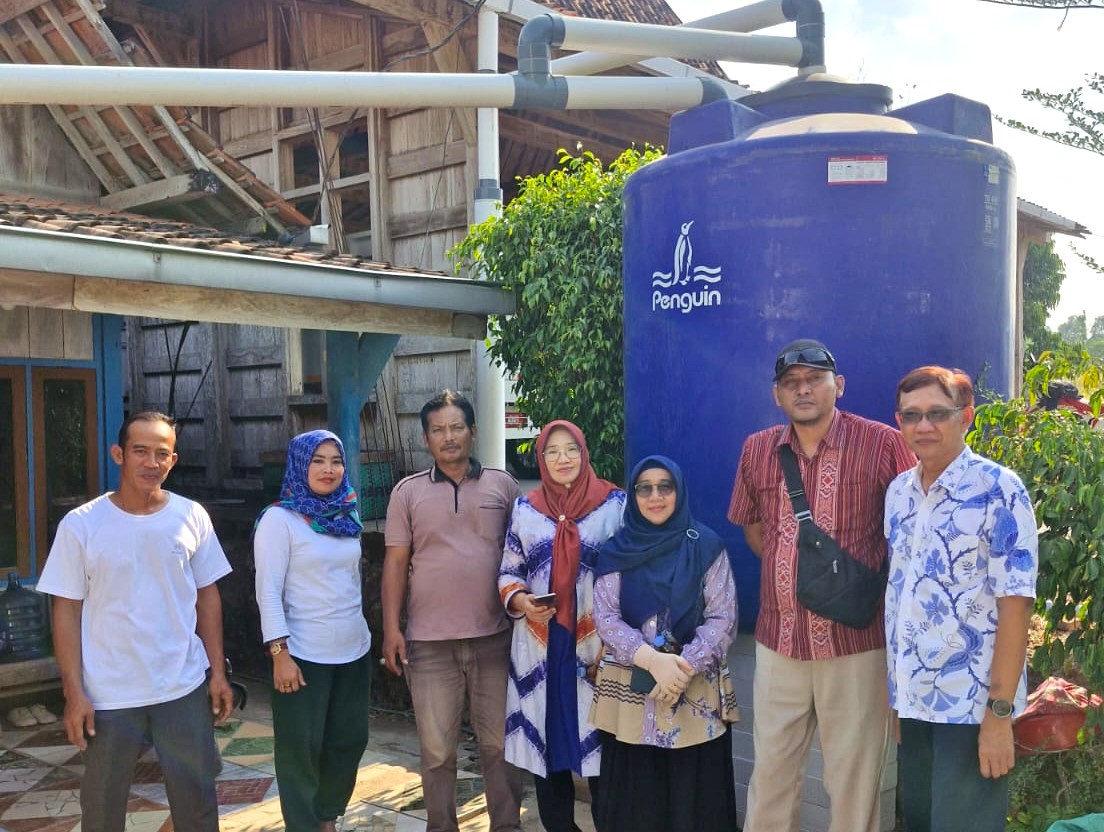
During the second visit, the team conducted a detailed field survey to determine the location for the IPAH installation and the placement of clean water storage tanks. Once the locations were agreed upon, the team and residents constructed a pilot IPAH system together. Local residents were actively involved in the implementation process and received technical guidance from UNNES experts.
The third visit focused on more in-depth socialization and educational sessions concerning rainwater harvesting. The activity took place at the residence of KTHR Pendowo Limo Chairperson Rencono Saputro and was conducted in an informal and participatory atmosphere. Residents and lecturers sat together and engaged in an open discussion about water availability and environmental challenges in their area.
Prof. Tri Marhaeni Pudji Astuti emphasized that rainwater utilization could become part of the solution to Jambangan’s water shortage.
“Rainwater harvesting can be a solution to the water shortage affecting Jambangan Village,” Prof. Marhaeni said.
According to her, rainwater harvesting is not only useful for providing a water reserve during the dry season, but can also serve as part of flood mitigation efforts when the area experiences high rainfall.
“With the support of the IPAH and clean water storage tanks, we hope residents will be willing to maintain them. Ideally, they will also be encouraged to build their own rainwater harvesting systems at home so that the water problem can be addressed more sustainably,” she added.
In addition to constructing the pilot installation, the community service team provided education on the proper maintenance and care of the IPAH system. The training was intended to ensure that the installation remains functional over the long term and that residents have the knowledge and skills to maintain the facilities independently.
The program received a positive response from the local community. Rencono Saputro, Chairperson of KTHR Pendowo Limo, expressed his appreciation for the initiative. He considered the program relevant to the community’s needs and said that residents could directly experience the benefits of collaboration with the university.
“The socialization of the Rainwater Harvesting program is very beneficial. We hope that similar programs can continue to be implemented to support sustainable development in Jambangan Village,” Rencono said.
He also expressed hope that the program could be expanded beyond the initial location and reach other hamlets and neighborhood units within Jambangan Village.
“We hope similar activities can be carried out in other hamlets and neighborhood units so that all residents of Jambangan Village can benefit from the assistance provided by UNNES,” he added.
The program concluded with a group photo involving residents and the community service team. Beyond the construction of the pilot installation, the initiative is expected to serve as a model for broader community-based water conservation efforts.
The development of IPAH demonstrates how local communities can be involved from the coordination and survey stages through construction and maintenance. Such participation provides residents with practical knowledge and experience in managing water resources within their own environment.
The utilization of rainwater also offers an opportunity to reduce households’ dependence on purchased clean water during prolonged dry periods. At the same time, storing rainwater can help reduce the amount of surface runoff that would otherwise be discharged directly during periods of heavy rainfall.
The program contributes directly to the Sustainable Development Goals (SDGs), particularly SDG 6: Clean Water and Sanitation, through efforts to strengthen access to and sustainable management of water resources. It is also relevant to SDG 11: Sustainable Cities and Communities, by strengthening community resilience in responding to environmental challenges and water scarcity.
The program’s connection to SDG 7: Affordable and Clean Energy is more indirect because the primary resource utilized by the IPAH system is rainwater rather than electricity or another energy source. Nevertheless, the use of relatively simple, low-energy technology to support water management is consistent with the broader principle of developing resource-efficient and sustainable solutions.
Through the development of the rainwater harvesting system, UNNES and the residents of Jambangan Village are working to transform rainwater that was previously underutilized into a manageable and useful resource. The initiative demonstrates how academic knowledge, appropriate technology, and active community participation can be brought together to address local water challenges and strengthen community resilience.