HIMA Sejarah UNNES Launches PITA to Support Female Students’ Comfort on Campus

Universitas Negeri Semarang > Faculty of Social Sciences and Political Science > News > HIMA Sejarah UNNES Launches PITA to Support Female Students’ Comfort on Campus

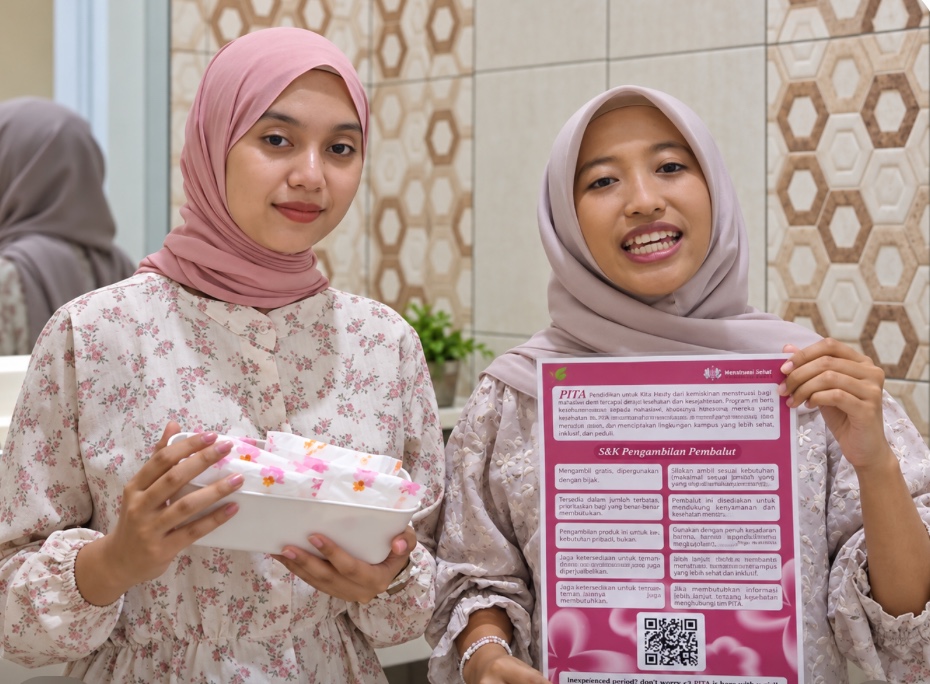
The History Students Association of the Faculty of Social and Political Sciences, Universitas Negeri Semarang (HIMA Sejarah FISIP UNNES), through its Department of Publication, Social Affairs, and Culture, has launched PITA (Pembalut untuk Kita), or Sanitary Pads for Us, a program designed to provide easier access to menstrual products for female students who experience an unexpected period while on campus.

The initiative responds to a practical concern frequently faced by female students in their daily academic lives. Menstruation that begins unexpectedly can cause discomfort and anxiety, particularly when students are attending classes, organizational meetings, or other campus activities. In such situations, they may need to leave campus facilities to find a nearby shop or rely on friends for sanitary pads.

Through PITA, HIMA Sejarah seeks to provide a more accessible source of menstrual products within the campus environment. The availability of sanitary pads is expected to help female students feel more secure and comfortable while continuing their academic and organizational activities.

The idea for PITA originated from student aspirations expressed through DIORAMA (Dialog Ramah Tamah), a forum organized by HIMA Sejarah to facilitate communication between students and the organization’s management. One of the concerns raised during the forum was the need to provide sanitary pads in women’s restrooms as part of basic support for female students.

The Department of Publication, Social Affairs, and Culture subsequently followed up on the proposal and developed it into the PITA program. This process reflects the role of DIORAMA not merely as a forum for discussion, but also as a mechanism for translating student concerns into concrete action.

Beyond addressing an immediate practical need, PITA also carries a broader message about menstrual health. Menstruation is a normal aspect of women’s reproductive health, yet discussions surrounding menstrual needs are still sometimes treated as private or sensitive matters within public and educational spaces.

Dimas Anggoro, S.Pd., M.Pd., faculty adviser to the student associations of the History Education Study Program and the History Study Program, welcomed the initiative as an example of students’ responsiveness to real needs within their campus community.

According to Dimas, student organizations should not function solely as spaces for implementing annual programs. They should also provide opportunities for students to learn how to listen, identify concerns, and respond to the needs of others.

“What may appear simple to some people can be very important to others. PITA shows that students are able to listen to aspirations, understand the needs of female students, and transform those concerns into concrete action,” Dimas said.

He added that attention to menstrual needs should be understood as part of the effort to create a more comfortable and inclusive educational environment.

“A campus should be a place where every student can learn and participate in activities comfortably. Paying attention to the basic needs of female students is part of building a culture of mutual respect that should continue to be strengthened,” he said.

Through PITA, HIMA Sejarah also aims to encourage more open discussion of women’s health. Menstruation should not be regarded as a taboo subject, but rather as a normal health-related matter that deserves appropriate understanding and support.

In the longer term, HIMA Sejarah hopes that PITA will not remain a temporary initiative. The organization expects the program to continue sustainably and to inspire other student organizations at UNNES to pay greater attention to similar needs within the campus community.


Related Posts

Leave a Reply

* Kode Akses Komentar:

* Tuliskan kode akses komentar diatas:

GDPR

  • Privacy Policy

Privacy Policy

At unnes.ac.id, the privacy of our visitors is of extreme importance to us. This privacy policy document outlines the types of personal information that is received and collected by unnes.ac.id and how it is used.

Log Files

Like many other Web sites, unnes.ac.id makes use of log files. The information inside the log files includes internet protocol (IP) addresses, type of browser, Internet Service Provider (ISP), date/time stamp, referring/exit pages, and number of clicks to analyze trends, administer the site, track user’s movement around the site, and gather demographic information. IP addresses and other such information are not linked to any information that is personally identifiable.

Cookies

unnes.ac.id uses cookies to store information about visitors’ preferences, to record user-specific information on which pages the site visitor accesses or visits, and to personalize or customize our web page content based upon visitors’ browser type or other information that the visitor sends via their browser.

Third-party ad servers or ad networks use technology in their respective advertisements and links that appear on unnes.ac.id and which are sent directly to your browser. They automatically receive your IP address when this occurs. Other technologies (such as cookies, JavaScript, or Web Beacons) may also be used by our site’s third-party ad networks to measure the effectiveness of their advertising campaigns and/or to personalize the advertising content that you see on the site.

unnes.ac.id has no access to or control over these cookies that are used by third-party advertisers.

You should consult the respective privacy policies of these third-party ad servers for more detailed information on their practices as well as for instructions about how to opt-out of certain practices. unnes.ac.id’s privacy policy does not apply to, and we cannot control the activities of, such other advertisers or web sites.

If you wish to disable cookies, you may do so through your individual browser options. More detailed information about cookie management with specific web browsers can be found at the browsers’ respective websites.

Consent

By using our website, you hereby consent to our privacy policy and agree to its terms.

Update

This Privacy Policy was last updated on: 2023-02-14. Should we update, amend or make any changes to our privacy policy, those changes will be posted here.

Contact Us

If you have any questions, comments, or concerns about our Privacy Policy or our practices with regards to your personal information, please feel free to contact us through the contact form on our website or by emailing us at humas[at]mail.unnes.ac.id.

This Privacy Policy is intended as a general guide to our practices in collecting and using information. If there is any inconsistency between this Privacy Policy and the terms of the Service Agreement or any other terms that may apply to specific services you use, then those specific service terms shall apply.

Terms of Use

By using our website, you agree to abide by this Privacy Policy. If you do not agree with this Privacy Policy, please do not use our website. We reserve the right to update this Privacy Policy from time to time without prior notice. Please review our Privacy Policy periodically to check for changes. Your continued use of our website following the posting of changes to this Privacy Policy means that you accept the changes.

Thank you for reading our Privacy Policy. We are committed to protecting the privacy of our website visitors and will continue to update our Privacy Policy to ensure optimal protection.