

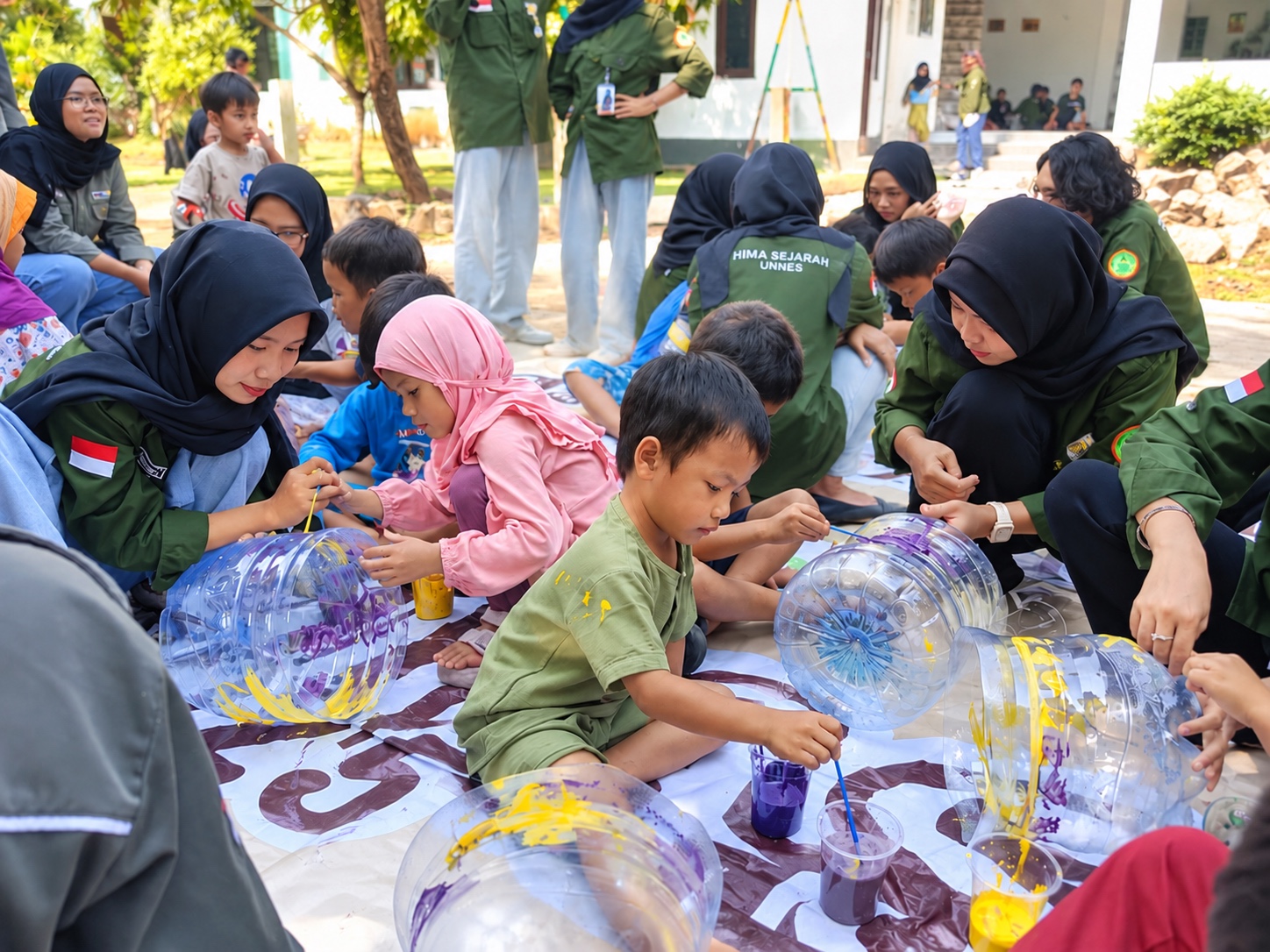
Hands went into the soil as children and university students gathered around makeshift planting pots at the Manarul Mabrur Orphanage. Some of the pots had once been plastic water containers. Now filled with soil, fertilizer and young fruit and vegetable plants, they became part of a small lesson in caring — for the environment and for one another.
The planting was one of a series of activities organized by the History Students Association of Universitas Negeri Semarang (HIMA Sejarah UNNES) as part of its 2026 community service program at the orphanage.
But for the students involved, the program was intended to be more than a campus organization making a brief visit. It was designed as an opportunity to confront a broader question about higher education: how students can translate what they learn at university into empathy and responsibility toward others.
Fatoni Hasan, chairman of HIMA Sejarah UNNES, said the program reflected the humanitarian values embedded in Pancasila, Indonesia’s national philosophy.
“As fellow human beings, we have a responsibility to help one another and bring happiness to others,” Fatoni said. “Through this community service program, we want to put into practice the second principle of Pancasila — a just and civilized humanity.”
That idea shaped activities that brought university students into direct interaction with children at Manarul Mabrur, creating a space not only for service but also for conversation, play and shared experiences.
Aria Al Dzikri, who chaired the organizing committee, said the program was also part of the students’ effort to fulfill the community-service dimension of the Tri Dharma of Higher Education, the three central responsibilities of Indonesian universities.
“We hope this experience can strengthen empathy and social awareness among members of HIMA Sejarah and EXSARA,” Aria said. “Community service should give students an opportunity to understand the people and communities around them.”
For the orphanage, the students’ arrival was welcomed with a hope that the relationship would extend beyond the event itself.
Riki, a representative of the Manarul Mabrur Orphanage, thanked the students for spending time with the children and said he hoped their involvement would have a lasting effect.
“We welcome you wholeheartedly,” Riki told the students. “I hope your presence here will not simply be a one-time community service visit, but something that can provide lasting benefits for the children.”
Dimas Anggoro, S.Pd., M.Pd., faculty adviser to the History Education and History student organizations at UNNES, said experiences of this kind were an important part of preparing students for responsibilities that extend beyond academic achievement.
University students, he said, will eventually occupy positions of responsibility in society. Their education, therefore, should cultivate not only intellectual ability but also an awareness of people whose lives and circumstances may be different from their own.
“University students are future leaders of this nation. Academic ability must go hand in hand with social responsibility,” Dimas said. “They need to learn to see the circumstances of others, to be present for people around them and to care for children who need support and affection, including orphans.”
Leadership, he added, should not be measured solely by a person’s ability to make decisions.
“A good leader must also have empathy and concern for others,” Dimas said. “Those are values that need to be cultivated while they are still students.”
That principle became visible on the second day of the program, when the students and children moved outdoors to plant fruit and vegetable seedlings together.
Rather than purchasing new planting containers, the group reused discarded plastic water gallons as pots. The simple choice introduced the children to the idea that materials often treated as waste can be given another purpose, while also connecting the activity to environmental responsibility and conservation.
The children appeared eager to take part. They handled soil mixed with fertilizer, filled the reused containers and planted the seedlings alongside the university students, seemingly unconcerned about getting their hands dirty.
After the planting activity, the program shifted from environmental awareness to personal health. Students demonstrated proper hand-washing techniques, using the moment after gardening to reinforce everyday habits of cleanliness and healthy living.
The activities were modest: planting seedlings, reusing discarded containers, washing hands and spending time together. Yet organizers said their significance lay precisely in those direct encounters.