

History learning should not stop at memorizing dates, names, and major events. A study conducted at SMP Negeri 2 Semarang shows that students’ historical understanding becomes more meaningful when teachers connect textbook material with social phenomena and experiences that are close to their everyday lives.
The study, conducted on May 19, 2026, examined how historical knowledge is constructed through the curriculum, textbooks, classroom teaching, and students’ learning experiences. The research was conducted by Dhoni Frizky Aryasahab, a Master’s student in Social Studies Education (PIPS), together with researchers from Universitas Negeri Semarang.
The study uses a Foucauldian discourse analysis approach to examine historical knowledge not simply as a collection of objective facts, but as knowledge shaped through processes of selection, representation, and legitimation within educational practices.
Dhoni explained that historical knowledge goes through several stages before it is understood by students.
“Historical knowledge is not simply material transmitted from textbooks to students. The curriculum determines what knowledge is considered important, textbooks represent historical narratives, and teachers reconstruct and contextualize that knowledge through classroom learning,” Dhoni said.
The research found that the Kurikulum Merdeka provides teachers with greater space to interpret historical and social studies material. Rather than emphasizing factual memorization, the curriculum encourages students to understand social change in relation to time and space.
However, the study also found that textbooks remain an important source of historical knowledge in the classroom. The Grade VIII Social Studies textbook generally presents history through chronological narratives, major events, national figures, political developments, and broad social changes.
Such a structure provides students with basic historical information but leaves relatively limited space for alternative narratives and the experiences of particular social groups.
This is where the teacher’s role becomes important.
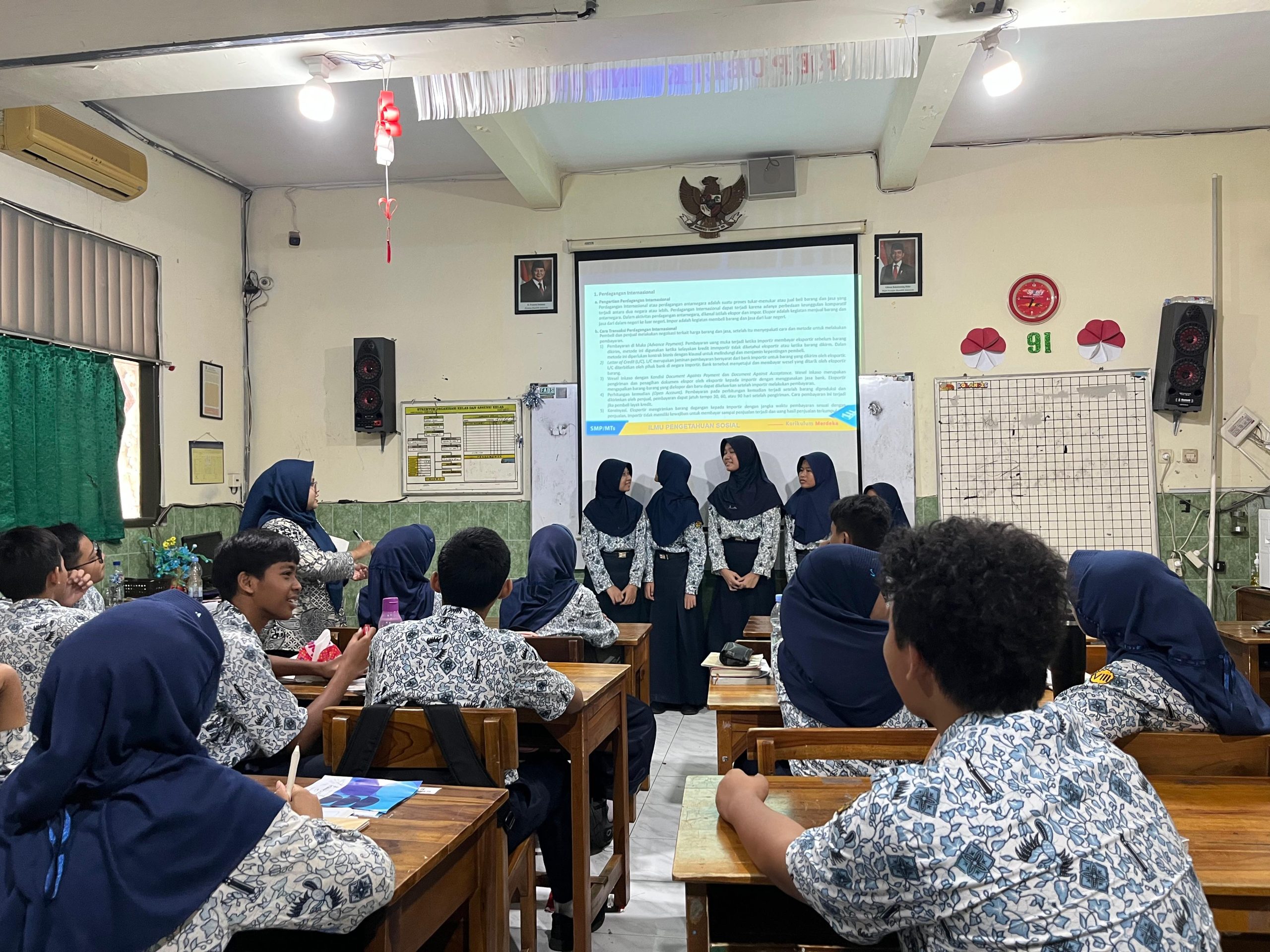
At SMP Negeri 2 Semarang, the teacher does not rely exclusively on the textbook. Classroom observations showed that the teacher adds explanations, connects historical material with social phenomena familiar to students, and uses reflective questions to encourage students to interpret historical events.
“I do not only use the textbook, because if students only read the student book, they usually understand only the basic information. I try to connect the material with examples that are close to their lives so that students understand the meaning of a historical event,” said Rositawati, a teacher at SMP Negeri 2 Semarang.
According to Dhoni, this process demonstrates that teachers are not merely transmitters of knowledge. They also act as interpreters who reconstruct historical narratives in accordance with the learning context and the needs of their students.
“When historical knowledge moves from the curriculum and textbook into the classroom, a process of reconstruction takes place. Teachers determine how a narrative is introduced, which aspects receive emphasis, and how students are encouraged to interpret it,” he said.
The research also found changes in students’ understanding of history. Students who initially perceived history primarily as a subject requiring them to memorize dates and names gradually began to understand why historical events occurred, how they produced social change, and how their consequences remain relevant to the present.
This process encourages students to develop historical thinking through cause-and-effect relationships, perspectives on social change, and connections between the past and the present.
The researchers describe this process as a “Historical Knowledge Construction Chain in Social Studies Learning.” It consists of four stages: the curriculum produces official historical knowledge; textbooks represent historical discourse; teachers reconstruct and contextualize that knowledge through pedagogical practices; and students ultimately construct historical meaning through their learning experiences.
The findings indicate that history education is therefore not a one-way process of transferring information. Historical understanding is constructed through interaction between educational policy, learning materials, teachers, and students.
For Dhoni, the objective of history learning should consequently extend beyond students’ ability to recall what happened in the past.
“What needs to be developed is not only students’ ability to remember what happened, but also their understanding of why an event occurred, how change took place, and how it relates to their lives today,” he said.
The study also contributes to Sustainable Development Goal (SDG) 4 on Quality Education by emphasizing contextual, critical, and meaningful history learning. Connecting historical knowledge with students’ social environment can strengthen their ability to understand the past while developing critical perspectives on contemporary social life.
Ultimately, the study suggests that history learning can become more meaningful when textbooks are treated as a starting point rather than the sole source of knowledge. Through contextualization, reflection, and multiple perspectives, teachers can help students move from simply knowing historical facts to understanding the meaning and relevance of history in their own lives.