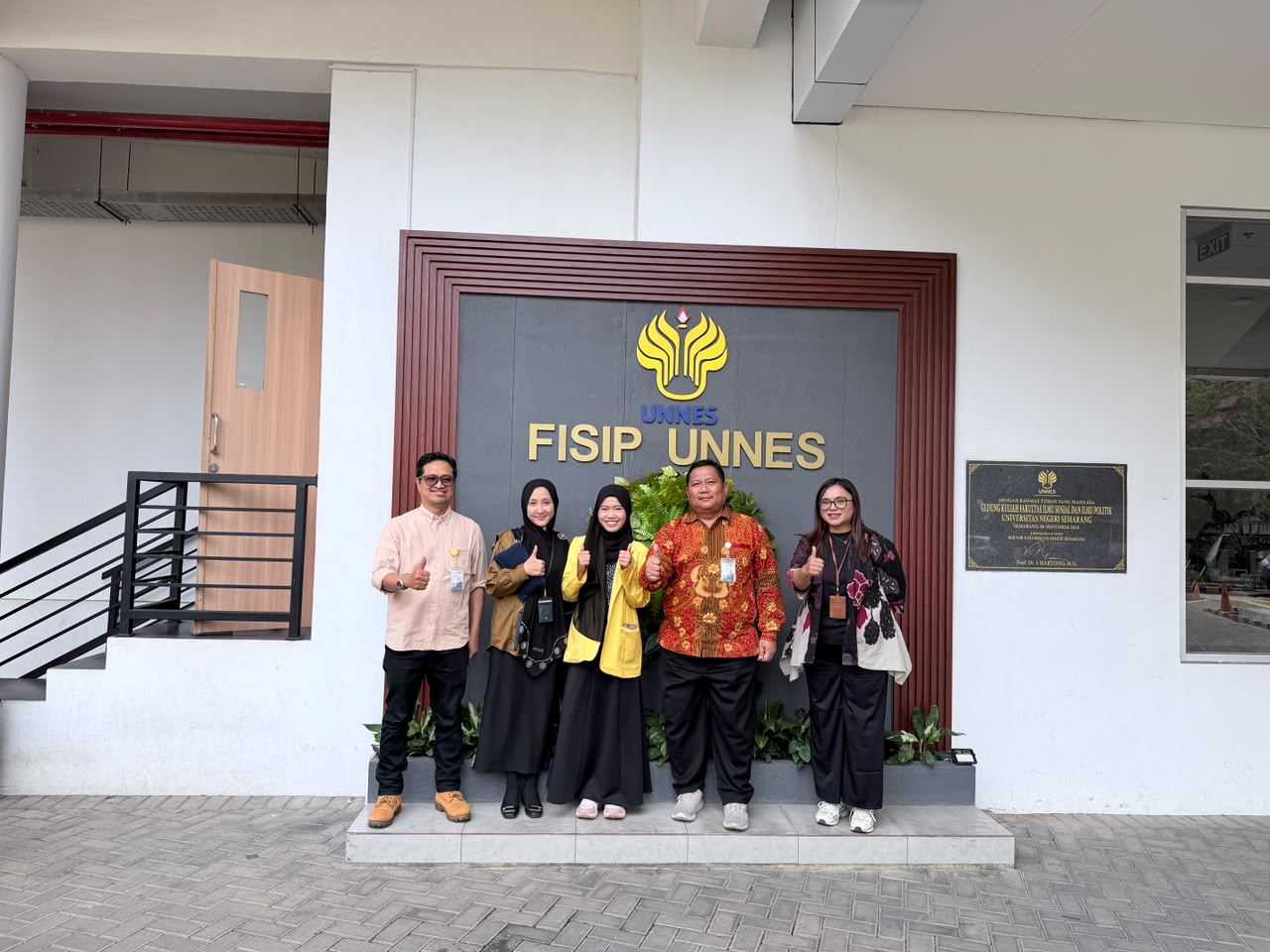
FISIP UNNES Sociology and Anthropology Education Student Wins Silver Medal at the National Jogja Essay Competition

Universitas Negeri Semarang > Faculty of Social Sciences and Political Science > News > FISIP UNNES Sociology and Anthropology Education Student Wins Silver Medal at the National Jogja Essay Competition

Yogyakarta – A student from the Faculty of Social and Political Sciences (FISIP), Universitas Negeri Semarang (UNNES), has once again brought pride to the university through a remarkable academic achievement. Nevia Anggriya Orvala, a student of the Sociology and Anthropology Education Study Program, won the Silver Medal at the National Jogja Essay Competition, organized by the Arabic Literature Student Association of Universitas Gadjah Mada (UGM). The award was announced on July 25, 2026.

Nevia earned the distinction with her essay entitled “Djanur: A Natural Language Processing-Based Digital Journey Assistant for Transforming Local Tourism Towards Golden Indonesia 2045.” The essay presents an innovative concept that utilizes Artificial Intelligence (AI) through Natural Language Processing (NLP) to develop a digital travel assistant capable of providing interactive tourism information, introducing Indonesia’s rich cultural heritage, and enhancing visitors’ travel experiences across destinations throughout the archipelago.

Through this innovation, Nevia highlights the importance of digital transformation in the tourism sector as a strategic approach to strengthening the competitiveness of local tourism while supporting the national vision of Golden Indonesia 2045. The proposed Djanur platform is envisioned as a bridge between technology and cultural preservation by providing accessible, user-oriented, and adaptive tourism information while promoting Indonesia’s local destinations to a broader audience.

This achievement was made possible through the guidance of Harto Wicaksono, S.Pd., M.A., who served as Nevia’s academic advisor. Throughout the preparation process, he provided mentorship in refining the research idea, strengthening its academic substance, and preparing the essay for the national competition.

Harto Wicaksono expressed his appreciation for Nevia’s dedication, creativity, and commitment throughout the writing process. According to him, the achievement demonstrates that students in the social sciences are capable of contributing meaningful innovations by integrating digital technology with socio-cultural perspectives.

“This achievement proves that students are not only capable of understanding social issues but are also able to develop innovative solutions that are relevant to technological advancements and societal needs. I hope this accomplishment will inspire other students to continue producing outstanding work and achieving success at both the national and international levels,” he said.

Nevia’s success further strengthens the culture of innovation, creativity, and academic excellence within FISIP UNNES. Beyond bringing pride to the Sociology and Anthropology Education Study Program, the achievement also reflects UNNES’s commitment to encouraging students to produce research-based innovations that benefit society and contribute to national development.

This accomplishment is also aligned with Universitas Negeri Semarang’s commitment to supporting the Sustainable Development Goals (SDGs). The Djanur innovation contributes to SDG 4 (Quality Education) by fostering creativity, digital literacy, and students’ research competencies. The application of Natural Language Processing (NLP) to promote local tourism also supports SDG 8 (Decent Work and Economic Growth) by strengthening sustainable tourism development, as well as SDG 9 (Industry, Innovation, and Infrastructure) by encouraging digital innovation as part of the transformation of the tourism industry. Furthermore, by promoting Indonesia’s cultural heritage and tourism potential, the project contributes to SDG 11 (Sustainable Cities and Communities) through the preservation of cultural heritage and the advancement of inclusive and sustainable tourism destinations. Through this achievement, FISIP UNNES students have once again demonstrated that knowledge-based innovation can serve as a driving force toward realizing the vision of Golden Indonesia 2045.
Related Posts

Leave a Reply

* Kode Akses Komentar:

* Tuliskan kode akses komentar diatas:

GDPR

  • Privacy Policy

Privacy Policy

At unnes.ac.id, the privacy of our visitors is of extreme importance to us. This privacy policy document outlines the types of personal information that is received and collected by unnes.ac.id and how it is used.

Log Files

Like many other Web sites, unnes.ac.id makes use of log files. The information inside the log files includes internet protocol (IP) addresses, type of browser, Internet Service Provider (ISP), date/time stamp, referring/exit pages, and number of clicks to analyze trends, administer the site, track user’s movement around the site, and gather demographic information. IP addresses and other such information are not linked to any information that is personally identifiable.

Cookies

unnes.ac.id uses cookies to store information about visitors’ preferences, to record user-specific information on which pages the site visitor accesses or visits, and to personalize or customize our web page content based upon visitors’ browser type or other information that the visitor sends via their browser.

Third-party ad servers or ad networks use technology in their respective advertisements and links that appear on unnes.ac.id and which are sent directly to your browser. They automatically receive your IP address when this occurs. Other technologies (such as cookies, JavaScript, or Web Beacons) may also be used by our site’s third-party ad networks to measure the effectiveness of their advertising campaigns and/or to personalize the advertising content that you see on the site.

unnes.ac.id has no access to or control over these cookies that are used by third-party advertisers.

You should consult the respective privacy policies of these third-party ad servers for more detailed information on their practices as well as for instructions about how to opt-out of certain practices. unnes.ac.id’s privacy policy does not apply to, and we cannot control the activities of, such other advertisers or web sites.

If you wish to disable cookies, you may do so through your individual browser options. More detailed information about cookie management with specific web browsers can be found at the browsers’ respective websites.

Consent

By using our website, you hereby consent to our privacy policy and agree to its terms.

Update

This Privacy Policy was last updated on: 2023-02-14. Should we update, amend or make any changes to our privacy policy, those changes will be posted here.

Contact Us

If you have any questions, comments, or concerns about our Privacy Policy or our practices with regards to your personal information, please feel free to contact us through the contact form on our website or by emailing us at humas[at]mail.unnes.ac.id.

This Privacy Policy is intended as a general guide to our practices in collecting and using information. If there is any inconsistency between this Privacy Policy and the terms of the Service Agreement or any other terms that may apply to specific services you use, then those specific service terms shall apply.

Terms of Use

By using our website, you agree to abide by this Privacy Policy. If you do not agree with this Privacy Policy, please do not use our website. We reserve the right to update this Privacy Policy from time to time without prior notice. Please review our Privacy Policy periodically to check for changes. Your continued use of our website following the posting of changes to this Privacy Policy means that you accept the changes.

Thank you for reading our Privacy Policy. We are committed to protecting the privacy of our website visitors and will continue to update our Privacy Policy to ensure optimal protection.