

Magelang – Organic waste, often regarded merely as an environmental burden, holds significant potential to enhance food security and promote sustainable agriculture when managed properly. Inspired by this perspective, the Community Service Team (PkM) of Universitas Negeri Semarang (UNNES) implemented a community empowerment program in Munggangsari Village, Kaliangkrik District, Magelang Regency, on 24 June 2026. Through an educational and participatory approach, the program aimed to strengthen the community’s capacity to convert organic waste into compost while improving agricultural productivity and environmental sustainability.
The community service program was led by Muhammad Fauzan Ramadhan, S.Si., M.Sc., together with Prof. Dr. Eva Banowati, M.Si., Mohammad Syifauddin, S.Pd., M.Pd., Ayu Wulansari Pramita, S.Si., M.T., Halim Sukma Aji, A.Md., Dr. Apik Budi Santoso, M.Si., Sriyanto, S.Pd., M.Pd., and Drs. Saptono Putro, M.Si. The initiative also involved UNNES students—Nasywa Alif Anindya, Ahmad Bayhaqi, and Vivi Nur Hidayah—as part of the university’s commitment to integrating education, research, and community engagement under the Tri Dharma of Higher Education.
Most residents of Munggangsari Village depend on agriculture, particularly vegetable and fruit cultivation, as their primary source of livelihood. However, household organic waste and agricultural residues have not been optimally utilized. In fact, vegetable scraps, fruit peels, leaves, and crop residues can be processed into high-quality organic compost that enriches soil fertility while reducing farmers’ reliance on chemical fertilizers. Recognizing this opportunity, the UNNES team introduced a community assistance program designed to establish a more productive and sustainable organic waste management system.
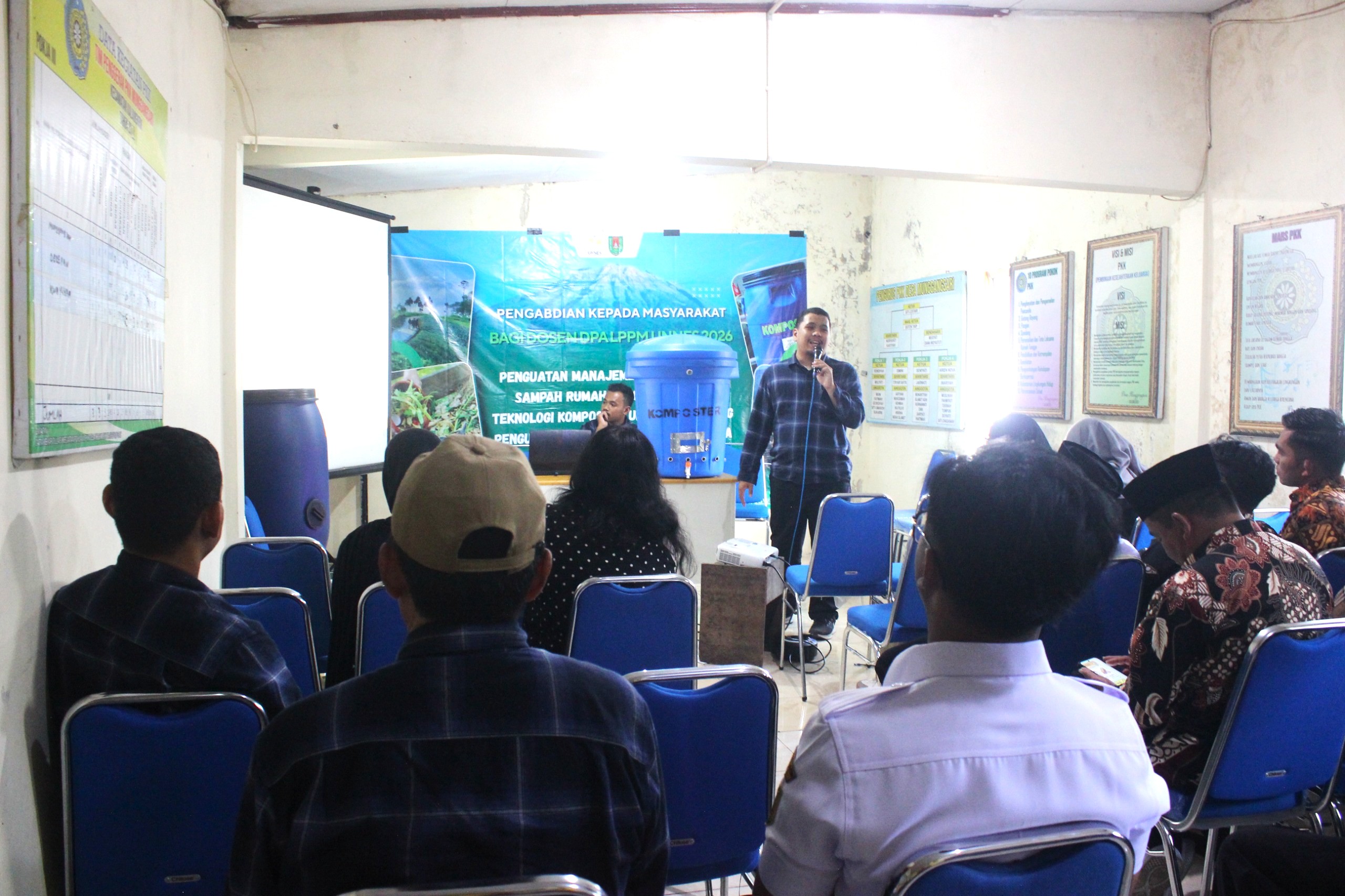
The program began with an educational session highlighting the importance of waste segregation at the household level. Participants learned to distinguish between organic and inorganic waste, understand the environmental consequences of improper waste disposal, and recognize the crucial role of every household in building a sustainable waste management system. The facilitators emphasized that changing community behavior toward waste sorting is the essential first step in fostering environmentally responsible practices.
Following the awareness session, participants took part in hands-on composting training using composting barrels (composters). During the practical workshop, residents learned each stage of the composting process, from selecting suitable organic materials and maintaining proper moisture levels to fermentation techniques and producing ready-to-use organic fertilizer. Various organic materials—including vegetable waste, fruit peels, leaves, and kitchen waste—were used during the demonstration, enabling participants to acquire practical skills that can be applied independently at home or within local farmer groups.
To improve the efficiency of the composting process, the team also introduced an organic waste shredding machine. This equipment reduces the size of organic materials before they are placed in the composter, allowing decomposition to occur more quickly and efficiently. The technology is particularly suitable for Munggangsari Village, where large volumes of agricultural waste are generated during each harvest season. Rather than being discarded or burned, these agricultural residues can now be transformed into valuable organic fertilizer that supports sustainable farming practices.
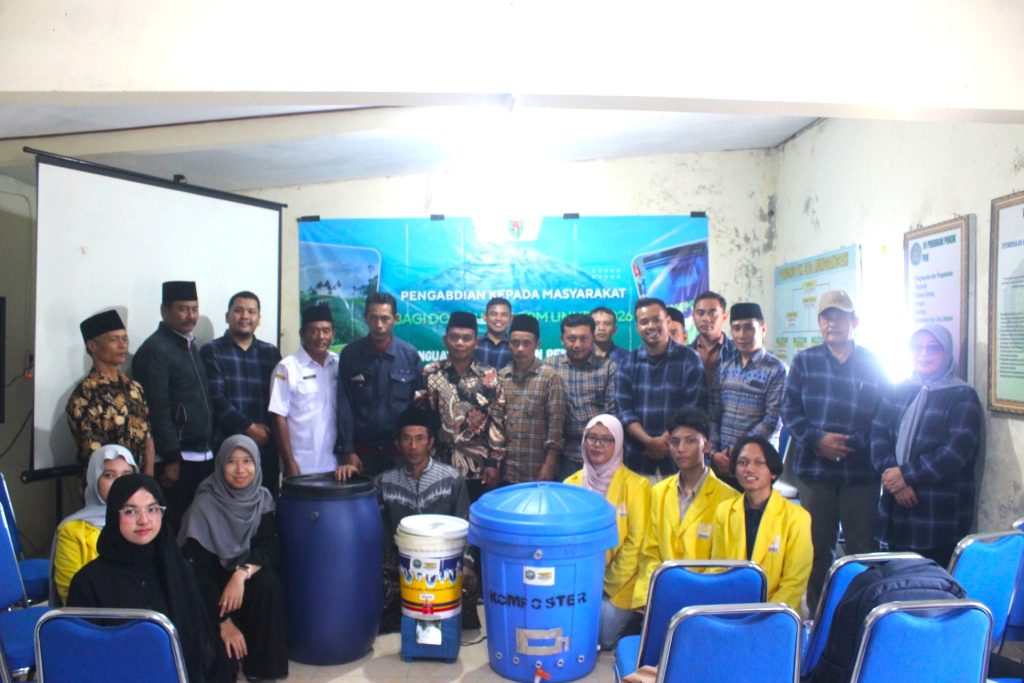
As a tangible commitment to the sustainability of the program, the UNNES Community Service Team donated five composting barrels and two organic waste shredding machines to the Munggangsari Village Government. The equipment is expected to be jointly utilized by local residents, especially farmer groups, to establish a community-based organic waste management system. These facilities will also serve as educational resources, enabling villagers to produce sufficient quantities of compost to support local agricultural needs independently.
The project leader, Muhammad Fauzan Ramadhan, S.Si., M.Sc., explained that organic waste management offers not only environmental benefits but also economic value for rural communities. According to him, waste that has traditionally been viewed as useless can become a productive resource supporting sustainable agriculture. “Through this assistance program, we hope to transform the community’s perception of organic waste—from an environmental problem into a valuable resource that can be processed into high-quality compost to improve agricultural productivity while preserving the environment,” he stated.
The initiative received positive responses from the local community. Suyanto, Head of Munggangsari Village, expressed his appreciation for the program, noting that it had provided residents with new knowledge and motivation regarding organic waste management. He also expressed hope that both the knowledge and the equipment provided would be utilized effectively to generate long-term benefits for the village.
Similarly, Welas, representing the Munggangsari Millennial Farmer Group, emphasized that the composters and shredding machines would significantly assist farmers in processing agricultural waste into valuable organic fertilizer. According to him, the equipment would make farming more efficient, reduce production costs, and support environmentally friendly agricultural practices.
This collaborative initiative between the university, the village government, farmer groups, and the local community is expected to foster a new culture of responsible waste management while strengthening the village’s agricultural sector. The program directly contributes to the achievement of the Sustainable Development Goals (SDGs), particularly SDG 2 (Zero Hunger) by enhancing agricultural productivity and strengthening local food security through the use of organic fertilizer, and SDG 12 (Responsible Consumption and Production) by promoting responsible waste management and the sustainable reuse of organic resources. By increasing public awareness of waste management and sustainable agriculture, Munggangsari Village is expected to become a model for community-based waste management that simultaneously supports productive, environmentally friendly, and sustainable agricultural development.