

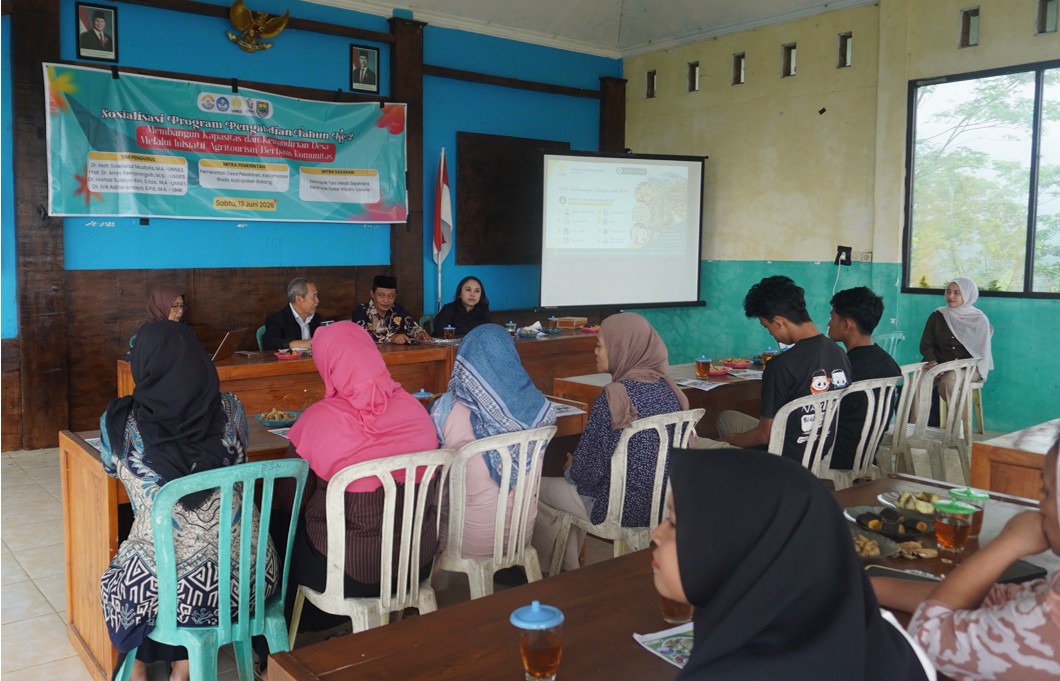
Batang – Universitas Negeri Semarang (UNNES) continues to demonstrate its commitment to community empowerment through its Community Service Program under the Regional Empowerment Scheme (Pemberdayaan Wilayah/PW). Entering the second year of its 2025–2027 multi-year program, the UNNES community service team has resumed its assistance in developing a community-based agrotourism initiative in Pesantren Village, Blado District, Batang Regency.
Funded by the Directorate of Research and Community Service, Directorate General of Research and Development, Ministry of Higher Education, Science, and Technology, the program aims to enhance the capacity of local communities to manage their resources independently, productively, and sustainably. The initiative involves two key community groups: the Melati Sejahtera Farmers Group and the SADESA Tourism Awareness Group (Pokdarwis), with full support from the Pesantren Village Government led by Village Head Sukirno.
The program is led by Dr. Moh. Solehatul Mustofa, M.A., alongside Prof. Dr. Ir. Amin Retnoningsih, M.Si., Dr. Hartati Sulistyo Rini, S.Sos., M.A., and Dr. Erik Aditia Ismaya, S.Pd., M.A. from Universitas Muria Kudus. Students from the Faculty of Social and Political Sciences (FISIP) and the Faculty of Mathematics and Natural Sciences (FMIPA) of UNNES are also actively involved in the community engagement activities.
The achievements of the program’s first year have provided a strong foundation for the development of agrotourism in Pesantren Village. Major accomplishments included the establishment of demonstration plots for premium agricultural commodities, the development of processed agricultural products and local souvenirs, institutional strengthening of community groups, the preparation of Standard Operating Procedures (SOPs), product packaging design, and the optimization of digital promotional media.
In its second year, the program focuses on strengthening agricultural downstream industries, improving tourism area management, diversifying high-value commodities, designing educational tourism routes and packages, and expanding digital marketing strategies. Featured commodities include Butternut Jacqueline and Kabocha pumpkins, lettuce, Red Panama and Golden Panama passion fruit, and Pratama 2 taro, all of which possess strong economic potential and can serve as attractions for educational tourism.
Beyond agricultural development, the program also integrates the village’s natural assets into the tourism concept. A clear-water rocky river area will be combined with educational gardens to create a unique destination that blends agricultural learning, environmental appreciation, and local economic empowerment.
Through this initiative, local residents are encouraged not only to improve agricultural productivity but also to develop skills in tourism management, digital marketing, and community-based entrepreneurship. This approach is expected to generate new and sustainable economic opportunities while strengthening village self-reliance.
The program is closely aligned with UNNES’s commitment to achieving the Sustainable Development Goals (SDGs). It contributes to SDG 8 (Decent Work and Economic Growth) by creating productive employment opportunities, enhancing community economic capacity, and fostering rural entrepreneurship. It also supports SDG 11 (Sustainable Cities and Communities) through the development of sustainable, participatory, and community-driven rural tourism. Furthermore, the initiative advances SDG 12 (Responsible Consumption and Production) by promoting agricultural value-added products and encouraging the efficient use of local resources. The integration of environmental education and natural resource management within the agrotourism area also contributes to SDG 15 (Life on Land) by supporting environmental conservation and sustainable land-use practices.
Through collaboration among the university, village government, farmer groups, tourism communities, and local residents, the program is expected to become a model for community-based agrotourism development that enhances community welfare while promoting inclusive, independent, and sustainable rural development.