

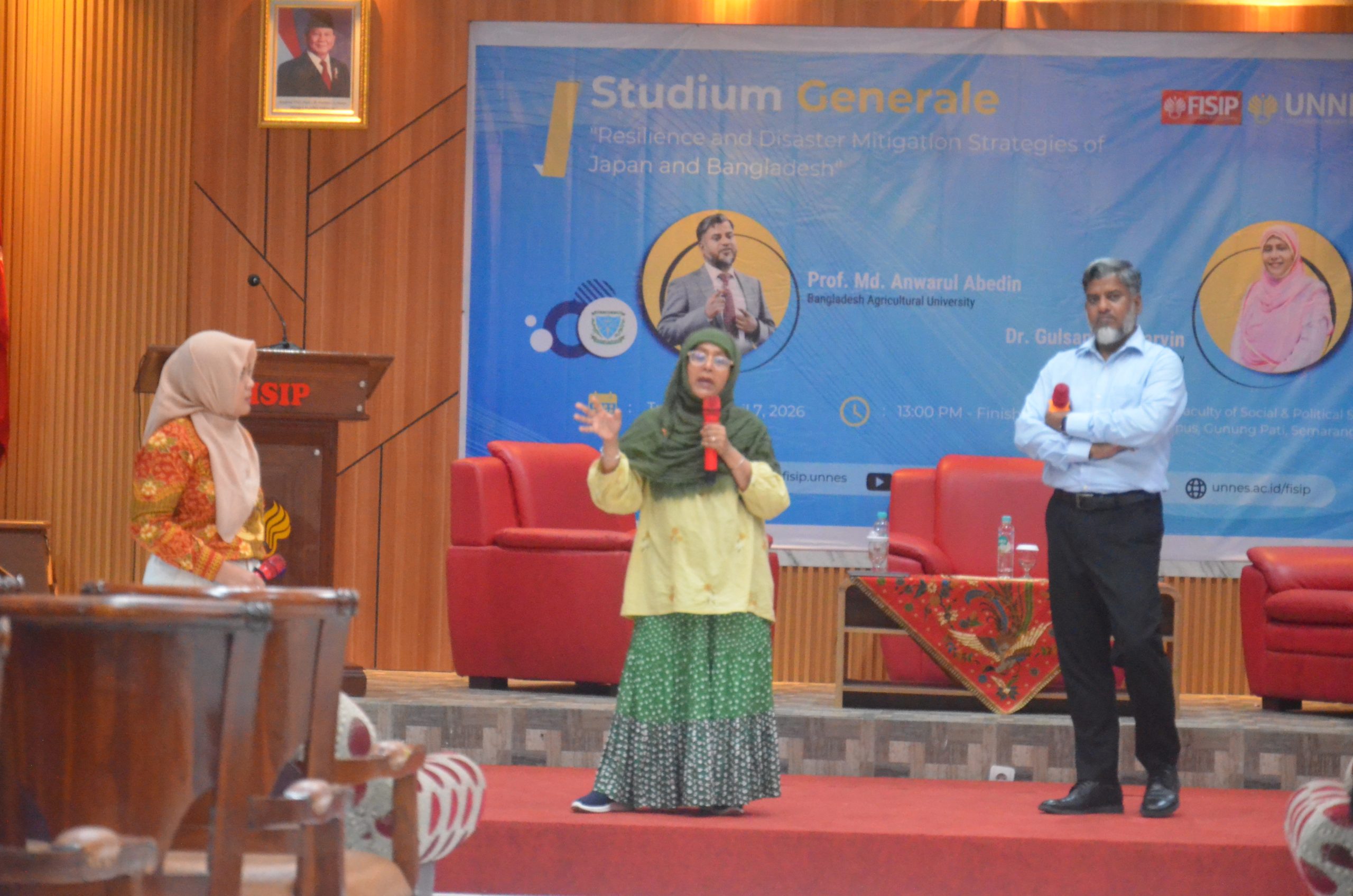
The Department of Geography, Faculty of Social and Political Sciences (FISIP), Universitas Negeri Semarang (UNNES), held an international studium generale focusing on disaster mitigation and community resilience. The event took place at the C7 Building Hall, UNNES, on Tuesday (April 7, 2026).
Carrying the theme “Resilient and Disaster Mitigation Strategies of Japan and Bangladesh,” the lecture featured two international speakers: Prof. Md. Anwarul Abedin, Ph.D. from Bangladesh Agricultural University and Dr. Gulsan Ara Parfin from Ritsumeikan University, Japan.
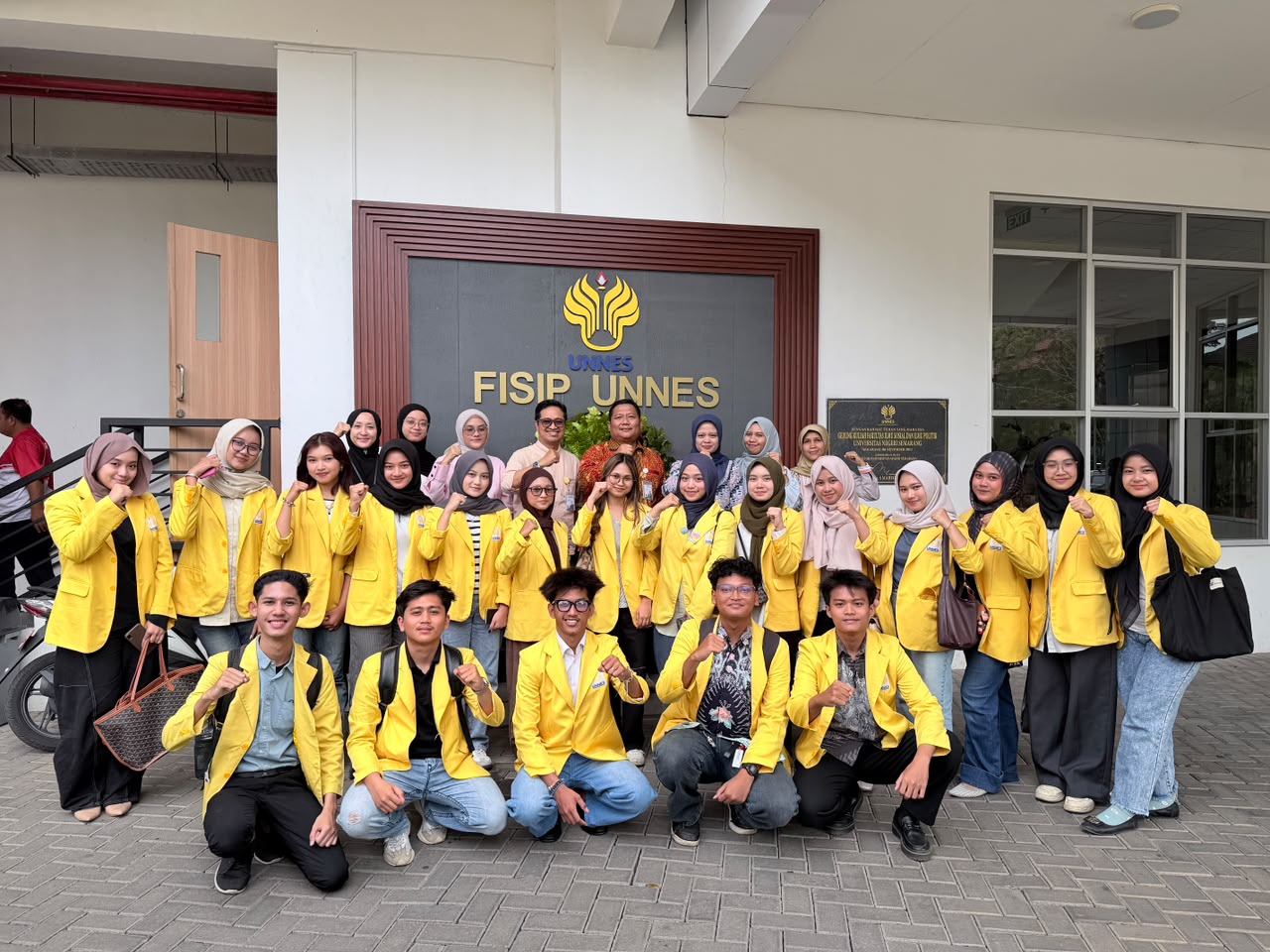
Speaking before hundreds of students, Prof. Anwarul Abedin emphasized the crucial role of young generations in responding to environmental and disaster-related challenges.
“As future leaders, you have a fundamental responsibility to protect the earth, preserve land and water, and ensure sustainability,” he said.
He highlighted issues related to water sustainability and land subsidence in Bangladesh and Indonesia, particularly in the face of extreme weather conditions.
Meanwhile, Dr. Gulsan Ara Parfin explained Japan’s advanced disaster management system, including its strong culture of preparedness in dealing with earthquakes, tsunamis, typhoons, and other natural hazards.
She noted that storms were the most frequent disasters in Japan between 2000 and 2018, followed by earthquakes. However, earthquakes remained the deadliest, especially the 2011 earthquake that triggered a devastating tsunami.
Flooding, on the other hand, affected the largest number of people, followed by storms and earthquakes.
The discussion also covered environmental management, including forest governance. In Japan, a significant portion of forests is privately owned, playing an important role in watershed protection and environmental conservation.
Participants showed strong enthusiasm during the discussion session, particularly when exploring how mitigation strategies from Japan and Bangladesh could be adapted to Indonesia’s context.
Joan Thalita, a Geography Education student, stressed the importance of community involvement in disaster response, especially in water-related disasters. “Community-based initiatives are essential to improve preparedness,” she said.
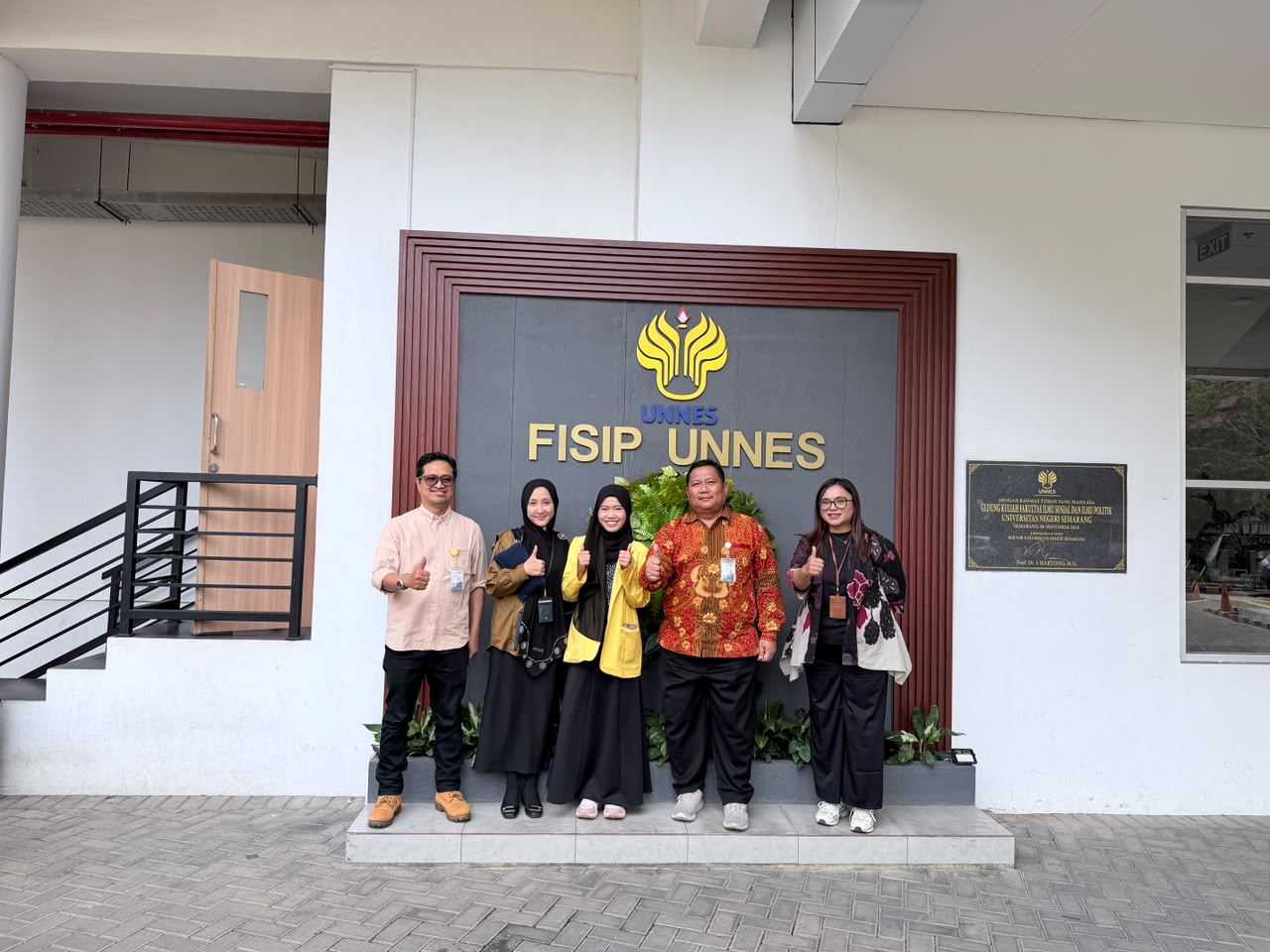
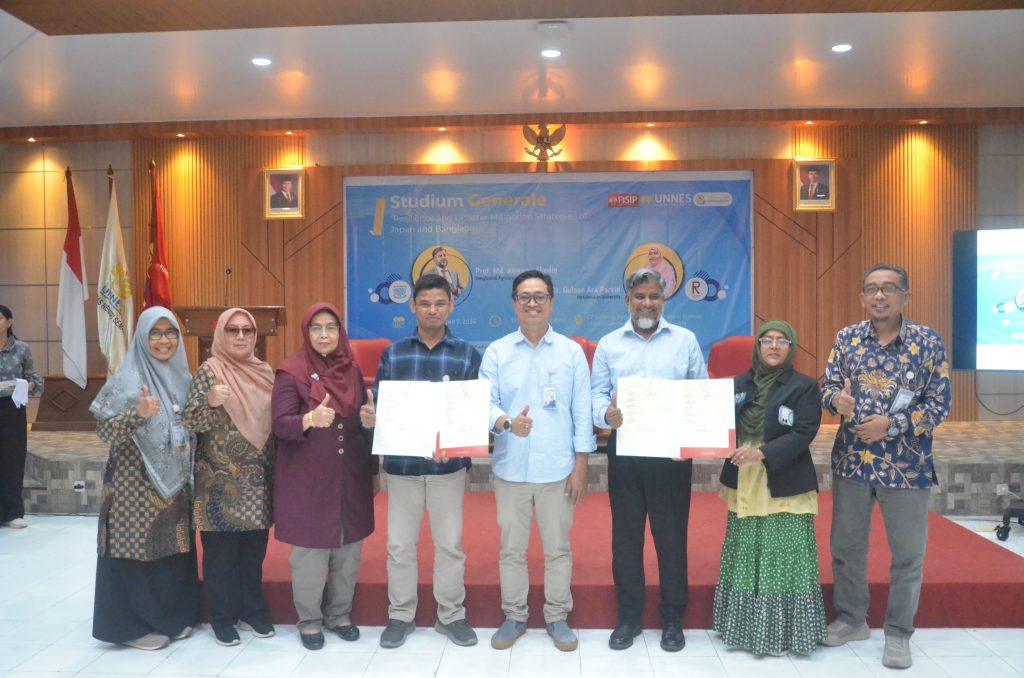
The event also included the signing of a Memorandum of Understanding (MoU) between FISIP UNNES, Bangladesh Agricultural University, and Ritsumeikan University. The agreement was represented by the Vice Dean II of FISIP UNNES, Dr.scient.med. Fadly Husain, S.Sos., M.Si.
This collaboration is expected to strengthen research partnerships, knowledge exchange, and academic cooperation in disaster mitigation.
The seminar also contributes to the achievement of the Sustainable Development Goals (SDGs), particularly in enhancing community resilience and promoting environmental sustainability.