Minister of Culture Opens Exhibition Supported by UNNES History Study Program

Universitas Negeri Semarang > Faculty of Social Sciences and Political Science > News > Minister of Culture Opens Exhibition Supported by UNNES History Study Program

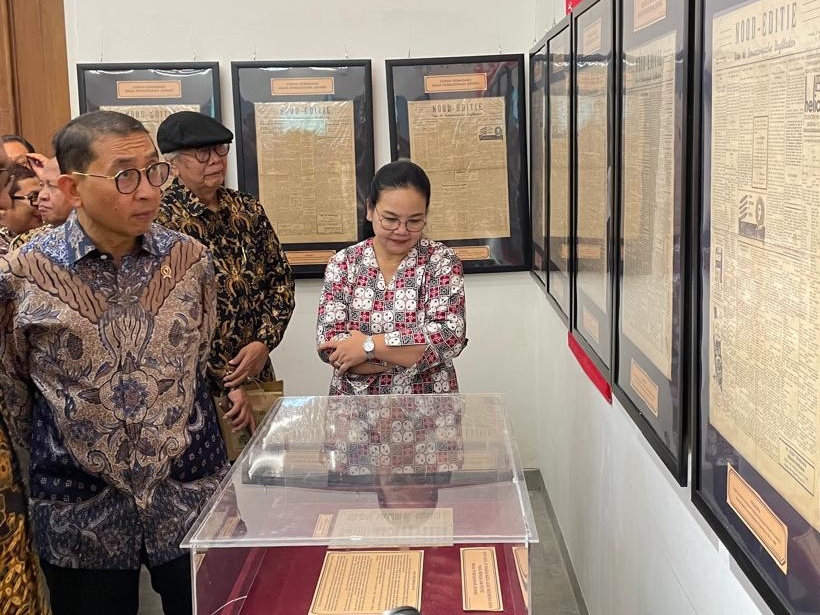
Indonesian Minister of Culture Fadli Zon officially opened the historical archive exhibition “Under the Grip of the Elder Brother: Tracing the Japanese Occupation in Indonesia through Philatelic Archives, 1941–1945” at Rumah Pohan, located in Semarang’s Old Town, on Sunday (May 31, 2026).

The exhibition was organized with the support of the History Study Program of Universitas Negeri Semarang (UNNES) in collaboration with Rumah Pohan. It presents a unique collection of philatelic materials and historical archives that document various aspects of life during the Japanese occupation of Indonesia from 1942 to 1945.

In his opening remarks, Minister Fadli Zon emphasized the importance of philately as a historical source that helps the public understand significant chapters of Indonesia’s past.

“Through philatelic collections, we can observe one of the important episodes in our nation’s history, particularly during the Japanese occupation. These materials reveal how the Japanese administration carried out its colonial rule in a systematic and often harsh manner,” Fadli said.

The exhibition features six series of Japanese occupation-era postage stamps, 26 pieces of occupation currency, 87 postal history items, and 72 archival documents. Together, these collections offer insights into government administration, economic policies, social life, education, and communication systems under Japanese rule.

Among the highlights are stamps depicting Indonesian cultural symbols such as Borobudur Temple, traditional wayang performances, and West Sumatran vernacular architecture. The exhibition also showcases postal cards, censored mail, and official correspondence that illustrate the strict control exercised by the Japanese military administration over public communication.

Beyond philatelic collections, the exhibition explores the role of food production during wartime. Through archival materials and reproductions from the magazine Djawa Baroe, visitors can learn how agriculture became a strategic component of Japan’s war effort in Southeast Asia.

According to Bambang Rakhmanto, lecturer in the History Study Program at UNNES, food production was not merely an economic matter during the occupation period but a crucial element of military logistics.

“For the Japanese military government, rice fields were not only a source of food for the population but also an essential resource for supporting the war effort. Consequently, agricultural production was placed under strict supervision,” he explained.

The exhibition presents documents related to the introduction of Horai rice, agricultural propaganda campaigns, and the compulsory rice delivery system that required farmers to surrender part of their harvest to the colonial administration. These records demonstrate how food production became closely tied to state control and wartime needs.

Semarang Mayor Agustina Wilujeng Pramestuti expressed particular interest in the exhibition section dedicated to food policies during the occupation. She noted that the topic resonated with her previous research on food and Indonesia’s struggle for independence.

“This section is particularly interesting because I have conducted research on food in the context of Indonesia’s struggle. It provides valuable perspectives on how food became an integral part of people’s daily resistance and survival,” she said.

By bringing together stamps, currency, postal materials, and archival records, the exhibition offers visitors a comprehensive view of Japanese occupation policies and their impact on Indonesian society. More importantly, it highlights the resilience of ordinary people who endured hardship while navigating a period marked by war, surveillance, and scarcity.

The exhibition will remain open to the public for eight days, from May 31 to June 7, 2026, at Rumah Pohan in Semarang’s historic Old Town district.
Related Posts

Leave a Reply

* Kode Akses Komentar:

* Tuliskan kode akses komentar diatas:

GDPR

  • Privacy Policy

Privacy Policy

At unnes.ac.id, the privacy of our visitors is of extreme importance to us. This privacy policy document outlines the types of personal information that is received and collected by unnes.ac.id and how it is used.

Log Files

Like many other Web sites, unnes.ac.id makes use of log files. The information inside the log files includes internet protocol (IP) addresses, type of browser, Internet Service Provider (ISP), date/time stamp, referring/exit pages, and number of clicks to analyze trends, administer the site, track user’s movement around the site, and gather demographic information. IP addresses and other such information are not linked to any information that is personally identifiable.

Cookies

unnes.ac.id uses cookies to store information about visitors’ preferences, to record user-specific information on which pages the site visitor accesses or visits, and to personalize or customize our web page content based upon visitors’ browser type or other information that the visitor sends via their browser.

Third-party ad servers or ad networks use technology in their respective advertisements and links that appear on unnes.ac.id and which are sent directly to your browser. They automatically receive your IP address when this occurs. Other technologies (such as cookies, JavaScript, or Web Beacons) may also be used by our site’s third-party ad networks to measure the effectiveness of their advertising campaigns and/or to personalize the advertising content that you see on the site.

unnes.ac.id has no access to or control over these cookies that are used by third-party advertisers.

You should consult the respective privacy policies of these third-party ad servers for more detailed information on their practices as well as for instructions about how to opt-out of certain practices. unnes.ac.id’s privacy policy does not apply to, and we cannot control the activities of, such other advertisers or web sites.

If you wish to disable cookies, you may do so through your individual browser options. More detailed information about cookie management with specific web browsers can be found at the browsers’ respective websites.

Consent

By using our website, you hereby consent to our privacy policy and agree to its terms.

Update

This Privacy Policy was last updated on: 2023-02-14. Should we update, amend or make any changes to our privacy policy, those changes will be posted here.

Contact Us

If you have any questions, comments, or concerns about our Privacy Policy or our practices with regards to your personal information, please feel free to contact us through the contact form on our website or by emailing us at humas[at]mail.unnes.ac.id.

This Privacy Policy is intended as a general guide to our practices in collecting and using information. If there is any inconsistency between this Privacy Policy and the terms of the Service Agreement or any other terms that may apply to specific services you use, then those specific service terms shall apply.

Terms of Use

By using our website, you agree to abide by this Privacy Policy. If you do not agree with this Privacy Policy, please do not use our website. We reserve the right to update this Privacy Policy from time to time without prior notice. Please review our Privacy Policy periodically to check for changes. Your continued use of our website following the posting of changes to this Privacy Policy means that you accept the changes.

Thank you for reading our Privacy Policy. We are committed to protecting the privacy of our website visitors and will continue to update our Privacy Policy to ensure optimal protection.