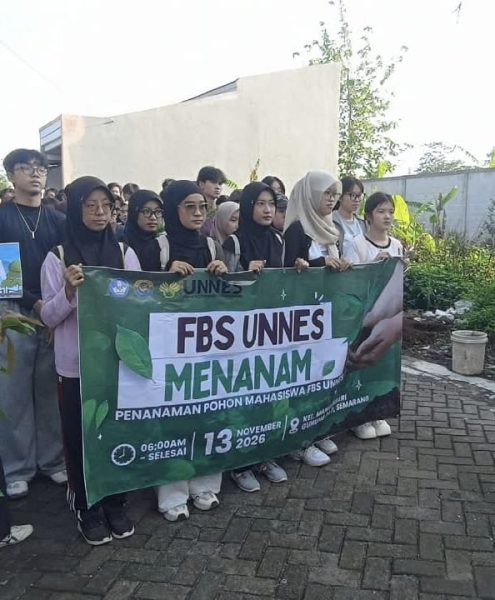


A total of 825 students from the Faculty of Languages and Arts (FBS) at Universitas Negeri Semarang (UNNES) planted 250 trees in Mangunsari, Gunungpati District, Semarang, on Friday, November 13, 2026, as part of efforts to mitigate climate change, protect local ecosystems, and strengthen the university’s commitment to environmental conservation.
The initiative aimed to increase vegetation cover, improve water infiltration, and support environmental sustainability in Gunungpati, an area that plays an important ecological role in Semarang.
As urban development, land-use changes, and climate-related challenges continue to place pressure on the environment, maintaining green spaces in Gunungpati has become increasingly important.
The students planted 250 saplings comprising various species of fruit-bearing and hardwood trees, including durian, mango, and longan. The diversity of vegetation is expected to provide long-term ecological benefits while potentially creating economic opportunities for local communities.
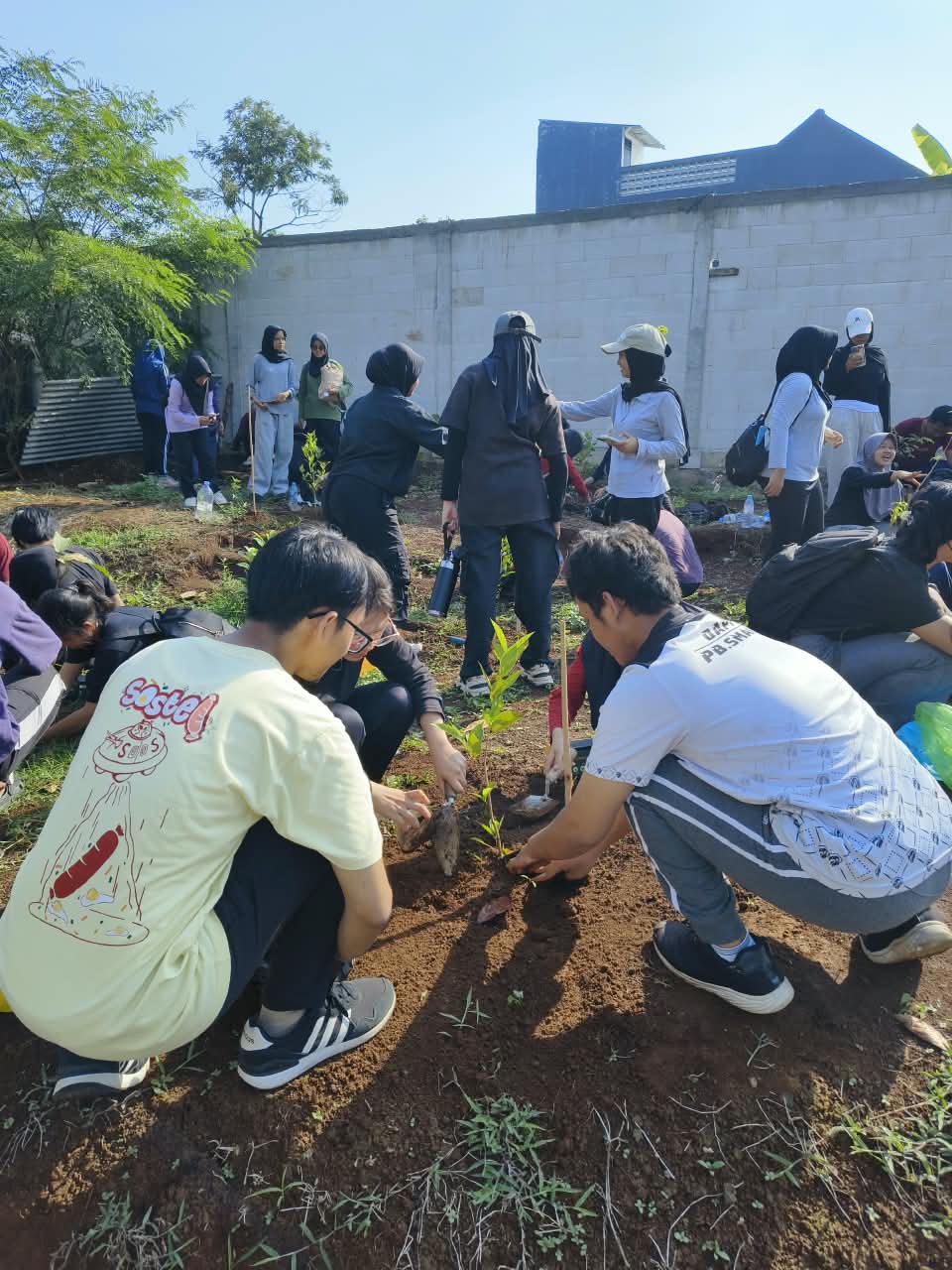
From early morning, hundreds of students worked together on open land near rice fields and residential areas. They dug planting holes, positioned the saplings, covered their roots with soil, and installed bamboo stakes to support the young trees.
The collective effort demonstrated how university students can contribute to addressing environmental challenges through practical and sustained action.
Tree Planting as a Climate Change Mitigation Strategy
Tree planting is widely recognized as a nature-based approach that can contribute to climate change mitigation.
As trees grow, they absorb carbon dioxide through photosynthesis and store carbon in their biomass, potentially helping reduce atmospheric greenhouse gas concentrations over time.
Beyond carbon sequestration, trees can also improve local microclimatic conditions. Their canopies provide shade, reduce direct solar exposure to the ground, and help regulate temperatures in surrounding areas.
In Gunungpati, increasing vegetation cover is particularly relevant to maintaining water infiltration and soil stability.
Tree root systems can help improve soil structure, facilitate water absorption under suitable conditions, and reduce the risk of erosion.
These environmental benefits are especially important in areas where agricultural land, residential settlements, and green spaces coexist.
However, the ecological benefits of tree planting depend on several factors, including species suitability, soil conditions, water availability, and long-term maintenance.
Ensuring that newly planted trees survive and grow successfully is therefore essential to achieving meaningful environmental outcomes.
Acting Dean: Conservation Must Become a Shared Commitment
Acting Dean of FBS UNNES, Prof. Heri Yanto, M.B.A., Ph.D., emphasized that student participation in environmental initiatives reflects the responsibility of higher education institutions to cultivate ecological awareness and social responsibility.
“Climate change is a shared challenge that requires awareness and concrete action from all sectors of society, including universities. Through this tree-planting initiative, we want students to understand that protecting the environment is not merely an institutional obligation, but a responsibility shared by every individual to safeguard the well-being of future generations,” he said.
According to him, UNNES’s identity as a Conservation University must be reflected in educational activities that provide students with opportunities to engage directly in environmental protection.
Higher education, he noted, should not focus solely on academic knowledge and professional skills, but should also develop environmentally responsible individuals who are aware of their roles in society.
He described the participation of 825 students as evidence of the potential of young people to contribute meaningfully to environmental conservation.
“University students must become part of the solution to environmental challenges. We hope this tree-planting experience will not end as a one-time activity, but will develop into a lasting commitment to protecting nature. Conservation values should influence how students think, create, and act, including those studying languages, literature, and the arts,” he added.
Prof. Heri Yanto also expressed hope that the initiative would strengthen cooperation between the university and surrounding communities through a shared commitment to environmental sustainability.
Vice Dean I: Conservation Education Requires Real-World Experience
Vice Dean I of FBS UNNES, Dr. Eko Raharjo, M.Hum., highlighted the educational value of involving students directly in environmental conservation activities.
He explained that practical experiences help students connect academic knowledge with environmental responsibility and develop a deeper understanding of the relationship between human activities and ecological sustainability.
“Conservation education cannot be limited to concepts and theories discussed in classrooms. Students need firsthand experiences to understand that every human action has consequences for the environment. Through this initiative, they learn about responsibility, cooperation, and the importance of maintaining ecological balance,” he said.
According to Dr. Eko Raharjo, experiential learning can strengthen students’ understanding of environmental challenges while encouraging them to become more actively involved in addressing these issues.
The participation of students from different study programs also demonstrated that environmental concerns extend beyond any single academic discipline.
Students specializing in languages, literature, and the arts can contribute to environmental protection through education, public communication, creative works, and community engagement.
“FBS students have considerable potential to communicate conservation messages through language, literature, performing arts, and various creative media. We hope this tree-planting experience will broaden their perspectives so that environmental awareness is reflected not only in practical activities but also in their academic work and creative contributions to society,” he added.
He further emphasized the importance of sustaining the initiative through tree maintenance and continued environmental education.
Protecting Gunungpati’s Ecological Functions
The selection of Mangunsari as the planting site reflected the importance of maintaining environmental quality in the Gunungpati area.
Green spaces in this part of Semarang contribute to ecological balance by supporting water infiltration, protecting soil, and providing habitats for various organisms.
Planting fruit-bearing and hardwood trees near agricultural land and residential areas is expected to increase vegetation diversity and strengthen the local green landscape.
Over time, successfully established trees may develop into a broader canopy that provides shade, supports soil conservation, and improves the visual quality of the surrounding environment.
Fruit-bearing species such as mango, durian, and longan may also offer economic benefits to local residents once the trees reach maturity.
Nevertheless, the long-term success of the initiative will depend on proper maintenance after planting.
Regular watering, weed management, sapling protection, and growth monitoring are important measures to ensure that the trees survive and develop.
The planting of 250 trees is therefore expected to serve as an initial step toward a sustained conservation effort rather than a ceremonial activity.
Supporting SDG 13 and SDG 15 Through Student Action
The initiative also aligned with the United Nations Sustainable Development Goals (SDGs), particularly SDG 13 (Climate Action) and SDG 15 (Life on Land).
Its contribution to SDG 13 was reflected in efforts to increase vegetation cover, which may support carbon sequestration and improve local microclimatic conditions over time.
The activity also provided an educational opportunity to raise students’ awareness of climate change mitigation and adaptation.
Meanwhile, its contribution to SDG 15 was demonstrated through the planting of diverse tree species that can help maintain soil quality, increase vegetation cover, and support terrestrial ecosystems.
The initiative illustrated how universities can mobilize students to address environmental challenges through collaborative action and community engagement.
The participation of 825 students also demonstrated that conservation initiatives can begin within university communities and extend to surrounding areas where environmental protection is equally important.
Through the planting of 250 trees in Mangunsari, FBS UNNES reaffirmed that responding to climate change requires sustained collective action.
Environmental conservation is not simply about increasing the number of trees planted, but also about developing a shared commitment to protecting ecosystems and ensuring their long-term sustainability.
By integrating education, social responsibility, and environmental action, FBS UNNES continues to strengthen its contribution to UNNES’s vision as a Conservation University while encouraging the development of environmentally conscious graduates committed to a more sustainable future.