


The Faculty of Languages and Arts (FBS), Universitas Negeri Semarang (UNNES), is expanding its international engagement through a strategic collaboration with the University of Melbourne (UoM), Australia. The partnership focuses on collaborative research in Indonesian for Speakers of Other Languages (BIPA) and the proposed establishment of a “Semarang Corner” as a platform for promoting Indonesian language and culture in Australia.
The collaboration was initiated by Dr. Wati Istanti, S.Pd., M.Pd., a lecturer at FBS UNNES, through a research partnership scheme involving a QS Top 100 university. The University of Melbourne, ranked 19th globally in the QS World University Rankings, was selected as a strategic partner for the initiative.
The collaborative research project, titled “Digital BIPA Textbook Based on Historical Literature Documentary Films: An Innovative Model for Strengthening Indonesia–Australia Strategic Relations within the Framework of SDG 17,” focuses on developing innovative digital learning materials for BIPA. By incorporating documentary films on historical literature, the project seeks to combine language learning with cultural and historical understanding while strengthening academic and cultural ties between Indonesia and Australia.
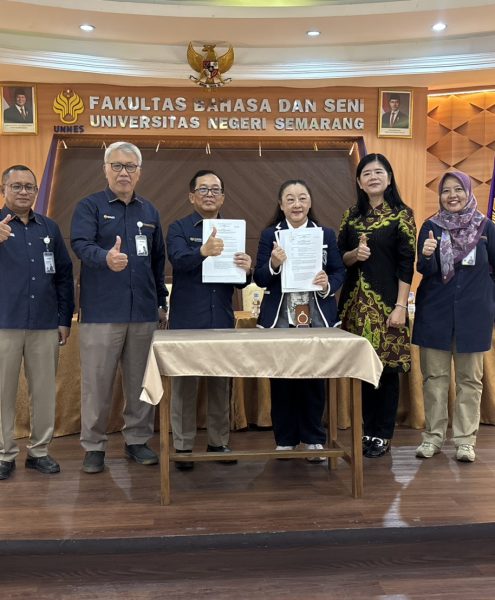
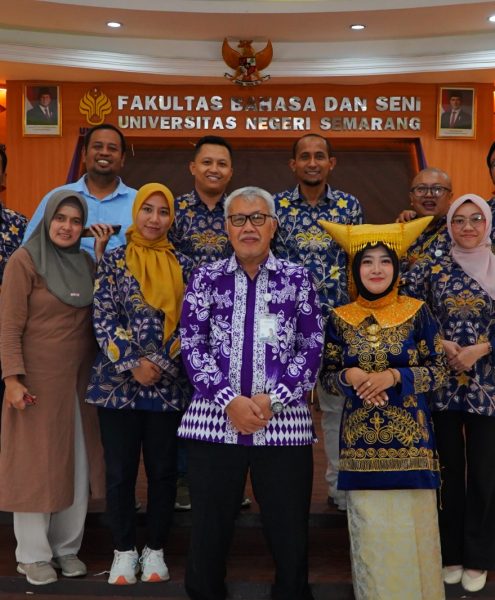
The research initiative was further strengthened through an in-person meeting between FBS UNNES and the University of Melbourne at the FBS UNNES campus in Semarang on June 11, 2026. The meeting brought together Justin Wejak, M.A., Ph.D., Head of the Indonesian Studies Program at the Faculty of Arts, University of Melbourne, and representatives of the Indonesian Literature Study Program at FBS UNNES.
Discussions focused on developing the partnership beyond a single research project toward sustainable collaboration in education, research, BIPA teaching, and the international promotion of Indonesian language, literature, and culture.
Dr. Wati Istanti said the joint research was designed to bring together innovation in BIPA teaching and cultural diplomacy within a broader framework of international academic collaboration.
“The development of a digital BIPA textbook based on historical literature documentary films is not only intended to provide innovative learning materials for learners of Indonesian. It also offers a contextual way of introducing Indonesia’s history, literature, and culture to international audiences. Through our collaboration with the University of Melbourne, we hope to strengthen academic engagement as well as the broader strategic relationship between Indonesia and Australia,” she said.
Suseno, S.Pd., M.A., Coordinator of the Indonesian Literature Study Program at FBS UNNES, welcomed the initiative and highlighted its potential to develop into broader institutional cooperation. One of the initiatives being explored is the establishment of a “Semarang Corner” at the University of Melbourne as a platform for introducing Indonesian language, literature, arts, and culture, with particular emphasis on the cultural heritage of Semarang and Central Java.
“This collaboration demonstrates the strong potential of FBS UNNES’s academic expertise within international networks. BIPA research serves as an important entry point for broader cooperation. We hope the Semarang Corner can eventually become a space for learning and cultural exchange that brings Indonesia and Australia closer together,” Suseno said.
Justin Wejak, M.A., Ph.D., Head of the Indonesian Studies Program at the Faculty of Arts, University of Melbourne, also welcomed the prospect of further collaboration. FBS UNNES’s expertise in language, literature, BIPA teaching, and local cultural studies offers significant potential to support the development of Indonesian language learning and cultural engagement in Australia.
The partnership is strategically significant as it connects FBS UNNES with one of the world’s leading universities. It also demonstrates how faculty-led research can serve as a gateway to wider international cooperation, ranging from joint knowledge production and learning-material development to academic exchange and language and cultural diplomacy.
The initiative directly supports Sustainable Development Goal (SDG) 17: Partnerships for the Goals by strengthening global academic partnerships between UNNES and the University of Melbourne. It also contributes to SDG 4: Quality Education through innovation in digital BIPA learning materials and SDG 11: Sustainable Cities and Communities by promoting the appreciation and preservation of local literary, historical, and cultural heritage in international learning contexts.
Through this collaboration, FBS UNNES reaffirms its commitment to promoting impactful, globally oriented research. The partnership with the University of Melbourne is expected not only to produce a digital BIPA textbook based on documentary films but also to create opportunities for joint research, knowledge exchange, stronger Indonesian language education, and the development of the Semarang Corner as a hub for Indonesian cultural diplomacy in Australia.
The collaboration marks another step in FBS UNNES’s efforts to bring Indonesian language, literature, and culture into the global academic sphere while fostering sustainable international partnerships in line with the spirit of SDG 17.