

In many villages across Bima Regency, West Nusa Tenggara, women’s migration for overseas employment has become an important strategy for improving family livelihoods. The money they send home enables families to finance their children’s education, renovate houses, and invest in their future.
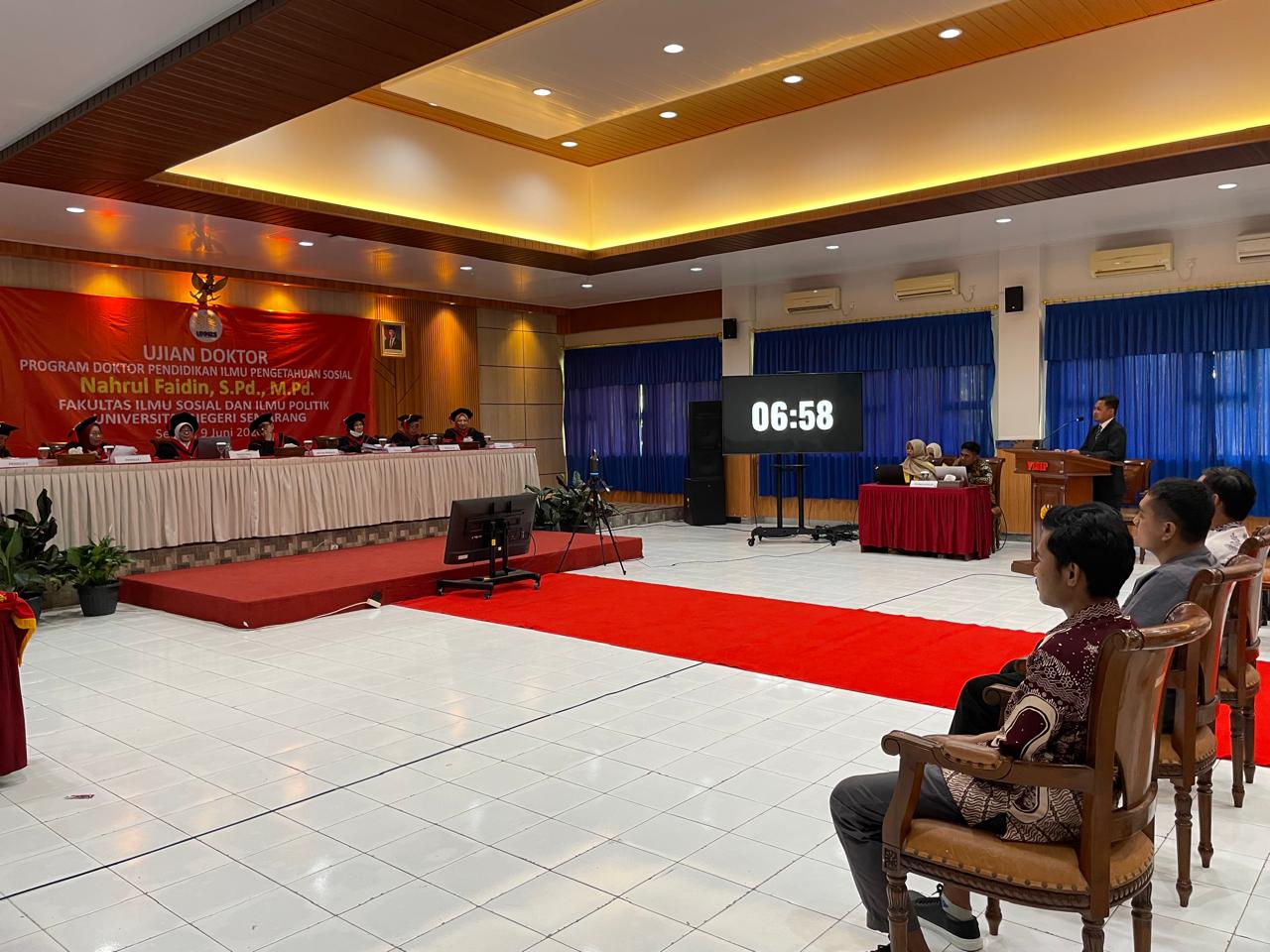
Behind these economic achievements, however, lies a less visible challenge: how children grow and develop when their mothers are present only from afar. This question led Nahrul Faidin to earn a doctoral degree during the public defense of his dissertation at the Doctoral Program in Social Science Education, Faculty of Social and Political Sciences, Universitas Negeri Semarang (UNNES), held at the FISIP UNNES Hall in Sekaran, Gunungpati, Semarang, on June 9, 2026.
Through his dissertation, entitled Strategies for Shaping Children’s Social Behavior in the Family Interactions of Female Migrant Workers in Langgudu District, Bima Regency, Nahrul sought to understand the social life of female migrant-worker families while formulating strategies to foster children’s social behavior.
The research was conducted in Langgudu District, the largest contributor of female migrant workers in Bima Regency. Between 2021 and 2025, a total of 524 women from the district were recorded as working abroad. This phenomenon has brought significant changes to family structures and parenting patterns.
Nahrul’s findings show that the social life of female migrant-worker families is characterized by limited parental educational backgrounds, declining quality of family interactions due to the mother’s absence, and economic dependence on remittances—the money sent home by migrant workers from overseas. Although household needs are generally fulfilled, the process of character formation among children faces considerable challenges.
“The social behavior of children in female migrant-worker families has not yet developed optimally,” Nahrul explained during his dissertation presentation.
In terms of obedience, many children tend to ignore parental instructions and are inconsistent in following household rules. Regarding discipline, they often struggle to maintain regular schedules for studying, worship, and daily activities. In terms of responsibility, some children have not yet developed the ability to independently carry out household chores and personal obligations.
According to Nahrul, these conditions are closely linked to reduced parental supervision and the decline of role-modeling within the family. When mothers work abroad, caregiving responsibilities are frequently transferred to grandparents, uncles, aunts, or other relatives.
During the public defense, several examiners highlighted the social dynamics emerging within migrant-worker families. One of the examiners, Professor Tri Marhaeni Pudji Astuti, questioned the social construction that develops when women become the primary economic providers through remittances while their husbands continue working in their hometowns.
According to Marhaeni, the phenomenon is particularly interesting because it does not always align with common assumptions about migrant-worker households. In many cases she has observed, husbands continue to work hard even though much of the family’s economic needs are supported by their wives’ overseas earnings.
Factors such as self-respect, social prestige, and men’s traditional position as heads of households, she argued, require deeper sociological analysis. “Social data can only be understood when its context is understood,” Marhaeni remarked.
Nahrul also emphasized the importance of understanding who serves as a role model for children in migrant-worker families. “When mothers are abroad, children still need behavioral models from their immediate surroundings whom they can observe and emulate,” said the History Education lecturer at STKIP Taman Siswa Bima.
To address these issues, Nahrul employed the Analytical Hierarchy Process (AHP) method to determine priority strategies for shaping children’s social behavior. The results identified religious education as the most important strategy, with a weight of 47.5 percent. This strategy includes the cultivation of religious values, the establishment of worship habits, and the strengthening of religious understanding in everyday life.
The second priority is role-model-based education, with a weight of 29.4 percent. This approach emphasizes positive examples through effective communication, respect, hard work, and empathy within family life. Honesty education ranks third, with a weight of 28.5 percent, focusing on consistency between words and actions, truthfulness, and the courage to admit mistakes.
For Nahrul, the son of Ridwan Tance and Hasiah, these findings demonstrate that raising children in migrant-worker families cannot rely solely on long-distance communication or economic support. Children need the presence of individuals who can serve as role models and foster meaningful social interactions in their daily lives.
The public defense, chaired by Fadly Husain, concluded with Nahrul Faidin being awarded a doctoral degree with a cumulative grade point average of 3.71 and the distinction of Very Satisfactory. The youngest of four siblings, he also became the tenth doctoral graduate of the Social Science Education Doctoral Program at FISIP UNNES.
Inside the examination hall, the family’s emotions were difficult to hide. Ridwan Tance expressed his gratitude and pride in his son’s achievement.
“Alhamdulillah, Nahrul is the only member of our family who has reached this level of higher education,” he said.
Nahrul’s accomplishment marks the emergence of a new scholar who has brought an important issue from his hometown into academic discussion: how to safeguard the growth and development of young people amid the continuing flow of labor migration. As his research suggests, family well-being should not be measured solely by the amount of remittances sent home, but also by a family’s ability to nurture the character and social values that will shape the future generation.