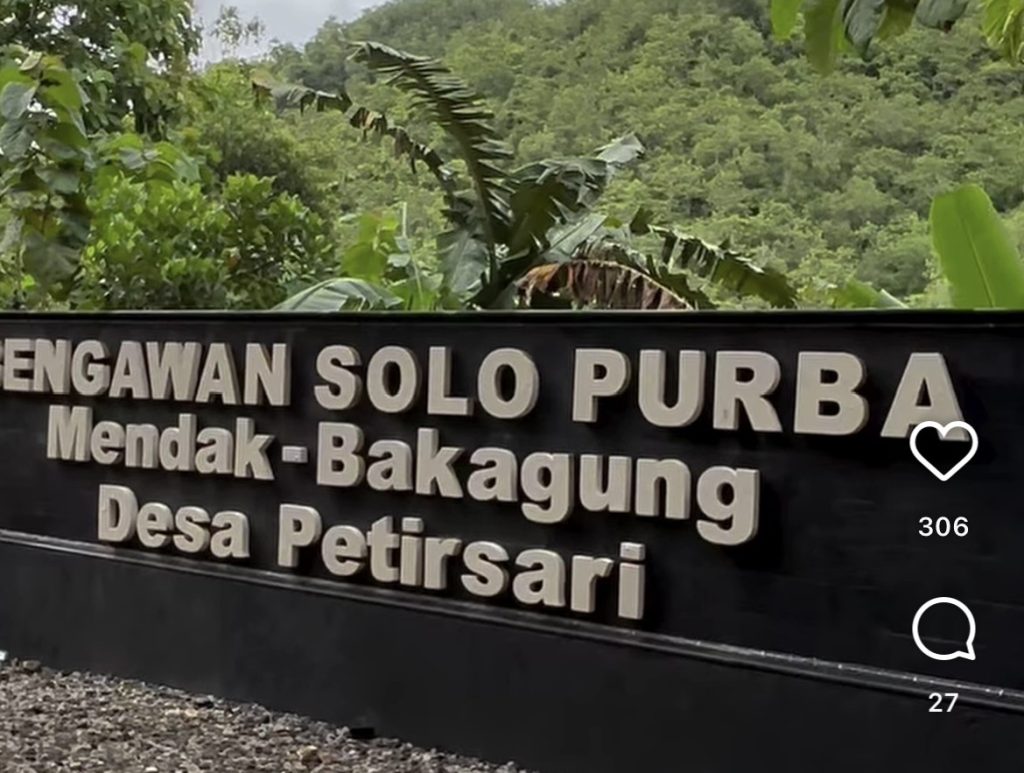





Wonogiri — The relationship between communities and water is reflected not only in the way water resources are managed, but also in the names of places passed down from one generation to another. This perspective was explored through the study “Toponymy and the Reality of Pracimantoro Communities in Interpreting Water Through the Ages,” conducted in collaboration with the Pracimantoro Subdistrict Government, Wonogiri Regency, on February 15, 2026, involving members of the Wonogiri community.
The activity examined toponymy, or the naming of places, in the Pracimantoro area, particularly the names of lakes and reservoirs, to understand the relationship between place names, geographical conditions, cultural values, and local knowledge that has developed within the community.
The study was carried out by identifying various place names associated with water sources and then tracing the origins, meanings, and backgrounds behind those names. This approach was used to examine how local communities interpret their surrounding environment and how their experiences with nature have shaped knowledge that has subsequently been preserved through place names.
The head of the activity said that toponymic studies are important because a place name serves not merely as a geographical marker. It can also contain information about the relationship between a community and the natural and environmental conditions it faces.
“Through this activity, we want to understand how local communities give names to places and what meanings are contained behind those names. The names of lakes in Pracimantoro do not merely indicate locations, but can also reflect the relationship between communities and the natural conditions and environment around them,” he said.
In the study, local communities were positioned as important sources for uncovering knowledge about the history and meanings of place names. Collective memory became an essential component in understanding how the relationship between people and their environment has changed over time.
For the people of Pracimantoro, the existence of lakes and reservoirs has not only a physical function as a source of water, but is also closely connected with the history of community life and regional identity. Therefore, documenting knowledge about the origins and meanings of place names is considered important to ensure that such information is not lost amid changing times.
The Pracimantoro Subdistrict Government, as the project partner, emphasized that place names in the area are closely connected to local history, natural conditions, and community life. The names of lakes that remain known today have become part of the region’s identity while also representing local knowledge that needs to be continuously documented and preserved.
“The naming of places in Pracimantoro is closely connected to the history, natural conditions, and everyday life of the local community. The names of lakes that are still known today are part of the region’s identity and local knowledge that needs to be continuously documented and preserved,” the partner representative said.
The toponymic study also serves as an effort to strengthen public understanding that environmental management cannot be separated from knowledge developed at the local level. By recognizing the history and meaning of places, communities can build a stronger foundation for understanding the characteristics of their region and protecting the water resources that play an important role in their lives.
From an academic perspective, the activity brought together scientific knowledge and community experiences in understanding the environment. Information about lakes, reservoirs, geographical conditions, history, and local culture can become part of regional knowledge documentation that is valuable both for communities and for the development of future studies.
The activity also contributes to the achievement of the Sustainable Development Goals (SDGs), particularly SDG 6: Clean Water and Sanitation, by strengthening community knowledge about water resources and the importance of protecting the environment that supports the availability of water sources. It also supports SDG 16: Peace, Justice and Strong Institutions by encouraging the active involvement of communities and government institutions in managing local knowledge through collaborative, inclusive, and sustainable approaches.
Through toponymic research, the names of lakes and other places preserved in community memory become more than geographical markers. They provide an entry point for understanding history, the environment, culture, and the ways in which communities have built their relationship with water through the ages.