

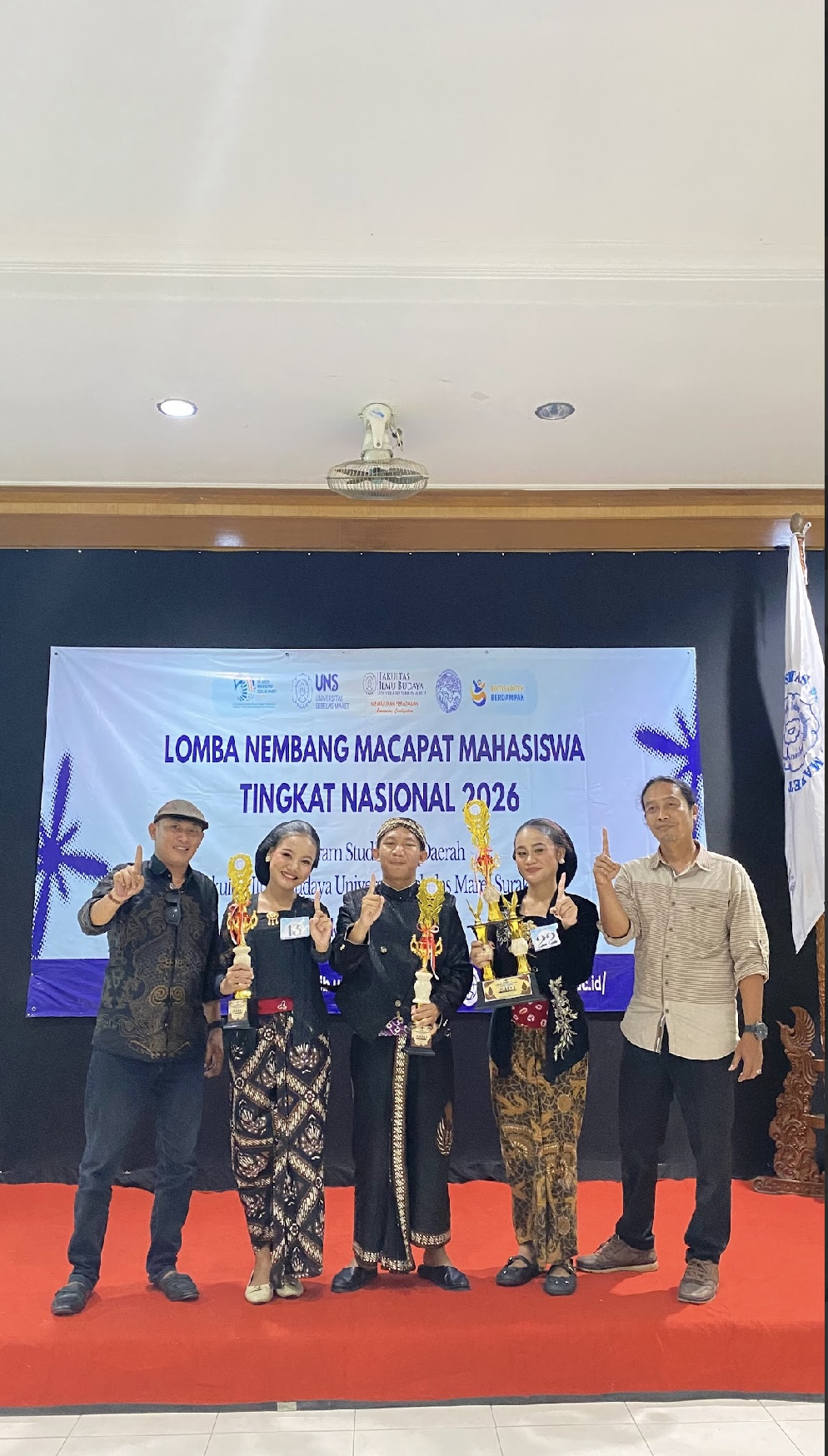
The gentle yet powerful echoes of tembang macapat have faded from the auditorium of Universitas Sebelas Maret (UNS) in Solo, but the resonance of victory continues to travel. Competing against 51 contestants from universities across Indonesia, the delegation from Universitas Negeri Semarang (UNNES) did not return empty-handed. Three championship trophies now rest in their hands. More than a triumph in a traditional arts competition, the journey from Solo to Semarang has become living proof that macapat singing aligns with the global education agenda.
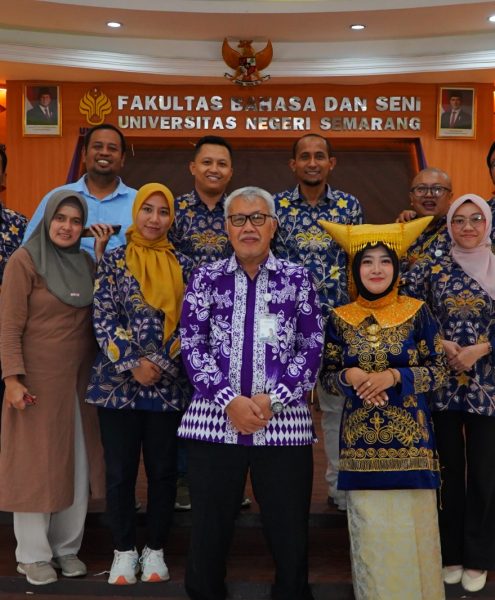
The UNNES team consisted of 16 students — eight males and eight females — who performed with confidence amidst fierce competition. The total number of participants reached 51, comprising 29 males and 22 females from universities throughout the archipelago. They competed not only in the precision of paugeran (poetic rules) but also in the depth of interpretation and character delivery. In the end, the names of UNNES students from the Faculty of Languages and Arts (FBS) filled the winners’ board. Diva Setiandra Rara R, a student of Javanese Language and Literature Education, claimed first place in the women’s category. The second place in the women’s category went to Agistya Rizki Fierdana from Music Education, while in the men’s category, second place was secured by Ipang Puji Saputro, also a student of Javanese Language and Literature Education.
Behind the team’s joy stands a figure who has consistently guided and trained the members of the Javanese Arts Student Activity Unit (UKM Kesenian Jawa Panembrama Langen Sekar), Indrawan Nur Cahyono, S. Sn. Serving as the coach and mentor — not a lecturer — Indrawan accompanied the students throughout the competition. He expressed gratitude not only for the trophies but also for the deeper significance they carry. For him, macapat is more than a heritage to be preserved; it is a medium for achieving global targets.
“Alhamdulillah, the hard work of these students has paid off. These three trophies are the result of their dedication and love for traditional arts. But I want to emphasize that activities like this macapat competition are a real implementation of the SDGs, particularly Goal 4: Quality Education, which emphasizes character development and cultural preservation, as well as Goal 11: Sustainable Cities and Communities, which includes protecting the world’s cultural heritage,” Indrawan said while accompanying the team.
Furthermore, Indrawan, who actively serves as the unit’s mentor, connected this achievement to the Higher Education Key Performance Indicators (IKU) promoted by the Indonesian Ministry of Education. “This success is relevant to IKU 2, where students gain experience outside the campus by competing at the national level across universities. It also aligns with IKU 5, where the results of coaching and mentoring in the arts can be utilized by the wider community as a model for cultural preservation. And of course, IKU 7, which emphasizes collaborative and participative learning environments,” he explained, carefully distinguishing his role as a coach and mentor, not as a faculty member.
Meanwhile, the First Vice Rector for Academic and Student Affairs of FBS UNNES, Dr. Eko Raharjo, M.Hum. , offered high praise. He stated that winning three trophies demonstrates that FBS UNNES excels not only in the classroom but also in developing talents in traditional arts. “We are very proud of this achievement. Competitions like the national macapat contest are fully aligned with the SDGs and IKU targets set by the government. The faculty will continue to support the Javanese Arts Student Activity Unit and its mentors, including Indrawan, to keep creating and bringing honor to UNNES,” Dr. Eko Raharjo said.
Shortly after the award ceremony, the UNNES contingent prepared to return to Semarang. On the bus gliding smoothly away from Solo, the three trophies were carefully placed in the front seats. For Indrawan and his 16 students, this journey was never just about bringing trophies home. It carried a larger narrative: that tembang macapat — often considered classical and traditional — remains deeply relevant and has truly earned its place within the global education agenda. From Solo to Semarang, UNNES has proven exactly that.