

A lecturer from Universitas Negeri Semarang (UNNES) has successfully defended her doctoral dissertation proposing a new model for developing English teaching materials tailored to the diverse needs of learners in non‑formal education settings.
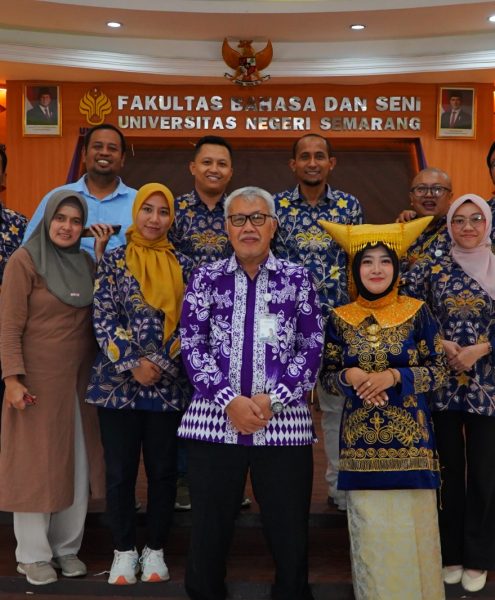
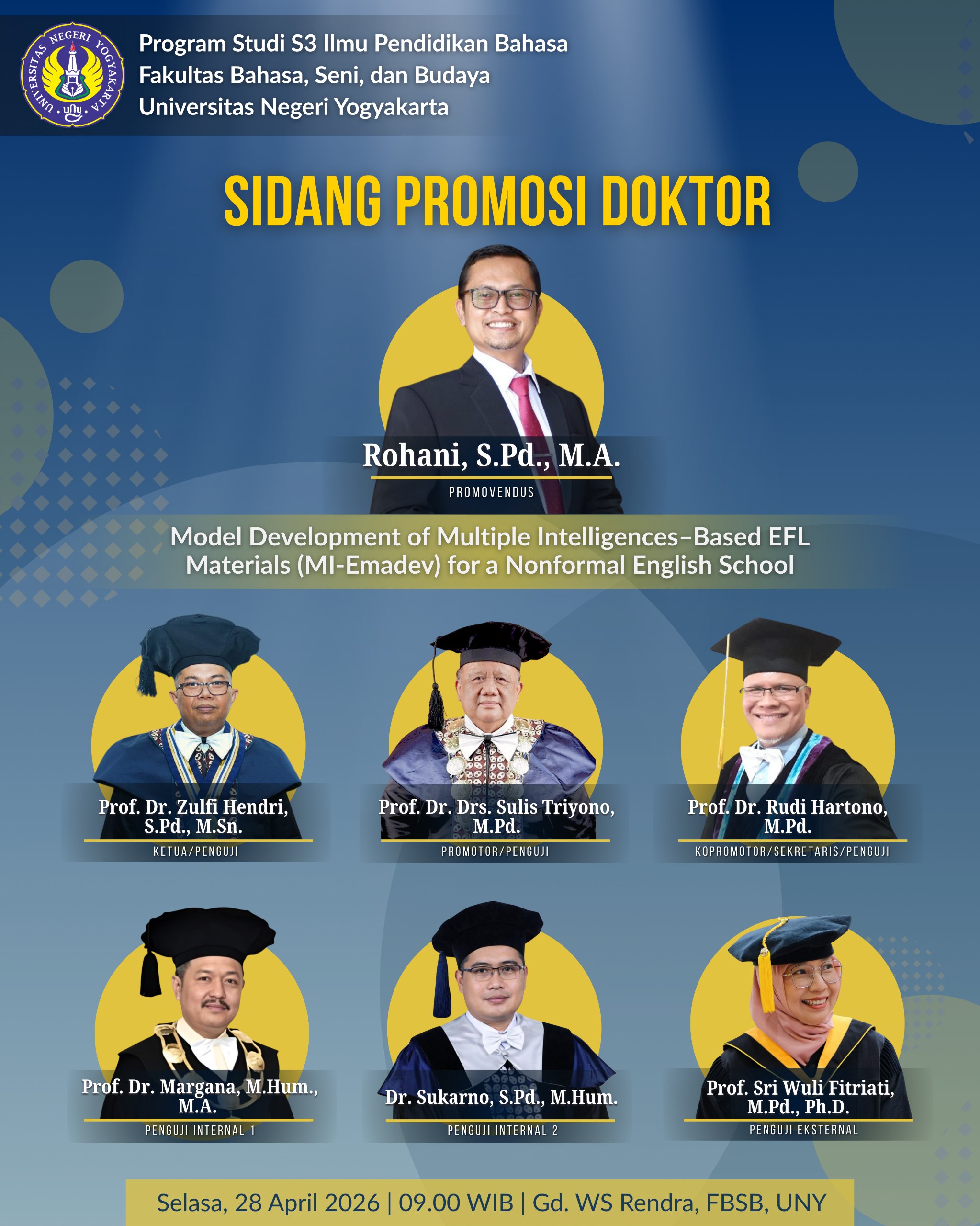
Rohani, S.Pd., M.A., a lecturer in English at UNNES, presented her dissertation titled “Model Development of Multiple Intelligences‑Based EFL Materials (MI‑Emadev) for a Non‑formal English School” at a doctoral promotion hearing held on Tuesday, April 28, 2026, at the WS Rendra Building, Faculty of Language, Arts, and Culture, Universitas Negeri Yogyakarta (UNY).
In her research, Rohani identified a persistent challenge in non‑formal English schools and course institutions: learners come with widely varying abilities, motivations, ages, and learning styles. However, the teaching materials used in such settings have tended to be uniform and have not fully accommodated this diversity.
A Model That Puts Multiple Intelligences at the Core
Through her study, Rohani developed the MI‑Emadev Model (Multiple Intelligences‑Based EFL Materials Development Model). Unlike previous approaches that typically apply multiple intelligences theory only to classroom activities, this model places multiple intelligences as the foundation of the material design process itself. The result is a systematic, flexible, and inclusive framework that helps teachers develop learning materials suited to the unique strengths of each learner.
“With this approach, teaching materials are designed to provide multiple learning pathways, allowing more students to engage according to their own learning strengths,” Rohani explained during her defense.
The research employed an Educational Design Research (EDR) approach, involving needs analysis, model design, expert validation, trials, evaluation, and iterative revisions at an English course institution in Semarang. The findings show that the MI‑Emadev Model possesses strong conceptual validity and is considered practical and feasible for use in non‑formal English learning contexts.
Four Supporting Products, Including an AI‑Based Application
Beyond the development model itself, the research produced four additional products: a user guidebook for the MI‑Emadev Model, a prototype of multiple intelligences‑based English teaching materials, a teacher’s guide for using the materials, and an AI‑based MI‑Emadev application. All research products have received copyright registration certificates from the Ministry of Law of the Republic of Indonesia.
Hoping to End ‘One Size Fits All’
Through this research, Rohani expressed her hope that the development of English teaching materials in the future will no longer rely on a “one size fits all” approach. Instead, she advocates for materials that respect the diversity of learners’ ways of learning and help teachers design more inclusive and adaptive instruction.
The doctoral promotion hearing was chaired by Prof. Dr. Zulfi Hendri, S.Pd., M.Sn., who also served as an examiner. The examining committee consisted of Prof. Dr. Drs. Sulis Triyono, M.Pd. as promotor, Prof. Dr. Rudi Hartono, M.Pd. as co‑promotor, Prof. Dr. Margana, M.Hum., M.A. as internal examiner, Dr. Sukarno, S.Pd., M.Hum. as internal examiner, and Prof. Sri Wuli Fitriati, M.Pd., Ph.D. as external examiner.
With the successful defense, Rohani becomes the latest doctoral graduate from the S3 Language Education Science program at UNY, bringing a tangible contribution to more inclusive and learner‑centered English language teaching in non‑formal education.