


Kendal – The Faculty of Mathematics and Natural Sciences (FMIPA) of Universitas Negeri Semarang (UNNES) strengthens coastal community resilience through environmental and disaster education from school age. Through two community engagement programs in Kendal Regency, FMIPA UNNES not only provided counseling but also built students’ environmental literacy and climate and disaster resilience through learning adapted to the risk characteristics of each region.
The two programs were implemented at SMP Negeri 2 Cepiring and SD Negeri 2 Bleder, Patebon District. Both are schools in coastal areas with different flood risk characteristics. Based on the Central Java Province Climate Change Adaptation Action Plan, Cepiring District is classified as an area with a moderate flood risk class, while Patebon District is classified as an area with a high flood risk class. Furthermore, SD Negeri 2 Bleder is located in an area that has long been affected by tidal floods or rob.
The difference in risk characteristics became the basis for FMIPA UNNES to design different interventions. At SMP Negeri 2 Cepiring, the program was directed at strengthening environmental literacy and waste management, while at SD Negeri 2 Bleder, the activity was focused on disaster preparedness and adaptive capacity to tidal floods.
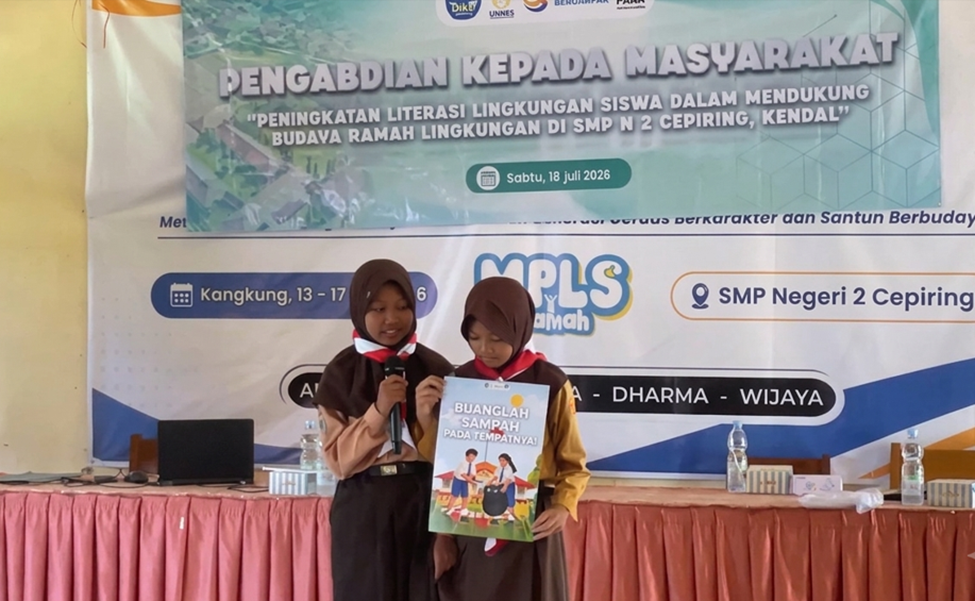
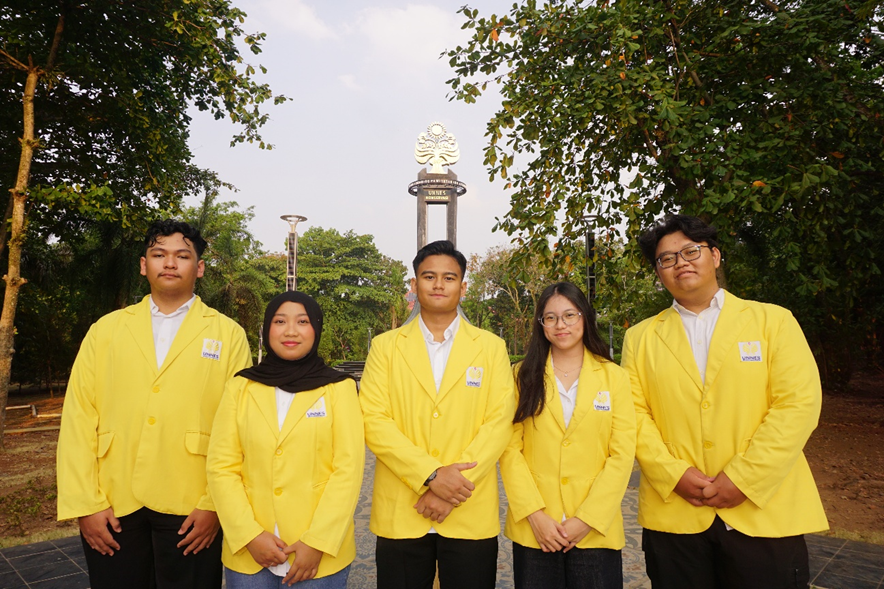
The first program, entitled “Improving Students’ Environmental Literacy to Support an Eco-Friendly Culture,” was implemented at SMP Negeri 2 Cepiring on July 18, 2026. The engagement team was chaired by Abdul Jabbar, S.Si., M.Ling., with members Prof. Dr. Parmin, M.Pd., Risa Dwita Hardianti, M.Pd., Ayu Rahayu, M.Pd., and Dr. Andin Vita Amalia, M.Sc.
The activity funded by LPPM UNNES was attended by 160 seventh-grade students. The activity began with strengthening the understanding of the importance of early environmental awareness. Ayu Rahayu conveyed that the waste problem is not only related to cleanliness but also linked to health and environmental sustainability.
Furthermore, Abdul Jabbar provided material on sustainable waste management, including the sorting of organic and inorganic waste, as well as simple practices that students can apply at home and school.
The learning was then followed by group discussions and the creation of posters themed around waste management. Students presented their poster results, which, among other things, highlighted the importance of sorting waste from an early age and reducing the use of single-use plastics.
The activity did not stop at material delivery. The engagement team also handed over sorted organic and inorganic trash bins, as well as environmental education media to the school. These facilities are expected to serve as learning tools while supporting the sustainability of eco-friendly behavior habits after the program concludes.
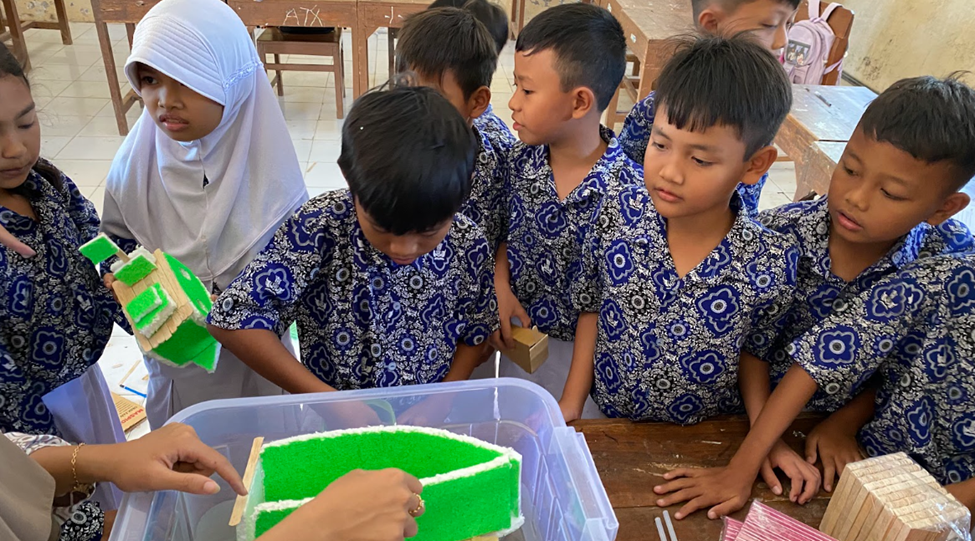
Meanwhile, the second program, entitled “Synergy of Science Education and Coastal Care: Building Elementary Students’ Resilience to the Impacts of Climate Change,” was implemented at SD Negeri 2 Bleder, Patebon District, on July 22, 2026. The engagement team was chaired by Rizki Nor Amelia, S.Pd., M.Pd., with members Trida Ridho Fariz, S.Si., M.Sc., Muhammad Ahganiya Naufal, S.Si., M.Si., Dr. Novi Ratna Dewi, S.Si., M.Pd., and Dr. Muhammad Tauiq, M.Pd. Unlike the activity at SMP Negeri 2 Cepiring, the program at SD Negeri 2 Bleder was specifically directed to build students’ preparedness and resilience to tidal floods. The learning utilized a Place-Based Disaster STEAM and 3H (Head, Heart, and Hands) approach, so students’ experiences with their surrounding environment became part of the learning process.
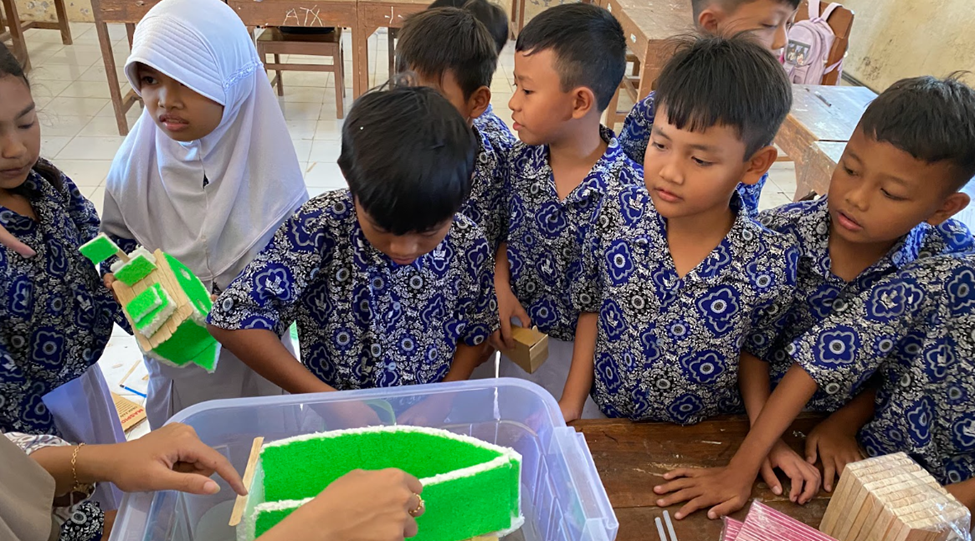
Students were first invited to share their experiences regarding tidal floods that occurred in their neighborhood. The activity then continued with a simple experiment on floating and sinking objects using tidal floodwater. Based on this experience, students then designed a miniature life raft that can be used to protect valuable items when tidal floods occur.
Through this activity, students not only received information about disasters but learned to identify risks, understand science concepts, collaborate, and design simple solutions based on the problems they face in their daily lives.
This approach is also important because the school is located in an area that directly faces the threat of tidal floods. Disaster education from elementary school is expected to build students’ adaptive capacity while strengthening the preparedness of families and communities in their neighborhood.
Both programs demonstrate that community engagement does not stop at knowledge transfer. FMIPA UNNES presents interventions tailored to local needs and risks, while also leaving tangible facilities that can continue to be used by the schools.
In addition to sorted trash bins and environmental education media, all student participants also received notebooks as part of the support for basic learning needs. Thus, the program combines aspects of education, environment, disaster preparedness, and support for student needs.
The implementation of both programs also highlights the importance of multi-party collaboration. FMIPA UNNES acts as a driver of knowledge and education, the school serves as a partner and implementation space, while PT PAMA Persada provides support through facilities and backing for the program’s execution. This collaboration strengthens a multi-stakeholder partnership approach in conducting community engagement.
Both FMIPA UNNES engagement programs contribute to the achievement of the Sustainable Development Goals (SDGs) through approaches in education, climate resilience, and partnerships. The activities support SDG 4 (Quality Education) through contextual learning in schools that connects materials with students’ real-life problems. The program at SD Negeri 2 Bleder specifically supports SDG 13 (Climate Action) through education on risks, impacts, and climate change adaptation in the context of tidal floods, as well as SDG 11 (Sustainable Cities and Communities) by strengthening the capacity of school communities in disaster-prone areas. Awareness of the coastal environment is also relevant to SDG 14 (Life Below Water).
The program at SD Negeri 2 Bleder also contributes to SDG Target 1.5, which is building the resilience of vulnerable groups and reducing vulnerability to climate-related extreme events and disasters. Disaster education, STEAM-based experiments, and the design of simple solutions serve as efforts to build students’ adaptive capacity from an early age. Meanwhile, the program at SMP Negeri 2 Cepiring supports sustainable communities through increased environmental literacy, waste management, and the provision of waste-sorting facilities. The collaboration among FMIPA UNNES, schools, and the business sector also strengthens SDG 17 (Partnerships for the Goals) through the synergy of knowledge, education, facilities, and community capacity building. Thus, both programs position schools as strategic spaces to build a coastal generation that cares for the environment, is adaptive to climate change, and is resilient in facing disaster risks.