


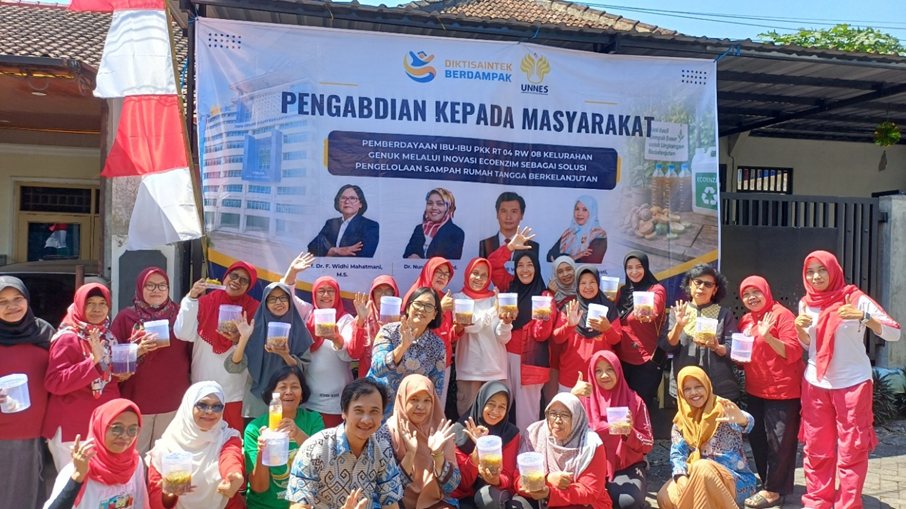
Semarang, August 9, 2026 — Universitas Negeri Semarang (UNNES) strengthened community capacity in household waste management through a community engagement program involving the Women’s Family Welfare and Empowerment (PKK) Group of RT 04 RW 08, Genuk Urban Village, Semarang City. The program, entitled “Empowering the Women’s PKK Group of RT (Neighborhood Unit) 04 RW (Community Administrative Unit) 08, Genuk Urban Village, through Eco-Enzyme Innovation as a Sustainable Household Waste Management Solution,” was conducted on Sunday, August 9, 2026. The program introduced a simple and practical approach to processing household organic waste into eco-enzyme that can be independently applied at the household level.
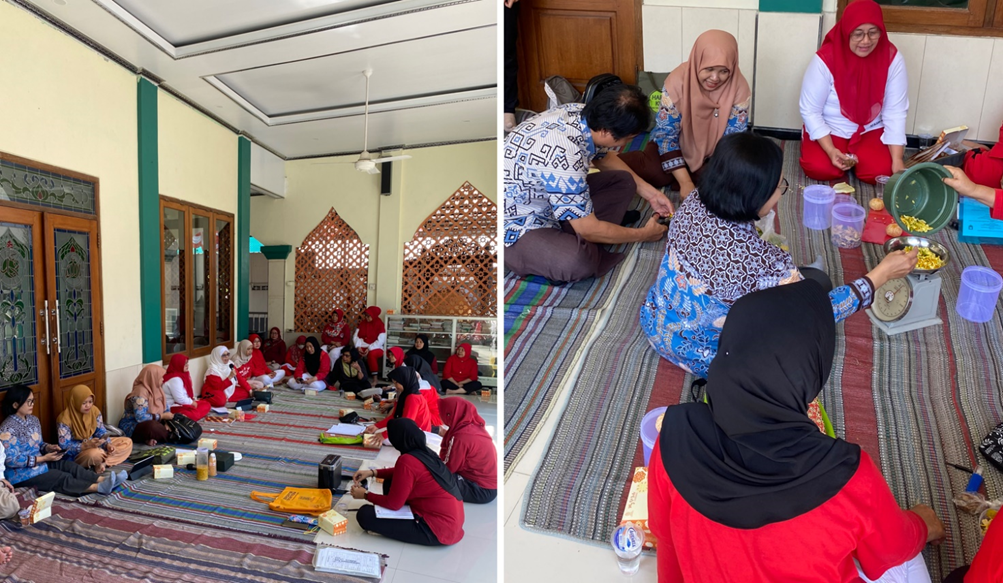
The program was led by Prof. Dr. F. Widhi Mahatmanti, M.Si., together with FMIPA UNNES faculty members Dr. Nuni Widiarti, S.Pd., M.Si., Samuel Budi Wardhana K., Ph.D., and Dian Sri Asmorowati, M.Pd., with the support of three students. The program engaged members of the local PKK women’s group as community partners in learning and practicing household organic waste management.
The initiative was designed to improve the knowledge, practical skills, and capacity of community members to manage organic household waste and reduce the amount of waste that may otherwise enter disposal systems. Through the program, household waste—particularly fruit peels and other organic materials—was introduced not simply as waste requiring disposal, but as a resource that can still be utilized through a simple processing method.
The activity consisted of three main sessions: household waste management education, an introduction to eco-enzyme, and hands-on eco-enzyme production. During the educational session, participants learned about the importance of managing waste at its source and the potential environmental consequences of improper household waste management. The session was followed by an introduction to the basic principles and production stages of eco-enzyme.
During the practical session, participants directly processed fruit peels as the main material for eco-enzyme production. The fruit peels were cut into smaller pieces and then mixed with brown sugar or palm sugar and water at a ratio of 1:3:10. Through this hands-on practice, participants gained direct experience in preparing the materials, applying the appropriate composition, and understanding the initial production process, enabling them to replicate the practice in their own homes.
The hands-on approach was an important component of the program because the community engagement activity went beyond the delivery of information. Participants acquired practical skills that can be independently replicated, transforming the learning process from simply understanding the importance of waste management into the ability to carry out household organic waste processing.
The participants showed strong engagement throughout the program. Members of the PKK women’s group actively followed the practical stages, raised questions, and discussed waste management practices that could be implemented in their households. This interaction strengthened the community learning process while creating an opportunity for knowledge exchange between the university and the local community.
The program also contributes to more responsible consumption and production practices by encouraging the utilization of organic waste before disposal. Household-level processing can help reduce the amount of organic waste entering disposal systems while increasing the utilization of materials that were previously considered to have little or no value.
From a community empowerment perspective, the program contributed to improving waste management literacy, organic waste processing skills, and household-level self-reliance. The knowledge and skills acquired by participants are expected to be shared with family members and the surrounding community, allowing the benefits of the learning process to extend beyond the immediate participants.
The community engagement activity also reinforces UNNES’s role in providing education, practical training, and capacity-building opportunities for communities outside the university. Collaboration among university lecturers, students, and local community members forms an important part of an applied learning process that generates direct benefits for the community.
Through this initiative, UNNES seeks to strengthen community capacity to manage waste at its source through a simple, participatory, and sustainable approach. The program contributes to SDG 4 through community education and outreach, SDG 12 through more responsible household waste management practices, and SDG 17 through community engagement and capacity building with local residents. From fruit peels once regarded as waste, participants gained new knowledge and practical skills to transform them into a potentially useful resource. A small change at the household level can become a meaningful step toward more responsible waste management and a more empowered community.