

Related to SDGs
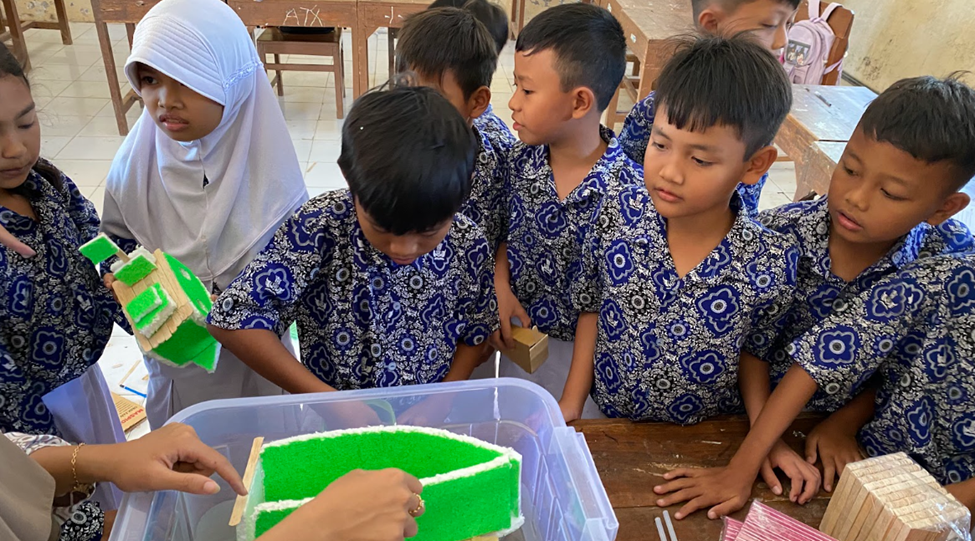
The Faculty of Mathematics and Natural Sciences (FMIPA) at Universitas Negeri Semarang (UNNES) strengthened the resilience of coastal communities in Kendal Regency through two tailored community service programs focused on environmental and disaster education. The first program, titled “Enhancing Student Environmental Literacy to Support Eco-Friendly Culture,” was held at SMP Negeri 2 Cepiring on July 18, 2026. The team was led by Abdul Jabbar, S.Si., M.Ling., alongside Prof. Dr. Parmin, M.Pd., Risa Dwita Hardianti, M.Pd., Ayu Rahayu, M.Pd., and Dr. Andin Vita Amalia, M.Sc., engaging 160 seventh-grade students. Meanwhile, the second program, “Synergy of Science Education and Coastal Care: Building Elementary School Students’ Resilience to Climate Change Impacts,” took place at SD Negeri 2 Bleder, Patebon District, on July 22, 2026. This initiative was led by Rizki Nor Amelia, S.Pd., M.Pd., together with Trida Ridho Fariz, S.Si., M.Sc., Muhammad Ahganiya Naufal, S.Si., M.Si., Dr. Novi Ratna Dewi, S.Si., M.Pd., and Dr. Muhammad Taufiq, M.Pd.
Interventions at both schools were tailored to the specific climate risk profiles outlined in the Central Java Climate Change Adaptation Action Plan. At SMPN 2 Cepiring, located in a moderate flood-risk area, activities focused on enhancing environmental literacy, organic and inorganic waste segregation, eco-poster campaigns, and providing sorted waste bin units. Conversely, at SDN 2 Bleder, situated in a high-risk tidal flood (rob) area, training prioritized disaster readiness and climate adaptation utilizing a Place-Based Disaster STEAM and 3H (Head, Heart, and Hands) framework. The FMIPA UNNES team emphasized that early awareness of waste management and disaster mitigation is vital to maintaining environmental health and fostering climate resilience among coastal communities.
The execution of these dual environmental education programs directly aligns with three key Sustainable Development Goals (SDGs). First, it advances Quality Education (SDG 4) by introducing contextual disaster and environmental learning tools into school activities. Second, the programs support Climate Action (SDG 13) by building local preparedness and adaptation against tidal flood risks. Finally, the initiative contributes to Sustainable Cities and Communities (SDG 11) by cultivating eco-friendly habits and sustainable waste management in coastal areas.