



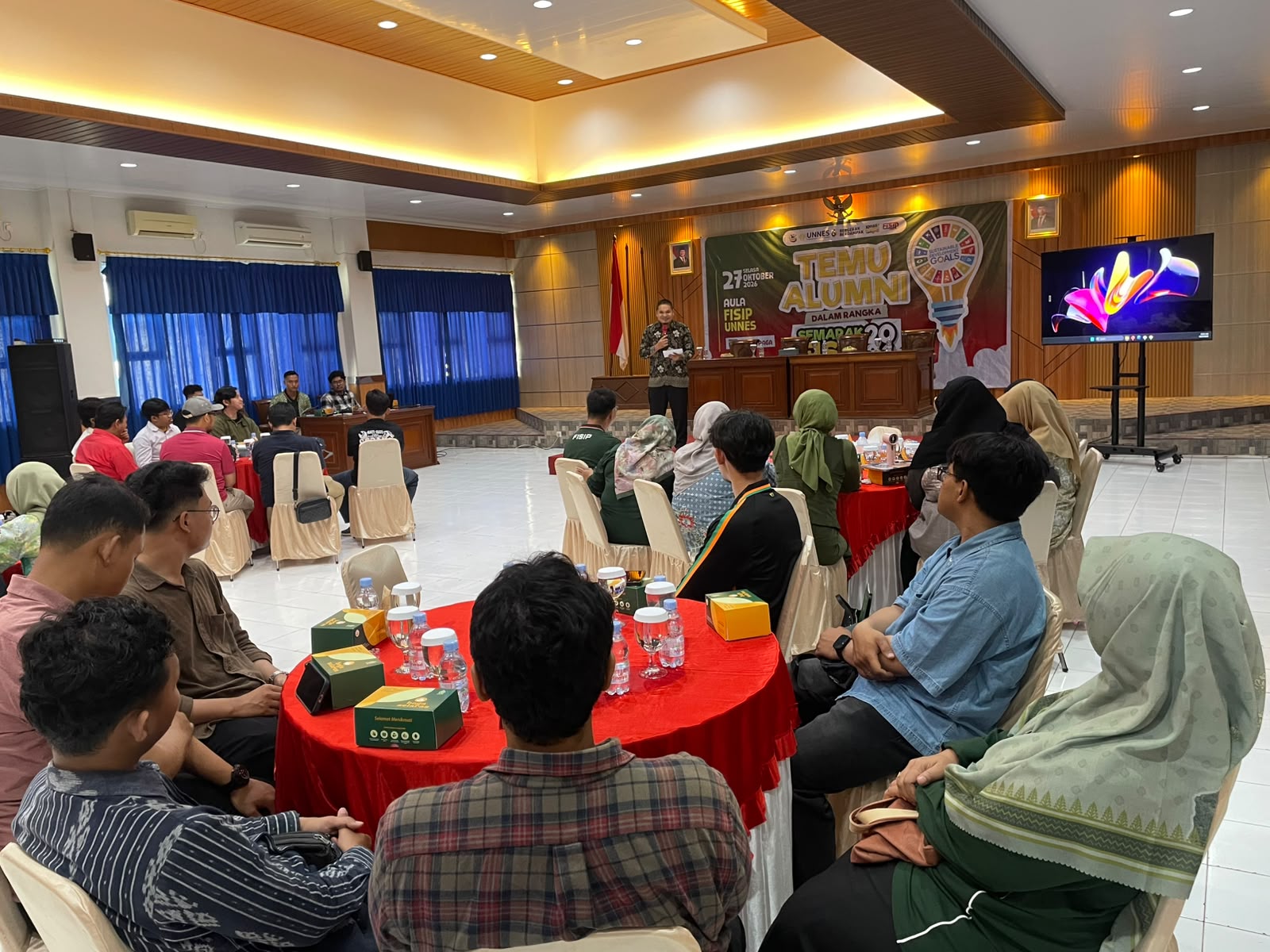
A total of 38 alumni of the Faculty of Social and Political Sciences (FISIP) at Universitas Negeri Semarang (UNNES) returned to campus as part of Semarak FISIP 2026 on Tuesday (October 27, 2026). Held at the FISIP auditorium in Sekaran, Gunungpati, Semarang, Central Java, the gathering provided a platform for alumni to share professional experiences, deliver guest lectures to students, and engage in discussions with faculty leaders to strengthen alumni networks.
The participants represented diverse professional backgrounds. Their experiences in education and higher education management offered valuable insights to enrich student learning while creating opportunities for collaboration between the faculty and its graduates.
Fadly Husain, Vice Dean for Academic and Student Affairs at FISIP UNNES, said alumni played a strategic role in supporting institutional development. Their contributions extend beyond academic activities to include alumni surveys, research, community service, and efforts to improve curricula and educational services.
According to Fadly, FISIP UNNES has 13,364 alumni who graduated between 2002 and 2026. This extensive network represents a significant resource for building sustainable collaboration between the university and its graduates.
He encouraged alumni, particularly recent graduates, to participate in the alumni tracer study. The survey results help the university track graduates’ career paths, evaluate the relevance of academic programs to labor market needs, and support institutional rankings and the improvement of educational services at UNNES.
“Completing the alumni survey is one of the most fundamental ways graduates can contribute. The results are highly valuable for curriculum development, university services, and institutional rankings,” Fadly said.
Beyond surveys, alumni can also participate directly in research and community service initiatives. The faculty provides opportunities for graduates to collaborate with lecturers, particularly through research related to their professional fields and the communities in which they work.
Such involvement enables alumni to become research partners and bridges between academic knowledge and real-world challenges. These collaborations are expected to produce tangible outcomes that advance knowledge and benefit society.
Fadly added that the Alumni Back to Campus program provides an important opportunity to connect alumni’s professional experience with students’ learning needs. Alumni can deliver guest lectures, share insights into developments in their respective professions, and introduce students to the competencies required after graduation.
Lazuardi Fajar, an FISIP alumnus who now teaches at MAN 1 Pati, said alumni gatherings could contribute significantly to educational development. He emphasized the need to expand alumni involvement in academic activities, particularly by providing students with opportunities to learn directly from education practitioners.
He also hoped that teaching practicums and school collaborations would extend beyond the Semarang area to reach more distant regions, including Pati Regency.
According to Lazuardi, expanding these activities would give students more diverse teaching experiences while enabling schools outside major urban centers to engage with future educators.
“Teaching practicums need to be continuously improved. If possible, they should not be limited to the Semarang area but should also reach more distant regions, such as Pati. This would allow students to help motivate children in those areas,” he said.
A similar perspective was shared by Didik Tri Setyoko, an FISIP UNNES alumnus who now serves as Dean of the Faculty of Teacher Training and Education at Universitas Muhadi Setiabudi in Brebes, Central Java. He emphasized that strengthening relationships between universities and alumni should be an ongoing priority, particularly in improving institutional quality and competitiveness.
According to Didik, alumni can contribute to various aspects of university development, including tracer studies, accreditation processes, and the formulation of institutional vision and mission statements. Their professional experience across different sectors can provide valuable insights into whether academic programs remain relevant to developments in the workplace and the needs of society.
Alumni involvement, he added, can also help universities establish development strategies that respond more effectively to changing professional environments and the challenges facing higher education at both national and international levels.
The alumni gathering at Semarak FISIP 2026 therefore served not merely as a reunion but also as a platform for building mutually beneficial relationships between the university and its graduates. The faculty gains insights into the relevance of its educational programs, while alumni have opportunities to share their knowledge, experience, and professional networks with the next generation of students.
Strengthening these networks aligns with the United Nations Sustainable Development Goals (SDGs), particularly SDG 4: Quality Education, through relevant learning experiences and collaboration with practitioners, and SDG 17: Partnerships for the Goals, through sustained cooperation among universities, alumni, and communities. By positioning alumni as strategic partners, FISIP UNNES seeks to build an educational ecosystem in which learning and contribution continue long after graduation.