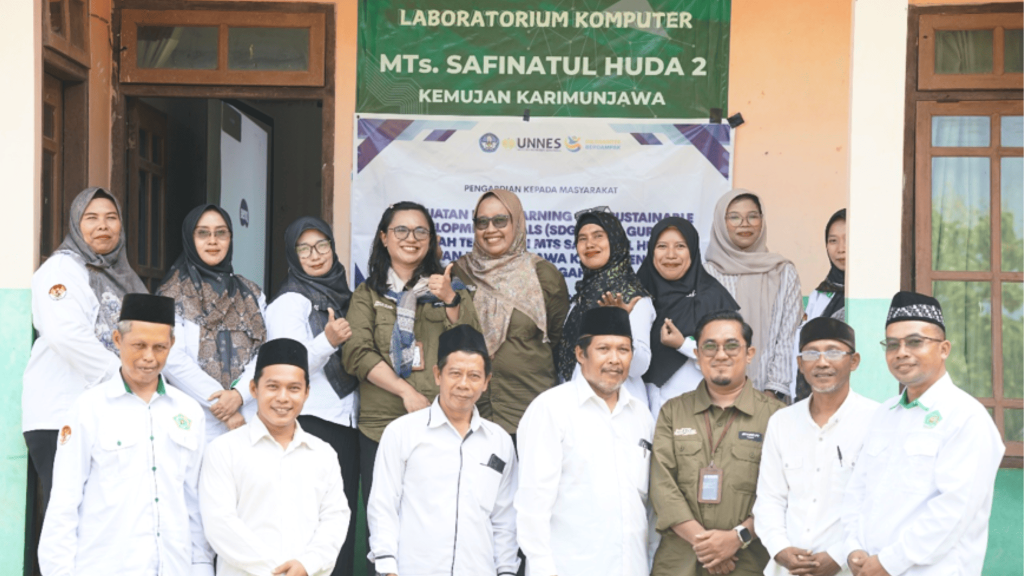




Jepara, Indonesia – Demonstrating its commitment to improving educational quality in Indonesia’s disadvantaged, frontier, and outermost (3T) regions, Universitas Negeri Semarang (UNNES) conducted a Community Service Program (PkM) entitled “Strengthening Deep Learning and Sustainable Development Goals (SDGs) for Teachers in a Remote School.” The program was held on 18 June 2026 at MTs Safinatul Huda 2 Karimunjawa, located on Jalan Serma Moh. Toha Km 03, Kemujan, Karimunjawa District, Jepara Regency, Central Java. The training brought together all teachers and educational staff of the school to enhance their capacity in implementing innovative, globally oriented teaching practices.
The community service program was led by Sanita Carolina Sasea, M.Pd., together with a multidisciplinary team consisting of Aisyah Nur Sayidatun Nisa, S.Pd., M.Pd., Dr. Muh. Sholeh, S.Pd., M.Pd., Yadi Suryadi, S.Pd., M.Pd., Radini Sinta, S.T., Fahrudin Hanafi, S.Si., M.Sc., Mahdatul Maesiyah, Tazkiyah Imtanan Hanifatul Millah, and Ahmad Khyas Muktafa. The collaboration between lecturers, educational staff, and university students reflects UNNES’s commitment to extending educational innovation to schools in remote island communities.
The training focused on strengthening teachers’ understanding of deep learning from a pedagogical perspective—an instructional approach that promotes meaningful learning through critical thinking, creativity, collaboration, and contextual problem-solving. Participants were also introduced to practical strategies for integrating the Sustainable Development Goals (SDGs) into classroom instruction, enabling students to connect academic knowledge with real-world sustainability challenges.
According to the head of the community service team, Karimunjawa, as one of Central Java’s outermost island regions, possesses tremendous natural potential while simultaneously facing geographical challenges that affect access to quality education. For this reason, teachers need broader technological insights and global perspectives to prepare students with the competencies required in the twenty-first century without losing sight of environmental stewardship and social responsibility.
“Through the deep learning approach, teachers move beyond rote memorization and help students develop contextual understanding, critical thinking skills, and awareness of sustainable development issues,” the team leader explained.
Throughout the program, the nine-member team facilitated a series of lectures, interactive discussions, and workshops on designing innovative learning materials. Teachers were encouraged to incorporate Karimunjawa’s local strengths—such as its rich marine ecosystems, coastal conservation initiatives, and sustainable tourism—into classroom learning. By using local contexts as teaching resources, the program aims to foster environmental awareness and sustainability literacy among students from an early age.
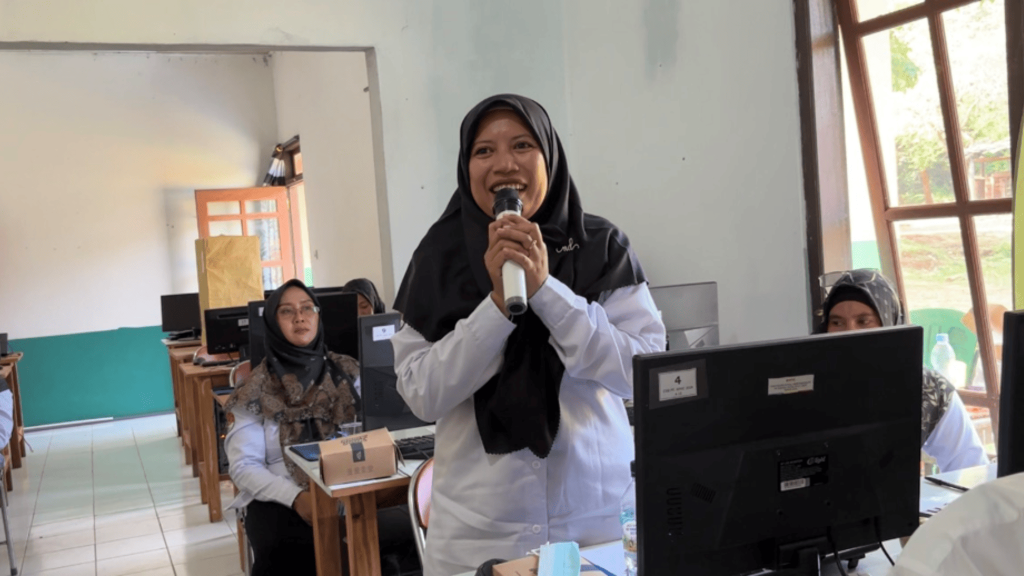
The Principal of MTs Safinatul Huda 2 Karimunjawa, Tajukdin, S.Pd.I., expressed his appreciation for UNNES’s commitment to supporting schools in remote areas. He emphasized that the training had provided teachers with valuable new knowledge and practical skills for improving classroom instruction.
“We sincerely appreciate the UNNES community service team’s dedication to supporting schools in disadvantaged and remote regions like ours. This training has energized our classrooms with fresh enthusiasm, equipping teachers with practical skills ranging from developing digital learning modules to implementing deep learning and integrating the SDGs into teaching. The remarkable collaboration between lecturers and students has provided us with valuable insights that we are ready to apply to improve the quality of education in Karimunjawa,” he said.
The UNNES team emphasized that this initiative represents the beginning of a long-term mentoring program rather than a one-time training event. Continuous assistance will be provided to ensure the effective implementation of SDG-based deep learning approaches in classroom practice. Through sustained collaboration, teachers are expected to become key drivers of educational transformation in the island region, nurturing students who are adaptive, innovative, environmentally conscious, and globally minded.
The community service program also reflects UNNES’s commitment to advancing the United Nations Sustainable Development Goals (SDGs). It contributes to SDG 4 (Quality Education) by enhancing teachers’ professional competencies and promoting innovative learning approaches; SDG 13 (Climate Action) by integrating climate change and environmental sustainability into classroom instruction; SDG 14 (Life Below Water) by utilizing Karimunjawa’s marine ecosystem as a context for conservation-based learning; and SDG 17 (Partnerships for the Goals) by strengthening collaboration between higher education institutions and schools to improve educational quality in Indonesia’s outermost regions. Through this initiative, UNNES once again reaffirms its role as a university committed to delivering educational innovation that reaches all communities, including remote island areas with unique challenges and tremendous development potential.