


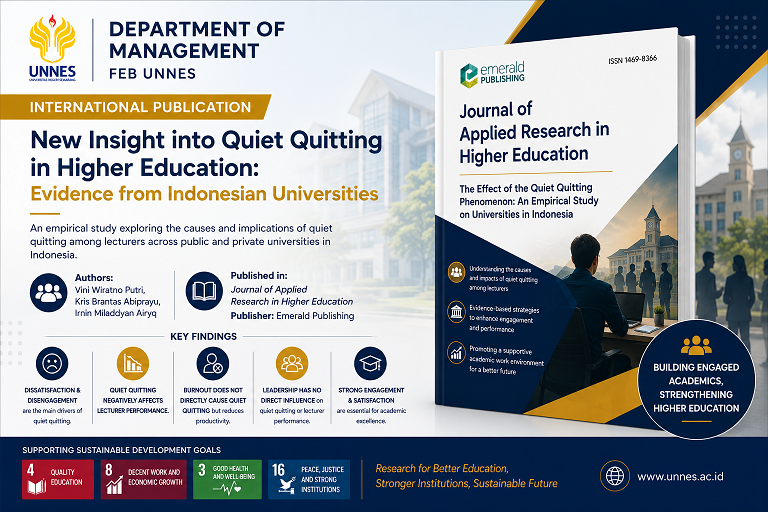
The Department of Management, Faculty of Economics and Business, Universitas Negeri Semarang (FEB UNNES), proudly announces the publication of an international research article entitled “The Effect of the Quiet Quitting Phenomenon: An Empirical Study on Universities in Indonesia” in the Journal of Applied Research in Higher Education (JARHE), a reputable international journal published by Emerald Publishing.
The article was authored by Vini Wiratno Putri, Kris Brantas Abiprayu, and Irnin Miladdyan Airyq. The publication reflects the department’s commitment to addressing emerging challenges in higher education through evidence-based research in human resource management, organizational behavior, and educational leadership.
The study explores the increasingly discussed phenomenon of quiet quitting among university lecturers in Indonesia. Rather than referring to employees leaving their jobs, quiet quitting describes a situation in which employees limit their work to formal job responsibilities and reduce discretionary efforts beyond their assigned duties. As higher education institutions continue to face rapid organizational and generational changes, understanding the factors that drive disengagement has become increasingly important.
Using the Social Exchange Theory (SET) as the conceptual framework, the researchers examined data collected from lecturers at public and private universities across Indonesia. The study employed Structural Equation Modeling–Partial Least Squares (SEM-PLS) to analyze the relationships among burnout, poor leadership, employee dissatisfaction, disengagement, generational characteristics, quiet quitting behavior, and lecturer performance.
The findings reveal that burnout does not directly trigger quiet quitting behavior among lecturers. However, burnout significantly reduces lecturer productivity. Similarly, poor leadership was not found to have a direct influence on quiet quitting or lecturer performance. In contrast, employee dissatisfaction and disengagement emerged as the primary drivers of quiet quitting, ultimately leading to lower lecturer performance and reduced institutional effectiveness.
The research highlights the importance of fostering a supportive academic work environment to enhance faculty engagement and job satisfaction. The authors recommend that higher education institutions invest in professional development opportunities, strengthen managerial support, establish regular employee engagement assessments, improve workload management, and provide mental health resources to prevent burnout and disengagement among academic staff.
Beyond organizational performance, the study emphasizes the broader societal implications of quiet quitting. Reduced lecturer engagement may negatively affect students’ learning experiences, limit academic innovation, and influence the future culture of higher education institutions. The findings are particularly relevant for understanding the work expectations of younger academic generations, whose perspectives continue to reshape the higher education workforce.
This publication demonstrates the Department of Management’s dedication to producing internationally recognized research that addresses contemporary challenges in organizational behavior and higher education management. The findings provide practical insights for university leaders, policymakers, and human resource practitioners seeking to create healthier, more productive, and more resilient academic institutions.
The study also contributes to several United Nations Sustainable Development Goals (SDGs). It supports SDG 4 (Quality Education) by promoting strategies that improve lecturer engagement, teaching quality, and institutional performance. The research aligns with SDG 8 (Decent Work and Economic Growth) by encouraging healthy workplaces, employee well-being, and sustainable human resource management practices. Furthermore, it advances SDG 3 (Good Health and Well-being) through its emphasis on preventing burnout and promoting mental well-being in the academic workplace, while also supporting SDG 16 (Peace, Justice and Strong Institutions) by encouraging effective leadership, transparent governance, and strong institutional cultures.
Through impactful international publications, the Department of Management FEB UNNES continues to strengthen its global research reputation while generating evidence-based solutions for contemporary organizational challenges. By advancing research on employee engagement and higher education management, the department remains committed to supporting sustainable institutional development and improving the quality of higher education in Indonesia and beyond.