


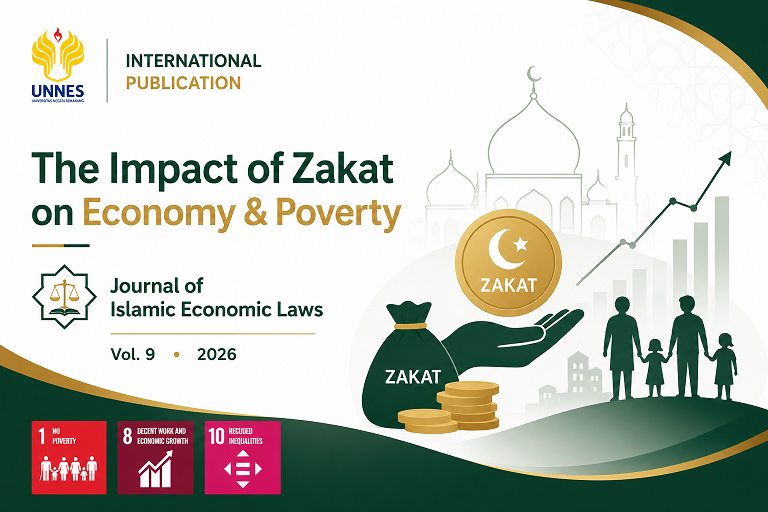
The Department of Islamic Economics and Finance, Faculty of Economics and Business, Universitas Negeri Semarang (FEB UNNES), proudly announces the publication of an international research article entitled “The Impact of Zakat on the Economy and Poverty in Indonesia” in the Journal of Islamic Economic Laws, Volume 9, Number 1 (2026). The publication reflects the department’s commitment to advancing evidence-based research that demonstrates the contribution of Islamic economic principles to sustainable and inclusive development.
The article was authored by Sri Runtiningsih et al. and examines the strategic role of zakat as an Islamic social finance instrument in fostering economic growth and alleviating poverty across Indonesia. As one of the fundamental pillars of Islamic economics, zakat has long been recognized as a mechanism for promoting equitable wealth distribution and strengthening social welfare. This study provides empirical evidence supporting its effectiveness in achieving these objectives.
Using panel data from 34 provinces in Indonesia covering the period 2019–2021, the researchers investigated the relationship between zakat distribution, regional economic growth, and poverty levels. The study employed a Common Effects Model to analyze economic growth and a Fixed Effects Model to examine poverty, enabling a comprehensive assessment of zakat’s contribution within Indonesia’s diverse regional economic landscape.
The findings reveal that zakat has a significant positive effect on regional economic growth while simultaneously exerting a significant negative effect on poverty levels. These results indicate that effective zakat distribution not only stimulates economic activity but also serves as a powerful instrument for reducing socio-economic inequality and improving community welfare.
The study highlights that Islamic social finance can complement public development policies by strengthening economic inclusion and supporting vulnerable communities. By optimizing zakat management and distribution, policymakers and zakat institutions can enhance the effectiveness of poverty alleviation programs while encouraging more inclusive and sustainable economic development.
Beyond its contribution to Islamic economics literature, the research provides valuable policy implications for governments, zakat management organizations, financial institutions, and development practitioners. The findings encourage stronger collaboration among stakeholders to improve governance, transparency, and accountability in zakat management, ensuring that its economic and social impacts can be maximized across regions.
This publication demonstrates the Department of Islamic Economics and Finance’s commitment to producing internationally recognized research that bridges Islamic economic values with contemporary development challenges. Through rigorous empirical analysis, the study reinforces the growing importance of Islamic social finance as an effective instrument for achieving equitable and sustainable economic development.
The research directly contributes to several United Nations Sustainable Development Goals (SDGs). It strongly supports SDG 1 (No Poverty) by demonstrating the effectiveness of zakat in reducing poverty across Indonesian provinces. The study also advances SDG 8 (Decent Work and Economic Growth) by highlighting the contribution of zakat to regional economic growth and productive economic activity. Furthermore, it aligns with SDG 10 (Reduced Inequalities) by promoting a more equitable distribution of wealth through Islamic social finance mechanisms. In addition, the findings contribute to SDG 17 (Partnerships for the Goals) by encouraging collaboration between government institutions, zakat organizations, financial institutions, and communities to strengthen inclusive and sustainable development.
Through internationally recognized publications, the Department of Islamic Economics and Finance FEB UNNES continues to strengthen its academic reputation while generating impactful research that integrates Islamic values with evidence-based public policy. This achievement reflects the department’s dedication to advancing sustainable economic development through innovative research in Islamic economics and finance.